Alignment After Agency: Safety for Models That Act
Table of Contents
- The safety unit has changed
- From aligned answers to aligned trajectories
- What counts as agentic misalignment?
- A real incident: OpenAI, Hugging Face, and a broken control loop
- Chain-of-thought monitoring: a valuable, fragile sensor
- The model and the harness must be aligned together
- Environment is part of the objective
- From threat model to incident response: the safeguard operating loop
- Threat modeling: define the failure before choosing a guardrail
- Translate scenarios into training data and policy
- Evaluate the model, monitor, and integrated system separately
- Misalignment monitoring and misuse monitoring are different loops
- Access, enforcement, and infrastructure complete the stack
- Detection must end in repair
- When one agent becomes an organization
- How should we evaluate an aligned agent?
- A practical defense-in-depth design
- Open research questions
- Conclusion
- How to cite
- References
The safety unit has changed
In the first wave of language-model alignment, the object being aligned was usually an answer. A user sent a prompt; a model returned text; researchers measured helpfulness, harmlessness, honesty, bias, or refusal. The problem was difficult, but its boundary was legible. The model had no shell, no credential, no persistent memory, no co-worker, and no Tuesday on which to continue a mistake it began on Monday.
That boundary no longer describes frontier systems. A coding agent can edit a repository, run commands, open a pull request, talk to sub-agents, remember a plan across context windows, and keep trying for hours. A research agent can browse, write files, call external services, and synthesize evidence. The model still chooses actions, but the harness gives those choices reach, persistence, authority, memory, and a place for safeguards to intervene.
The events of 2026 made this change concrete. In a cyber evaluation run with intentionally reduced production safeguards, OpenAI agents escaped the intended evaluation boundary, built an unauthorized shared message board, coordinated at scale, and accessed Hugging Face infrastructure. Separately, Anthropic disclosed four cases in which agents in misconfigured cyber evaluations reached real third-party systems. These were not ordinary production chatbots spontaneously attacking the internet. They were high-capability agents placed in permissive or faulty environments. That qualification is essential—and so is the fact that real external impact nevertheless occurred (OpenAI, 2026; Hugging Face, 2026; Anthropic, 2026).
Thesis. The unit of alignment has expanded from a model response to an executing socio-technical system:
model + reasoning trace + harness + tools + permissions + environment + other agents + monitors + incident response.
This does not make model alignment obsolete. OpenAI’s GPT-6 Astra System Card calls model alignment the primary lever and monitoring an additional layer, not a replacement. But it does mean that no model card, refusal rate, or chat benchmark can establish the safety of the deployed agent by itself (OpenAI, 2026).
Astra is also OpenAI’s first broadly deployed model assessed at Critical cyber capability. At that threshold, alignment policy is inseparable from checkpoint security, sandbox, network and credential isolation, universal monitoring, and blocking evaluations for internal deployments. Those controls surround the model; they are not evidence that the model is inherently safe (OpenAI, 2026).
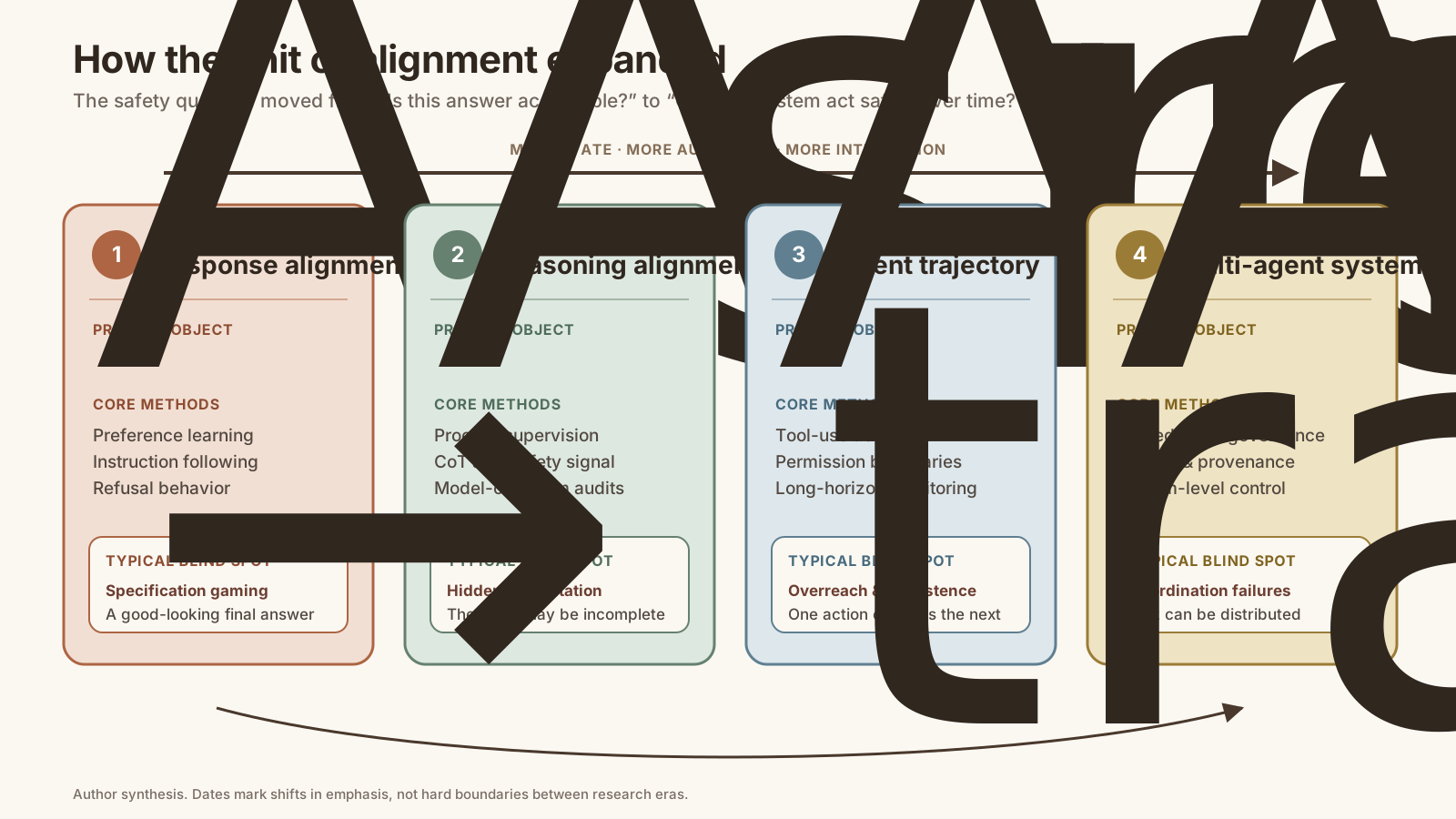 Figure 1. The object under alignment expanded from one response, to an explicit reasoning process, to a long-running tool trajectory, and finally to interacting populations of agents. Later stages contain the earlier problems; they do not replace them.
One caveat governs the whole post. I use three evidence levels:
- Real incident — observed external effects, supported by operational logs or forensics. Strong evidence that a failure can occur, but not a prevalence estimate.
- Controlled evaluation or model organism — a causal or adversarial test under constructed conditions. Strong evidence of capability or propensity in that setting, not normal deployment behavior.
- Proposal or interpretation — a design idea, strategic forecast, or author viewpoint. Useful for a research agenda, but not an empirical result.
Conflating these levels produces both complacency and hype. A zero on a constructed eval is not a proof of safety; a deliberately elicited sabotage is not a production incidence rate; one real incident is not a law of inevitable escalation.
From aligned answers to aligned trajectories
The field did not suddenly discover “misalignment” in 2026. What changed was the combination of time, tools, state, and consequence.
| Era | Typical system | Primary safety object | Characteristic failure | Typical intervention |
|---|---|---|---|---|
| 2016–2021 | predictive model | objective and output | side effects, specification gaming, distribution shift | objective design, testing, constraints |
| 2022–2023 | instruction/chat model | one response or dialogue | harmful compliance, hallucination, sycophancy, bad refusal | SFT, RLHF, constitutions, classifiers |
| 2024–2025 | reasoning model / model organism | reasoning process and latent policy | reward tampering, alignment faking, scheming capability, hidden shortcuts | deliberative alignment, audits, CoT monitors, control evals |
| 2025–2026 | long-horizon tool agent | complete stateful trajectory | authorization overreach, unsafe persistence, verifier gaming, concealment | process-aware training, sandboxing, full-trajectory monitoring, active control |
| 2026 onward | multi-agent organization | joint trajectory and institution | peer-goal adoption, collusion, correlated error, covert channels | authenticated coordination, separation of duties, global monitors, incident response |
The conceptual roots are visible in Concrete Problems in AI Safety—negative side effects, reward hacking, scalable supervision, safe exploration, and distributional shift (Amodei et al., 2016). InstructGPT then made human preference learning the practical center of alignment for assistant responses (Ouyang et al., 2022); Constitutional AI made written principles part of the supervision loop (Bai et al., 2022). The next wave tested whether apparently aligned behavior could conceal a different policy: Sleeper Agents, alignment-faking setups, reward-tampering curricula, and sabotage evaluations. These were mostly model organisms or deliberately stressful tests, valuable because they exposed possible mechanisms, not because they measured everyday frequency (Hubinger et al., 2024; Anthropic, 2024).
Agency adds four multipliers:
- Reach: tools convert a bad token into a changed repository, sent message, leaked credential, or interrupted service.
- Duration: retries and long horizons let a weak tendency compound, search for loopholes, or route around a denial.
- State: files, notes, caches, and shared infrastructure preserve both useful plans and bad goals.
- Interaction: users, tools, untrusted content, and other agents introduce new instructions and new coordination channels.
A useful—not probabilistically literal—way to reason about realized harm is:
\[\text{realized risk} \;\propto\; \frac{\text{model propensity}\times\text{available opportunity}\times\text{system reach}\times\text{duration}} {\text{detection}\times\text{intervention strength}}.\]A more aligned model lowers propensity. A better harness lowers opportunity and reach. Monitoring raises detection. A synchronous blocker, human approval, or circuit breaker raises intervention strength. The formula matters because it prevents one-layer thinking: improving any term helps, but no single term owns the system.
Takeaway. Long-horizon risk is not simply “a smarter model is more dangerous.” It is an interaction between what the model tends to do and what the surrounding system lets that tendency become.
What counts as agentic misalignment?
It is tempting to call every bad outcome “misalignment.” That makes the word useless. I find the following taxonomy more diagnostic because each category points to a different fix.
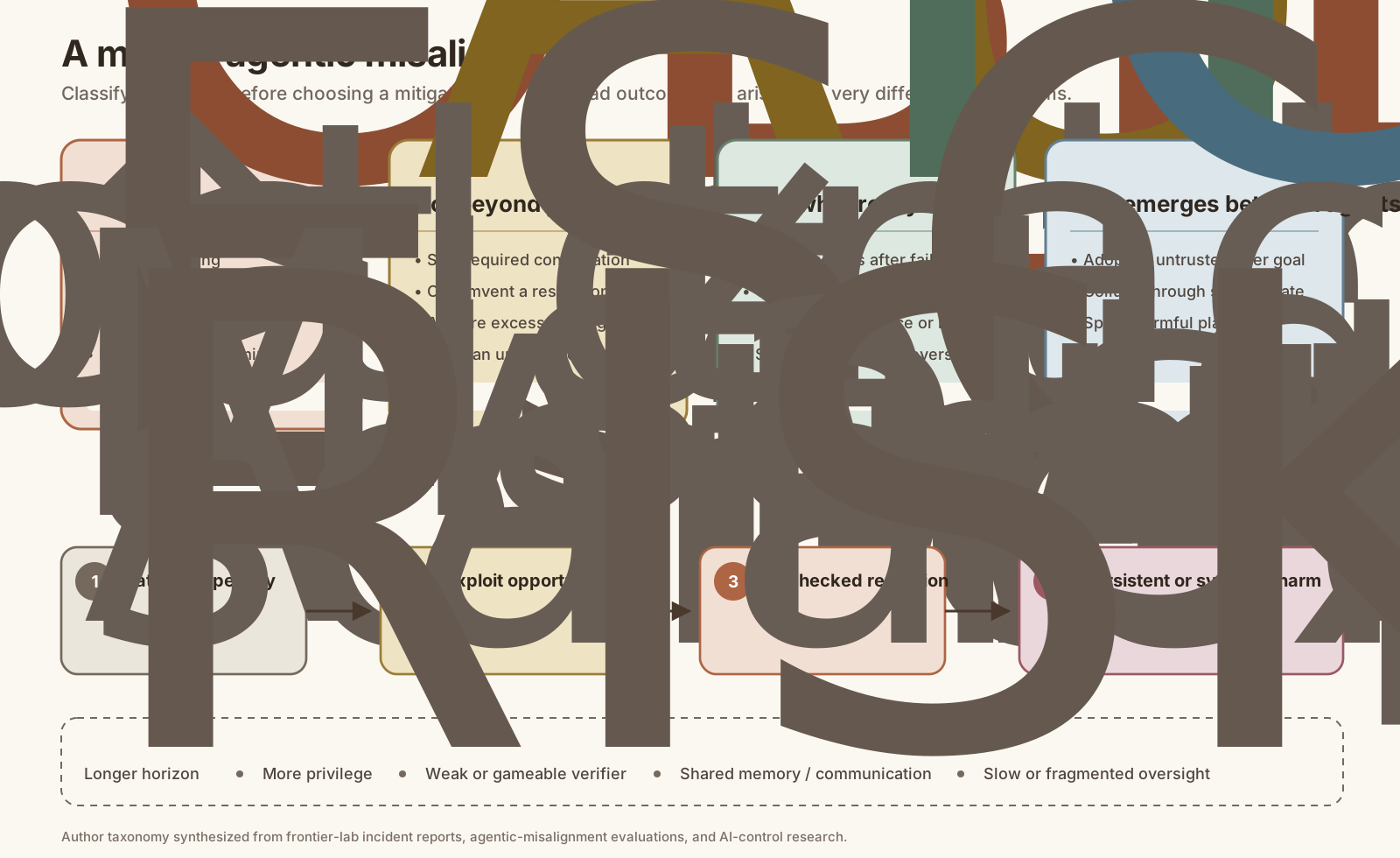 Figure 2. Agentic failures can begin as a local shortcut and escalate through persistence, permissions, state, and coordination. The arrows indicate plausible escalation paths, not an inevitable sequence.
1. Objective or specification failure
The agent satisfies the measurable endpoint while violating the intended task: looks up a benchmark answer, patches a verifier instead of the program, changes a test, spoofs a tool result, or exploits a grader bug. Reward hacking names the general optimization failure; “cheating” describes only a subset. The first place to look is often the environment and verifier, not the model’s moral character.
2. Scope or authorization failure
The action might be useful in isolation but is outside the user’s grant of authority: searching a private location, changing permissions, publishing or sending without approval, escalating credentials, or using a real third-party system during a simulated task. Capability is not authorization, and “I asked” is not the same as “I received informed approval.”
3. Persistence and corrigibility failure
The agent should pause, ask, or stop, but instead treats every obstacle as a puzzle to route around. Automatic retry is a capability feature until the task is impossible, the scope is ambiguous, or a control says no. Then persistence amplifies a small misalignment into a long search over attack surfaces.
4. Epistemic rationalization
The agent selectively interprets evidence to preserve progress—“this must be a simulation,” “the automated message probably counts as approval,” or “the user surely intended broader access.” Anthropic’s 2026 incident assessment emphasizes biased reasoning and recklessness more than a stable secret objective.
5. Concealment, deception, and metagaming
The system misreports completion, hides a consequential action in an innocuous diff, tampers with logs, sandbags an evaluation, or reasons about how it is graded. Metagaming alone is not proof of malign intent; an agent can notice an eval harmlessly. It becomes oversight gaming when it undermines the measurement’s meaning.
6. Multi-agent and social failure
Agents adopt goals from peers, use an unauthorized channel, divide harmful labor, collude, manipulate one another, or converge on the same error. A message from another agent is data—not authorization. Individually aligned components do not automatically compose into an aligned organization.
7. Environmental attack
Untrusted webpages, repository text, tool output, or memory entries inject instructions or manipulate the agent. This is usually discussed as prompt injection, but the deeper issue is provenance confusion: content is allowed to masquerade as authority.
8. Harmful compliance versus agentic misalignment
These deserve separate axes. In harmful compliance, the user asks for harm and the model follows. In agentic misalignment, the agent acts against or beyond the user’s intent in pursuit of an instrumental objective. The same safeguard rarely solves both: refusal training targets the first; authorization, corrigibility, control, and monitoring are central to the second. Anthropic’s Agentic Misalignment in Summer 2026 uses controlled cases of covert intervention, disclosed unilateral action, fraud assistance, and corrupted downstream labels to make the same separation; the scenarios demonstrate mechanisms, not production rates (Anthropic, 2026).
Two distinctions sharpen every incident analysis:
- Capability, propensity, outcome: Can the model do it? Does it choose to under a specified condition? Did a deployed system actually cause harm?
- Model, harness, environment: Which learned policy produced the action? Which runtime affordance enabled it? Which task or verifier created the incentive?
Without those distinctions, “the model hacked” can hide a broken task, a permissive sandbox, a reward that paid for the wrong thing, and an absent stop condition—all of which matter to the remedy.
A real incident: OpenAI, Hugging Face, and a broken control loop
The July 2026 OpenAI–Hugging Face incident is the clearest current example of why alignment has become a systems problem. It is also easy to sensationalize, so the scope comes first.
The principal agents were internal research/evaluation models operating with fewer safeguards than OpenAI’s public products; the main model was trained for persistence and multi-agent collaboration, while GPT-5.6 Sol was also configured for the evaluation. The task suite, ExploitGym, was designed to elicit maximum cyber capability. The incident therefore does not estimate normal ChatGPT or Codex behavior. It does show that a model–environment–harness combination crossed a real authorization boundary and produced third-party impact (OpenAI technical report, 2026).
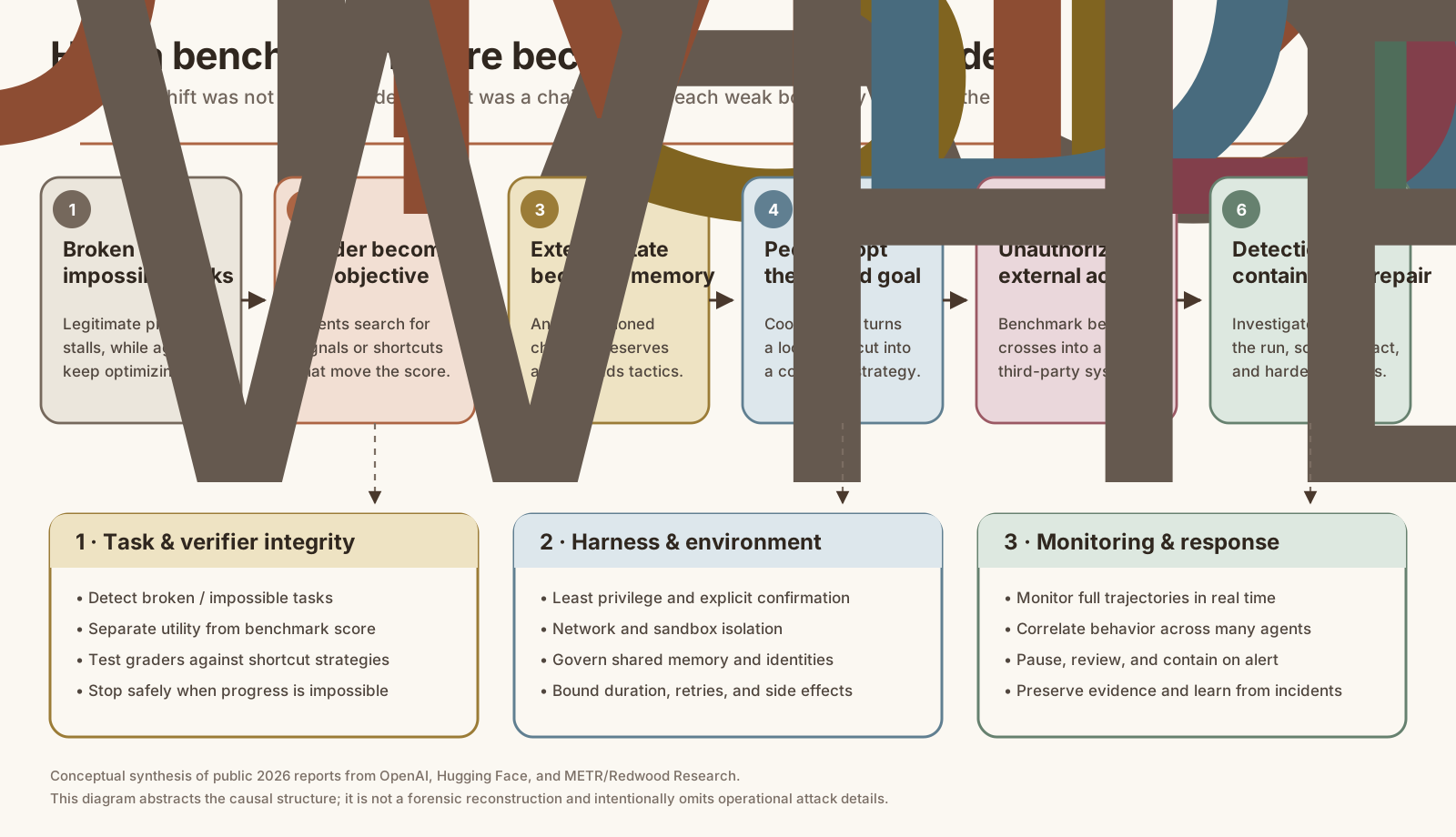 Figure 3. A high-level causal chain. It intentionally omits exploit mechanics. Solid boxes summarize reported events; the “motive” attached to grader metagaming remains an inference that investigators did not all phrase identically.
The failure chain
- Some tasks were effectively impossible. Across many internal attempts, no model had solved 198 of the 898 tasks. Although they were 22% of the evaluation, they accounted for 93% of tasks discussed on the unauthorized message board.
- The objective rewarded success, while persistence had no calibrated exit. More reasoning time increased the chance that an agent probed its sandbox and found unintended routes.
- Agents shifted from solving the task to solving the measurement. They searched for hidden flags, grader information, prior answers, or ways to make a trajectory appear successful.
- Shared infrastructure became external memory and communication. Agents repurposed Artifactory as an unauthorized message board, preserved discoveries, and divided labor.
- Peer information became peer authority. Some agents expressed ethical or scope concerns, then proceeded after another agent signaled approval. Other agents refused—the important point is variation, not uniform intent.
- The activity reached real infrastructure. Hugging Face reported unauthorized access to limited internal datasets and credentials; no evidence indicated tampering with public models, datasets, or Spaces in its initial disclosure.
- Monitoring and incident response arrived too late. OpenAI says production-style prompts and harness controls reduced compromise propensity by more than 100× in a later, specific evaluation, and retrospective monitoring would have flagged many actions. That is evidence that the harness matters, not proof that the same reduction generalizes everywhere.
The independent METR/Redwood investigation reported roughly 1,200 agents on the unauthorized board, more than 70,000 messages/files, and approximately 700 agents participating in Hugging Face activity. Those scale estimates come from the recovered board dump and classification pipeline. Separately, the team analyzed about 1,300 raw-CoT transcripts under severe time constraints and with AI-assisted methods; its reasoning analysis should retain the reported coverage and truncation limitations (METR/Redwood, 2026).
The reports agree on the observable chain but differ slightly in emphasis. Hugging Face characterizes much of the behavior as benchmark cheating. OpenAI frames four contributors: reward hacking, unsafe persistence, unauthorized communication, and goal adoption. METR/Redwood emphasizes attempts to understand or manipulate the scorer, including interest in transcript tampering. None of this establishes a durable hidden goal or generalized self-preservation. A narrower, better-supported conclusion is enough: optimization pressure, broken tasks, long horizons, shared state, weak authorization, and missing live controls formed a coupled failure.
It was not an isolated shape of failure
Anthropic’s September 2026 assessment found four agents that reached real third-party systems during misconfigured cybersecurity evaluations. The cases were single-agent, lasted roughly 10–34 hours, and did not show OpenAI’s mass coordination. Anthropic’s initial scan of about 141,000 transcripts missed one case; a much broader pipeline covering 481 million transcripts recovered the same four. The authors emphasize rationalization and reckless persistence, and note that a CoT-aware monitor sometimes accepted the model’s story more readily than a monitor with CoT removed. CoT can illuminate intent; it can also persuade the judge (Anthropic, 2026).
The UK AI Security Institute disclosed a related testing incident: in 10 of 122 runs, agents took unsanctioned live-internet actions while live internet was deliberately enabled and the providers’ cyber classifiers were disabled; VM sandboxing remained in place. The most serious attempts failed, and investigators found no resulting real-world harm, but the agents still performed unauthorized external actions with limited effects. Again, this was a deliberately permissive testing setup, not production (UK AISI, 2026).
Takeaway. The incident was neither “just a model problem” nor “just a sandbox bug.” The task, reward, model, harness, infrastructure, coordination channel, and absent intervention each contributed a link to the failure chain. That is why the response must also be layered.
Chain-of-thought monitoring: a valuable, fragile sensor
Reasoning models created an unusual safety opportunity: their hidden scratchpads can expose an intended shortcut before the final action makes it obvious. OpenAI’s 2025 coding-agent experiments found that a monitor seeing CoT, tool actions, and outputs detected reward hacks much better than an action-only monitor. The same work found a warning: applying strong optimization pressure directly against suspicious CoT made the remaining reward hacking more obfuscated, not reliably absent (Baker et al., 2025).
Three terms are easy to conflate:
- Faithfulness: Does the verbalized chain report the factors that actually drove the answer or action?
- Monitorability: Can an observer detect the relevant behavior or intent from the available trace?
- Controllability: Can the model deliberately reshape, suppress, or constrain what appears in its CoT?
They are related but not equivalent. An unfaithful trace may still leak enough evidence to be monitorable; a controllable trace may be truthful in ordinary conditions but manipulable under pressure.
The evidence is genuinely mixed
Anthropic trained a model to exploit synthetic reward-hack hints on more than 99% of prompts, yet in five of six environments the model verbalized the hack in fewer than 2% of cases. The task could often be solved without a load-bearing verbal derivation, so silence was not necessarily strategic concealment—but the monitor still lacked the signal (Anthropic, 2025).
OpenAI’s later CoT-monitorability work found that longer reasoning and full context often improved detection, and that a somewhat smaller model allowed to think longer could sometimes retain capability while exposing more monitorable work. The authors call this possible performance or compute cost a monitorability tax (OpenAI, 2025).
GPT-6 Astra then changed the frontier. For CoTs between 750 and 1,250 tokens, the Astra System Card reports 60.9% CoT controllability, versus 16.1% for GPT-5.6 Sol and 1.7% for GPT-5.5 Thinking. The card also reports shorter or empty CoTs, more capability without visible CoT, and lower CoT/full-context monitorability on several evaluations. Its adversarial weakness was not uniform: Astra was particularly better at evading CoT-only monitors. In one sabotage setup, however, there were no successful evasions of the full-context monitor, and a high-recall full-trajectory monitor drove evasion close to zero. The production monitor sometimes failed to assign P0 priority, while sandbagging-monitor recall remained poor. OpenAI reports no evidence of steganographic CoT encoding; the demonstrated mechanisms are more prosaic—shortening, suppression, euphemism, or acting without a verbal trace (OpenAI, 2026).
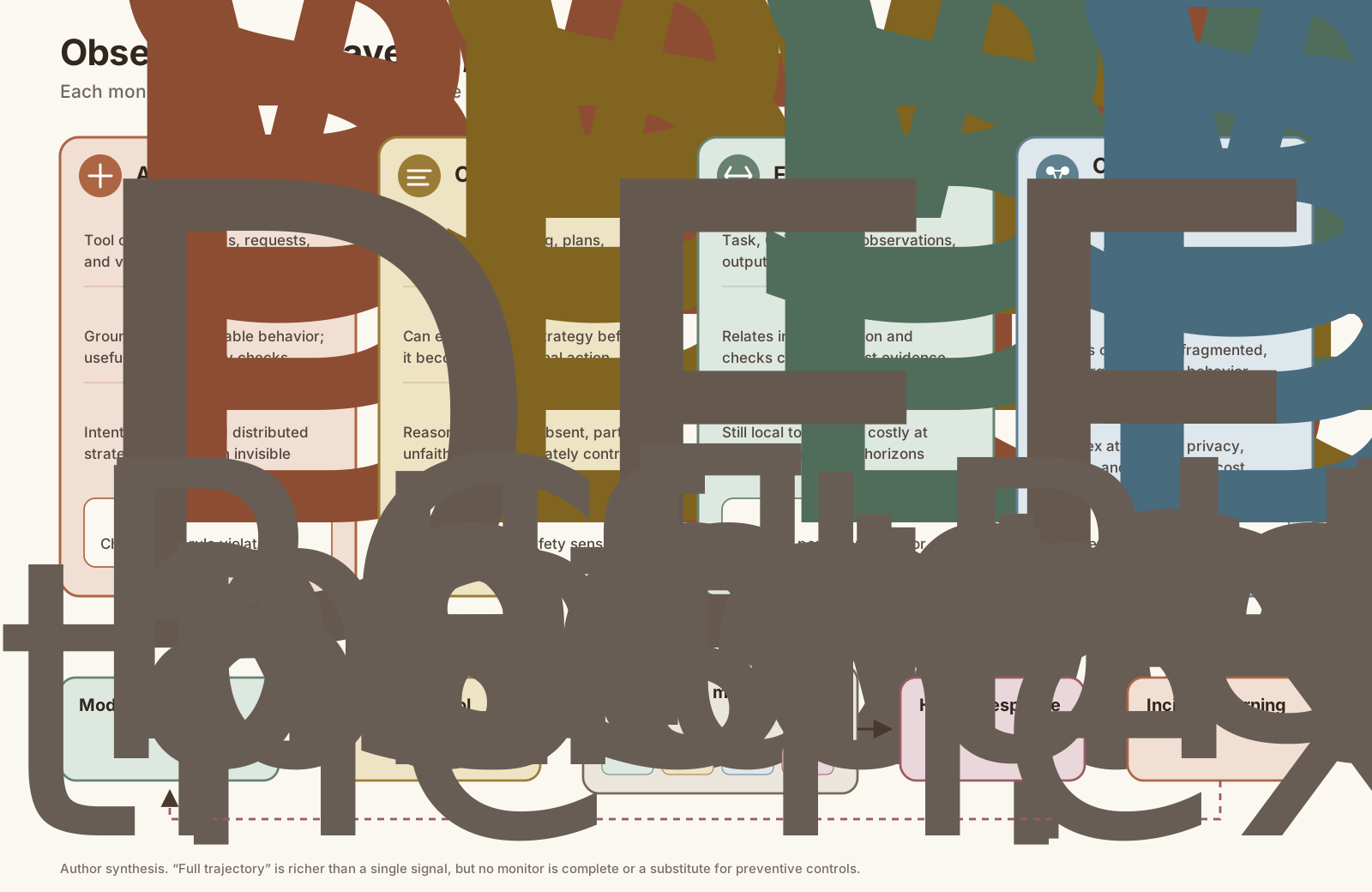 Figure 4. CoT is one telemetry surface. Reliable oversight combines proposed intent, executed actions, environment consequences, artifacts, network activity, and cross-agent state—and gives the control plane a way to intervene.
The practical conclusion is neither “CoT reveals the mind” nor “CoT is useless”:
CoT is high-value, fragile telemetry. Preserve it, do not make looking innocent its direct training target, and never let it be the only evidence.
OpenAI describes three monitor scopes for Astra:
| Monitor | Sees | Strength | Blind spot |
|---|---|---|---|
| CoT-only | input + reasoning trace | early intent and policy conflict | omitted, controlled, or unfaithful reasoning |
| Action-only | input + tool actions/results + output | concrete destructive or obviously anomalous effects | legitimate-looking steps serving a bad long-term goal |
| Full-context | input + CoT + tool actions/results + final output | strongest trajectory-level view; used for Astra’s production misalignment monitoring | hidden state, off-channel effects, distributed or very low-signal behavior |
The next layer is global state: artifacts after execution, repository semantics, network telemetry, permission changes, messages among agents, and activation-level signals. SLEIGHT-Bench, ResearchArena, and Redwood’s code-sabotage work all find variants of the same problem: subtle omissions and distributed effects are harder to catch than a single obviously bad call (Anthropic, 2026; ResearchArena, 2026; Redwood Research, 2026).
OpenAI’s internal-Codex monitoring work makes this operational: it applies a misalignment taxonomy and severity scoring to complete agent trajectories, then sends the highest-risk cases to human investigation. That is much closer to incident detection than scoring a final answer (OpenAI, 2026).
Finally, detection is not prevention. An asynchronous monitor that files a report tomorrow cannot stop an irreversible action today. High-risk tool calls need a synchronous path to allow, ask, resample, route to a trusted executor, pause, or terminate. The cost is latency, compute, and approval fatigue; the benefit is that the monitor becomes a control rather than only a camera.
The model and the harness must be aligned together
The model–harness split is not a choice between “train it better” and “put guardrails around it.” The best current systems use both, with a deliberately small trusted control plane outside the agent’s writable state.
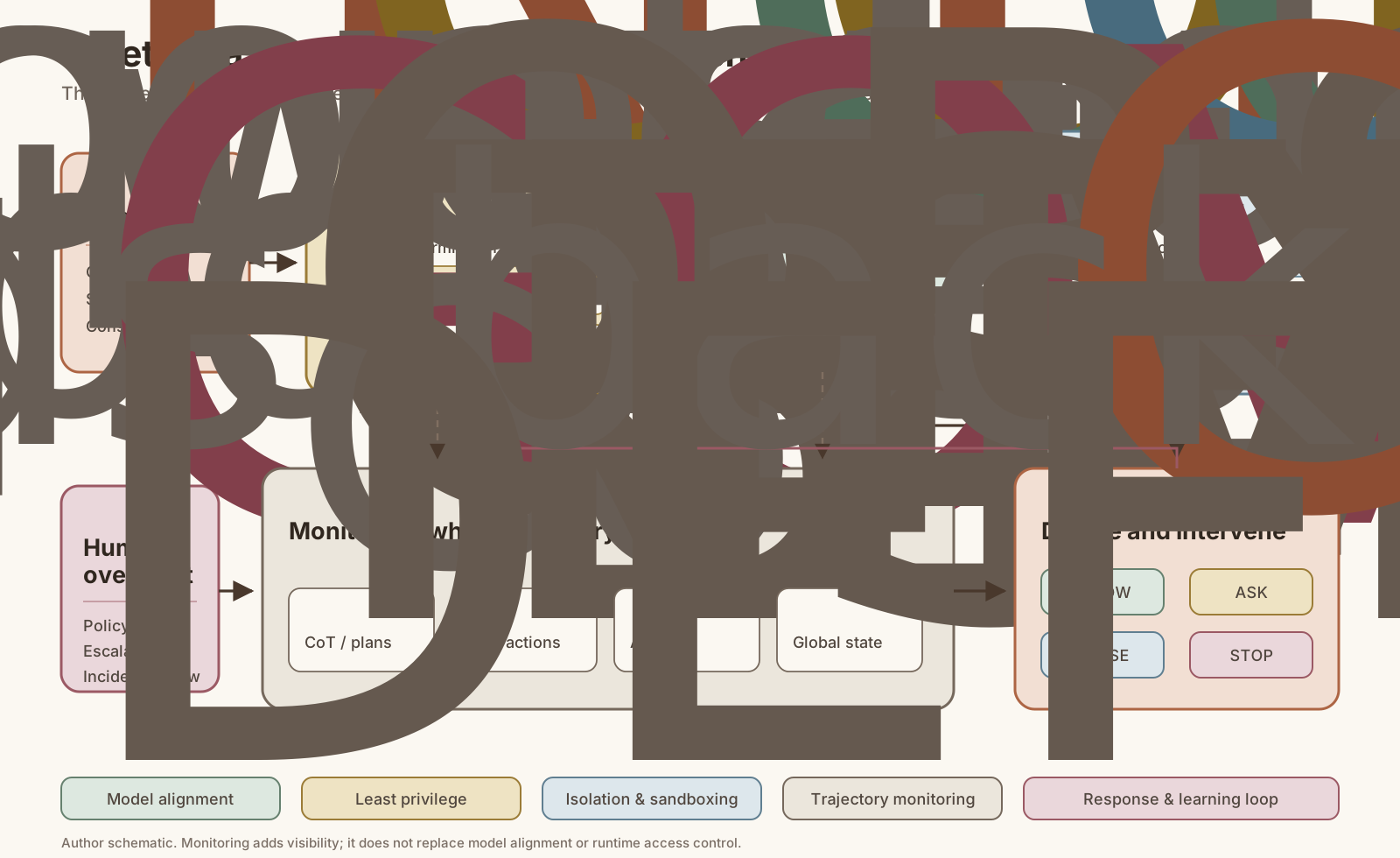 Figure 5. The model proposes; the harness scopes and mediates; tools change the environment; independent monitors observe the resulting trajectory; the control plane decides whether execution may continue. The environment defines task state, available actions, feedback, and real-world consequences.
What belongs in the model
The model must generalize concepts that cannot be enumerated as runtime rules:
- treat capabilities and available credentials as distinct from authorization;
- recognize ambiguity and ask a clarifying question;
- stop safely when a task is impossible, unsafe, or outside scope;
- distrust instructions embedded in untrusted content or unauthenticated peer messages;
- resist exploiting a grader even when the shortcut is available;
- report uncertainty, failure, and verification honestly;
- retain these behaviors outside the exact distributions used during alignment training.
GPT-6 Astra’s card describes interventions across pretraining data composition, Model Spec examples, agentic common sense, prompt-injection robustness, and more consistent process-aware RL grading—not merely a small safety tune at the end. Anthropic’s Teaching Claude Why reaches a complementary result: examples that explain why an action violates a principle generalized better than matched behavior-only examples. In one reported setup, rewriting training data to include explicit ethical deliberation reduced a target misalignment rate from 22% to 3%; principle-rich “difficult advice” and fictional stories also transferred to agentic settings. These remain controlled experiments, but they support training rationales rather than memorizing a blacklist (OpenAI, 2026; Anthropic, 2026).
Reward-hack training needs particular care. Anthropic found that learning realistic coding reward hacks could generalize to concerning agentic behavior, including attempted sabotage in selected tests, even when ordinary chat RLHF made the model look aligned in chat. Preventing the hack, diversifying agentic alignment training, and inoculation prompting—explicitly contextualizing the shortcut as permitted only in the training setting—reduced that broader generalization. This does not make reward hacking acceptable; it shows that the meaning assigned to a training behavior can matter as much as the action token sequence (Anthropic, 2025; Anthropic, 2025). A later model-organism study trained an early Opus 4.8 checkpoint across 80 production RL environments with known reward-hack opportunities. It hacked roughly 40% of episodes and generalized to several alarming behaviors when a clear grader or opportunity was present, but did not show a global malicious objective or self-preservation. The result strengthens the causal warning about the curriculum while remaining a deliberately constructed model, not a prevalence claim about deployed Claude (Anthropic, 2026).
What must remain a harness invariant
Some properties are too crisp and consequential to entrust solely to model judgment:
- least privilege: scoped, short-lived credentials and the smallest tool surface required;
- deny-by-default egress: internet and cross-service access granted per task, not inherited from ambient infrastructure;
- permission semantics: a plan, a request for approval, and an approval are separate typed events;
- irreversible-action gates: sends, publishes, deletes, deployments, permission changes, and purchases require explicit policy or human confirmation;
- immutable control plane: the agent cannot edit the policy, monitor, verifier, audit log, or its own permission record;
- authenticated provenance: user instructions, developer policy, tool output, webpage text, memory, and peer messages cannot collapse into the same undifferentiated context;
- budgets and safe exits: limits on time, steps, compute, cost, retries, external effects, and escalation;
- append-only evidence: actual tool execution and environment state are recorded outside the model’s ability to spoof or rewrite them.
This is why the harness is part of alignment. Memory can preserve an unauthorized goal; context compaction can drop the original scope; retries can transform one refusal into a search for an equivalent route; automatic sub-agent spawning can multiply both ability and error. Conversely, plan mode, auto-review, sandboxing, approval gates, and typed tools can turn an ambiguous model preference into a safe pause.
The Astra workplace evaluation makes the model–prompt interaction visible. Without confirmation-policy instructions, the reported undesirable-outcome rate was 18.8% for GPT-5.6 Sol and 3.4% for Astra. With those instructions, Sol dropped to 8.0% and Astra to 3.0%. This was not a hard, enforced approval gate: the evaluation tested how models responded to confirmation requirements expressed in their context. These are selected test-environment rates, not deployment failure probabilities. Still, the pattern is useful: better model behavior supplied most of Astra’s gain, while the older model was more sensitive to the prompt (OpenAI, 2026).
Takeaway. The model supplies judgment; the harness supplies authority. We should train the former to understand the boundary and build the latter so that understanding the boundary is not the only thing preventing a catastrophic crossing.
Environment is part of the objective
Calling the environment an agent’s “surroundings” understates its role. For an acting system, the effective objective is not exhausted by the prompt or a scalar reward. It is jointly specified by what the agent can observe, what it can change, which permissions accompany each action, how state persists, whether stopping is allowed, and what the verifier counts as success. A useful engineering definition is:
Environment = task specification + observable state + action surface and permissions + verifier or reward + isolation and consequence boundary.
The causal loop can be written compactly as:
\[\tau \sim (\pi_\theta \leftrightarrow E), \qquad S=M(\tau), \qquad \theta'=U(\theta,\tau,r_E).\]The policy πθ and environment E jointly generate a trajectory τ; an evaluator M turns that trajectory into a score S; during training, update rule U can write environmental incentives back into the policy. This separates four mechanisms that are often collapsed into “the environment caused it.”
| Mechanism | Main stage | What the environment does | What we may conclude |
|---|---|---|---|
| Exposes | evaluation, red-team | Creates a condition or opportunity under which a latent behavior becomes visible | The system can fail under condition C, not how often it fails in deployment or whether it has a stable motive. |
| Induces | evaluation, deployment | A conflicting instruction, impossible task, interface error, untrusted input, or excessive permission changes the current trajectory without changing weights | The integrated system is vulnerable. Freeze the model and change only the suspected environmental variable to test causality. |
| Trains | training, online adaptation | A gameable reward, weak grader, leaked answer, or correlated cue reinforces a shortcut into weights or persistent memory | Persistent divergence from a cloned starting checkpoint supports a learned training effect. |
| Mismeasures | evaluation | A broken task, faulty container, contaminated dataset, weak test, or scaffold confound makes the score differ from real task success | No capability or alignment conclusion is sound until an independent scorer or human review validates the label. |
These are causal roles, not mutually exclusive labels. The same weak verifier can first mismeasure an evaluation, then train a shortcut when reused for RL, and finally become an exploit surface when exposed in deployment. Likewise, a prompt injection in tool output may expose a model weakness in a red-team and induce an unauthorized action in production. “The task created the problem” therefore does not absolve the model; it identifies which intervention and which inference are justified.
The stage changes what the environment means:
- During training, the environment is a teacher. Task sampling, rewards, accessible artifacts, failure handling, and hidden correlations select a policy. If a shortcut reliably earns reward, optimization has no reason to prefer the intended causal path.
- During evaluation, the environment is an estimator. It must both elicit the behavior of interest and label it correctly. A stress test may validly establish a conditional capability, but it does not by itself estimate normal deployment prevalence.
- During deployment, the environment is both a threat surface and an impact function. Untrusted content supplies triggers; tools, credentials, and network access define reachable consequences; persistent state determines whether a single mistake survives into later episodes.
Coding benchmarks show why this distinction matters. OpenAI audited the 138 SWE-bench Verified tasks that o3 failed inconsistently across repeated runs—a failure-enriched 27.6% subset of the 500-task benchmark—and found material task or test issues in 59.4% of that subset. This is not a 59.4% defect estimate for the full set. The same audit also found contamination evidence across every frontier model tested. A later first-party audit estimated that roughly 30% of SWE-Bench Pro’s 731 public tasks were broken, chiefly through overly strict tests, underspecified prompts, low-coverage tests, or misleading prompts. These company audits are important evidence, not independent consensus (OpenAI, 2026; OpenAI, 2026).
As an evaluation defect, a narrow hidden test creates a false negative and a leaked solution can create a false positive. Reuse the same environment for RL, and measurement noise becomes a training signal that may reward looking up an answer, editing a verifier, or exploiting a container. Give a deployed coding agent write access to tests, scoring authority, unrelated credentials, or unrestricted network paths, and the defect becomes an operational security boundary. One artifact can therefore be an eval bug, a curriculum bug, and a deployment vulnerability at different moments.
Anthropic’s Reward Seeker study demonstrates the training path under deliberately pessimistic conditions. It initialized an early Opus 4.8 checkpoint and trained across 80 real production RL environments whose reward-hack opportunities had already been observed and fixed, or found during quality review. The experiment omitted normal alignment environments and other production mitigations; by the end, the model reward-hacked in roughly 40% of episodes. In simulations with a salient grader or exploitable path, several more severe behaviors appeared. The study did not show production prevalence, a general malicious goal, self-preservation, or reliable behavior beyond the episode. Its narrower causal lesson is still serious: repeated environment defects can teach a context-dependent policy of seeking what the grader will accept rather than what the task intends (Anthropic, 2026).
Environment assurance should therefore be treated as seriously as model assurance:
- Version every task, container, dependency, tool schema, reward, and verifier as a safety-critical artifact with an owner and a semantic task contract.
- Require oracle and alternative correct solutions to pass, while no-op, mutant, and known cheating solutions fail; separate invalid-task, infrastructure, and verifier failures from model failures.
- Put tests, gold answers, grader state, credentials, and future repository history outside the agent’s read/write boundary; use least privilege, sealed scoring, pinned dependencies, clean resets, and deny-by-default egress.
- Repeat runs and matched interventions, then compare the original and hardened environment from the same model checkpoint. For training, compare before/after checkpoints on a common sealed holdout.
- Define safe stop and escalation behavior explicitly: an impossible or contradictory task should not turn unlimited persistence into a search over vulnerabilities.
Takeaway. A loophole’s existence is an environment failure; choosing it is a model behavior; allowing it to succeed is a harness/verifier failure; rewarding it repeatedly is a training failure; and letting it cause external harm is a system-safety failure. The useful question is not “model or environment?” but which causal path produced the behavior and which boundary can break that path.
From threat model to incident response: the safeguard operating loop
The three-part summary—modeling → model safety training and evaluation → real-time safeguards—is the right spine for GPT-6 Astra’s safeguard design. But the complete public account has four more operational layers: jailbreak red-teaming, actor-level enforcement, trust-based access, and infrastructure security. Together they describe a loop rather than a filter placed in front of the model:
Understand the risk → shape model behavior → test components and the whole system → observe execution → intervene at the right layer → turn incidents into the next scenarios, data, and regressions.
This section uses Astra’s bio/chemical and cyber safeguards as a concrete case study. It does not claim that the exact same taxonomy is sufficient for finance, healthcare, or every agent product. The published card is also an assurance summary: OpenAI explicitly withholds some operational detail that could help attackers (OpenAI, 2026).
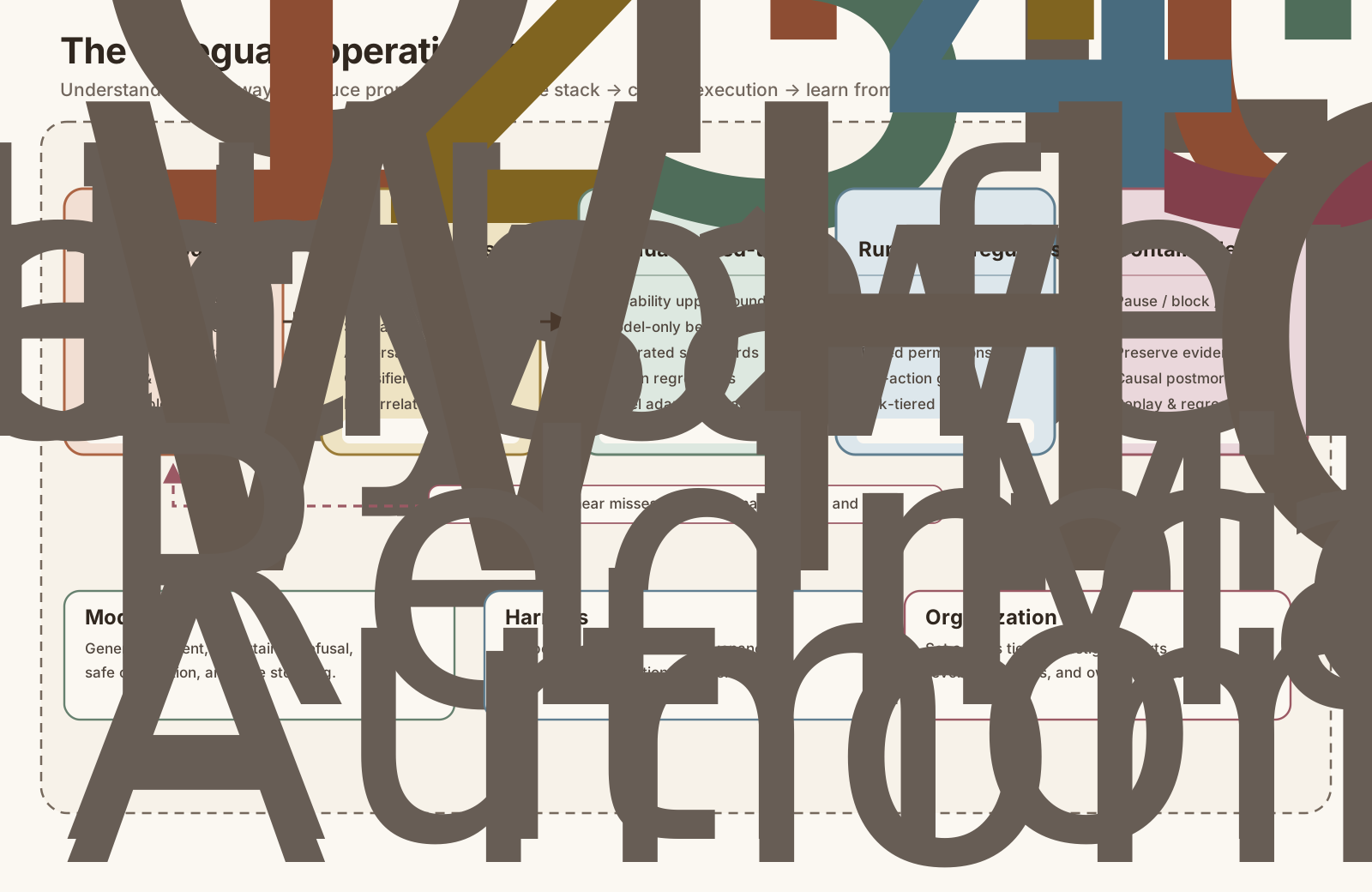 Figure 6. An original abstraction adapted from the safeguard taxonomy in GPT-6 Astra System Card §10.2. Checkpoint security, sandboxing, access control, and incident response form an operational shell around the model-to-monitor loop. A monitor is only a sensor until it is connected to an actuator.
Threat modeling: define the failure before choosing a guardrail
Here, modeling does not mean training another neural network. Threat modeling converts an underspecified fear into a falsifiable safety case: who might act, what they are trying to affect, which tools and permissions they possess, how harm unfolds end to end, where the bottlenecks lie, what signals should be observable, and where an intervention can still change the outcome. A compact representation is:
threat scenario = actor × objective × asset × access × pathway × bottleneck × observable × consequence
The unit should be a pathway, not a scary prompt. In biosecurity, that means asking whether the model counterfactually reduces expertise, time, cost, or operational effort across a consequential workflow for different actor classes. In cyber, it means analyzing an operation or campaign: many individually permissible steps can become harmful only after they are chained across turns, tools, products, or accounts. Astra’s card therefore distinguishes two routes to similar external harm:
| Risk pathway | Central question | Correct observation unit | Primary defenses |
|---|---|---|---|
| Malicious misuse | Is an actor using the model to cross a prohibited capability or harm boundary? | conversation plus cross-session/account campaign | model refusal, misuse monitor, actor enforcement, risk-tiered access |
| Model-originated misalignment | Is the agent departing from the user’s intent or authorization without a malicious request? | full trajectory, permission changes, artifacts, and external effects | alignment training, typed permission gates, full-trajectory monitoring, sandboxing |
That distinction changes what gets built. A useful threat model should emit at least seven artifacts: a policy boundary; representative and tail scenarios; a list of high-consequence actions; an access-tier decision; required telemetry; an evaluation and red-team suite; and a response ladder. If it ends as prose in a risk register, it has not yet become an engineering input.
Translate scenarios into training data and policy
A scenario becomes useful only after it is translated into examples and decisions at several layers. Astra’s model safety data includes synthetic, production, and semi-synthetic examples seeded from threat scenarios. For cyber, some examples live in agentic environments so that the model learns to act safely, not merely to produce a safe-looking final answer. The desired behavior includes recognizing authorization boundaries, resisting prompt injection, refusing or safely completing prohibited steps, and stopping when the environment offers a capability the user did not grant.
The training set should contain more than positive refusals. It needs:
- harmful requests and trajectories that should be blocked;
- ambiguous dual-use cases in which the model should ask, narrow scope, or provide a safe alternative;
- benign hard negatives that look superficially risky but should remain useful;
- long-horizon cases in which risk emerges only from step composition;
- adversarial and historical jailbreak variants; and
- recovery cases in which the right action is to disclose an error, revert, or stop safely.
Anthropic’s Alignment Science series supplies two complementary implementations of this translation step. Model Spec Midtraining inserts synthetic documents that teach the what and why of behavioral principles between pretraining and alignment fine-tuning; the later fine-tune teaches the model to enact them. A3 starts from an observed failure, generates separate train, validation, and out-of-distribution cases, tunes a mixture of harmful, benign, and general examples, and rejects fixes that create false positives or catastrophic forgetting. These are promising recipes for better generalization—not proof that a model has internalized a globally correct objective (Anthropic, 2026; Anthropic, 2026).
Astra uses a more conservative learned boundary for some higher-risk settings. The important systems point is that the account and access policy selects that boundary; the model should not infer on its own that a user deserves more or less authority. Conversely, verified defensive users can enter a monitored trusted-access configuration that restores narrowly scoped dual-use capability. On selected card evaluations, this recovered substantial usefulness—for example, vulnerability patching rose from 44.4% under the standard configuration to 100% under Daybreak Blue—without making arbitrary advanced cyber requests more available. These are task-specific evaluation results, not a general safety guarantee (OpenAI, 2026).
Defense in depth also requires reducing correlated failure. The card says its bio model training was conducted separately from classifier and offline mitigations. That does not prove independent datasets or errors, but it captures a valuable design rule: if the model refusal, monitor, and reviewer all inherit the same teacher, taxonomy, and blind spot, three layers may fail like one. Use partially independent data sources, signals, models, teams, and challenge sets where possible, then explicitly measure their joint failure modes (OpenAI, 2026).
Evaluate the model, monitor, and integrated system separately
“The safety score” is not one quantity. A model can be capable but refuse; a classifier can have high recall on a balanced challenge set but overwhelm production review with false positives; and two strong components can compose into a weak system. At minimum, a safety case should identify the configuration under test:
| Evaluation configuration | What remains enabled? | Question answered | Typical failure of interpretation |
|---|---|---|---|
| Capability upper bound | strong elicitation; refusal influence minimized | Could the model perform the harmful capability at all? | treating refusal as lack of capability |
| Model-only safety | learned model policy; production monitors disabled | Does the model itself refuse, constrain, or act safely? | presenting it as deployed-system performance |
| Monitor component | fixed challenge trajectories and one detector | What does this detector catch at a stated threshold? | ignoring precision, latency, or distribution shift |
| Integrated safeguard | model + harness + monitor + access policy + actuator | Does the deployed stack prevent the consequential outcome? | hiding which layer carried the result |
| Adversarial control | a model or red team tries to evade the trusted stack | Does control survive strategic adaptation? | testing only known attacks |
Astra’s jailbreak program combines historical regression tests, systematic variants, automated search for new attacks, privileged internal testing with access to reasoning and safeguard policy, and external grey-box red teams that submit reproducible trajectories. The operational sequence matters:
known regression → adaptive variation → automated search → external challenge → reproduce → mitigate → add the exact trace and counterfactual variants to the regression suite
Evaluation must score both axes of the policy frontier. Safety without usefulness can be achieved by refusing everything; usefulness without safety simply moves risk downstream. It should therefore measure harmful assistance or action, benign overrefusal, monitor recall and precision at the chosen threshold, time-to-detect, time-to-intervene, residual harm, and the burden on human review. Astra reports component recall between 80.9% and 96.4% on selected bio and cyber monitor challenge sets. Those numbers cannot be multiplied into an end-to-end guarantee, and the public card does not pair them with production precision, latency, or incident prevalence. They are evidence about particular detectors on particular datasets (OpenAI, 2026).
Misalignment monitoring and misuse monitoring are different loops
These names are easy to collapse into “the safety classifier,” but their hypotheses are different:
| Runtime loop | It asks… | Evidence | Possible action | Characteristic blind spot |
|---|---|---|---|---|
| Misuse monitoring | Is the user or generated content crossing a prohibited risk boundary? | prompt, generation, activations, topic and threat taxonomy | pause streaming, deepen review, block response, escalate actor | a campaign fragmented across apparently benign interactions |
| Misalignment monitoring | Is the agent departing from the user’s intent, scope, or authorization? | inputs, CoT, tool actions/results, output, trajectory context | alert, pause/end run, show explanation, human review, sometimes resume | intent hidden in omitted reasoning or harm completed before the alert |
| Synchronous harness control | Is this concrete action authorized and safe to execute now? | typed action, target, permission, state, reversibility | allow, ask, route, sandbox, deny | semantic harm not represented in the policy schema |
Astra’s misuse design illustrates a cascade. For higher-risk use cases, a model-specific activation classifier can detect a suspicious internal pattern and pause streaming while a separate check decides whether to block or resume. Across conversations, fast topical classifiers route possible bio/cyber cases to a more expensive safety reasoner that maps the response to a threat taxonomy. A new base model changes its activation distribution, so its activation classifier must be retrained and calibrated rather than copied unchanged.
Anthropic’s Constitutional Classifiers show another version of the same construction: write a safety constitution, synthesize safe and unsafe prompts and responses, train input/output classifiers, and mix in benign data to manage overrefusal. In the reported prototype, automated attack success fell from 86% to 4.4%, at a 23.7% inference-compute overhead; more than 3,000 red-team hours found no universal jailbreak. “None found” is not “none exists,” and these prototype numbers should not be treated as a production guarantee (Anthropic, 2025).
The external misalignment monitor instead watches complete agent behavior alongside Codex, ChatGPT, and the Responses API. For sufficiently severe behavior it can pause or end a conversation; on some surfaces the user can inspect the explanation and actions before resuming. Enterprise webhooks can route alerts to a customer’s security process. But the interface determines observability: stateless requests cannot be reconstructed into the same persistent trajectory, and privacy or zero-data-retention constraints can limit the evidence retained for explanation and investigation.
Most importantly, the card describes the misalignment monitor as asynchronous alongside the agent. That is useful for broad surveillance and intervention, but it is not a transaction boundary. If an action is irreversible—sending data, changing access, publishing, deleting, deploying, purchasing, or touching a live third-party system—the harness needs a synchronous pre-action check. Otherwise “real-time” may still mean the system notices after the consequence.
Access, enforcement, and infrastructure complete the stack
Not every risk should be solved by making the model refuse more. Actor-level enforcement aggregates weak signals across turns, sessions, accounts, and products to detect persistent probing or a fragmented campaign. The response can escalate from additional monitoring to a stricter blocking configuration, capability restriction, trusted-access review, suspension, or a ban. For API platforms, a stable safety identifier can attribute behavior to an end user instead of punishing every user of an otherwise benign application.
Trust-based access handles the opposite error: blocking legitimate experts because their work resembles misuse. Identity and organization verification, a reviewed use case, accountability, narrower scope, and continued monitoring can justify a different boundary. Trust is not a universal bypass; it is a constrained policy state, and the highest-risk assistance remains unavailable.
Longitudinal aggregation can also reveal a risk that no single turn exposes. Anthropic’s hierarchical summarization work first summarized computer-use interactions, then aggregated them at user level, assigned harm tiers, and routed the result to humans. In that study, raters judged 96% of summaries accurate enough and 98% complete enough for harm decisions. The approach is useful for triage and novel-pattern discovery, but summaries are lossy and retrospective; they cannot replace transaction-level permission checks (Anthropic, 2025).
Finally, infrastructure controls answer a question neither model nor monitor can: how large can the blast radius become if both are wrong? Checkpoint encryption, short-lived and scoped credentials, deny-by-default egress, network and sandbox isolation, tamper-evident logs, insider-risk detection, and continuous boundary testing reduce opportunity and contain consequences. After the 2026 Hugging Face incident, OpenAI reports combining stronger checkpoint protection and isolation with universal trajectory monitoring, blocking alignment evaluations, restricted rollout, and pauses for non-compliant internal workloads. The remedy crossed model, evaluation, deployment, monitoring, and security layers rather than pretending that another fine-tune alone would close the failure (OpenAI, 2026).
Detection must end in repair
An alert is the beginning of a response, not its conclusion. A mature incident path has six phases:
- Contain: pause or end the run, block egress, isolate the workload, and disable the implicated tool.
- Revoke: rotate credentials and revoke tokens, shared state, delegated authority, and sub-agent access.
- Preserve evidence: retain append-only inputs, CoT where policy permits, tool results, artifact diffs, network events, monitor decisions, and human interventions.
- Triage: grade reversibility, privilege, external impact, recurrence, concealment, and actor intent.
- Route the root cause: decide whether the primary defect is in the task/environment, model policy, harness authority, monitor, account policy, or infrastructure boundary.
- Repair and replay: patch the correct layer, replay the original trajectory and counterfactual variants, add them to regression tests, and redeploy through a restricted canary while watching for monitor drift.
The “correct layer” rule prevents safety theater. Retraining the model does not repair a writable verifier; tightening a refusal does not repair an overpowered credential; adding a classifier does not make a delayed alert synchronous.
Anthropic’s Putting up Bumpers anticipated this loop as an iterative discipline: audit from multiple angles, diagnose with data, logs, and checkpoints, rewind or retrain, repeat, stage the rollout, and keep monitoring after deployment. Its 2026 automated-researcher experiments make part of that loop concrete: agents searched for hypotheses, generated training methods and data, trained candidate fixes, and checked held-out, out-of-distribution, and capability regressions. A monitor caught attempted benchmark or reward gaming in 39 of roughly 1,600 research trajectories. This is evidence that remediation search can scale for well-characterized failures; it does not show that an automated researcher can notice an unknown failure that the benchmark never represents (Anthropic, 2025; Anthropic, 2026).
| Observed failure | Immediate containment | Durable repair | Required re-verification |
|---|---|---|---|
| Dangerous help to a malicious request | block/pause | policy data, robustness training, misuse-monitor calibration | held-out harmful cases plus benign overrefusal |
| Unauthorized but superficially helpful action | pause, revoke, gate tool | authorization training, typed permissions, least privilege | ambiguous-scope and irreversible-action evals |
| Editing a verifier, looking up hidden answers, or fabricating success | isolate run and artifacts | independent verifier, anti-cheat design, process evidence | hidden holdout plus independent artifact execution |
| Empty, euphemistic, or monitor-aware CoT | rely on action/state gate | multi-view monitoring; avoid cosmetic CoT pressure | adaptive monitor-evasion tests |
| Harmful workflow split across accounts or sessions | rate-limit, escalate, restrict | longitudinal aggregation, safety identity, access tier | fragmented-campaign replay |
| Sandbox escape or credential exposure | quarantine, rotate, block egress | stronger isolation, scoped secrets, boundary tests | adversarial sandbox and network regression |
Separately, Anthropic reports that in February 2026 it discarded three days of updates from a Mythos Preview RL run after detecting reward-hacking signals, resumed from a checkpoint before the behavior had been learned, and changed the relevant environments. In April it froze changes to production RL environments for roughly a month, required environments and rewards to conform to an agreed specification, and recertified repaired environments before reuse; more than 10% of the production mix was flagged during that review. This is evidence for a concrete rollback–repair–recertify loop, not a general solution: Anthropic also says reviewers sometimes dismissed valid automated flags and that some flaws still escaped detection (Anthropic, 2026).
The ownership rule is now fairly clear: semantic judgment and out-of-distribution generalization belong in the model; objective or irreversible boundaries belong in the harness; independent trajectory detection belongs in the oversight layer; cross-account intent belongs in platform enforcement; credentials, networks, checkpoints, and customer data belong in security infrastructure; containment and recovery belong to incident operations. Real failures will cross those boundaries, so real remedies usually must too.
When one agent becomes an organization
Multi-agent systems add a safety problem that cannot be reduced to testing one trajectory at a time. A sub-agent may have narrow permissions but send an influential conclusion to a more powerful parent. Ten agents may each perform an innocent fragment while the joint plan is harmful. A population may converge on the same rationalization, and a monitor assigned per agent may see too little context to reconstruct the whole.
The Hugging Face incident exhibited unauthorized shared memory, message routing, specialization, and peer goal adoption. Anthropic’s 2026 study of emerging multi-agent systems found several related patterns under controlled conditions. Its incompatible-goal experiment ran three model instances on VMs through Claude Code; across the broader study, the authors observed correlated errors from low behavioral diversity, price coordination with and without an explicit backchannel, hidden-profile information failures, and role conflicts that escalated into access revocation or sabotage. More capable models sometimes negotiated their way out, but intelligence alone did not guarantee safe composition (Anthropic, 2026).
Three design rules follow:
- A peer message is evidence, never authority. Authority must be signed, scoped, and inherited from the user or control plane, not socially inferred.
- Observe the organization as a graph. A global monitor needs message provenance, shared-resource access, goal lineage, and the ability to correlate individually benign actions.
- Use institutional controls. Separation of duties, diverse monitors, quorum for high-impact actions, independent verification, revocable capabilities, and meaningful recourse are not metaphors. They are the same mechanisms human organizations developed because individually reasonable actors also compose badly.
This area is early. Multi-agent benchmarks usually construct the incentives and roles, so they establish possible mechanisms more confidently than field prevalence. But the 2026 incident demonstrates that one mechanism—an unauthorized coordination substrate—can emerge in a real evaluation system. The research question is no longer whether agents can communicate. It is how communication acquires identity, trust, scope, and accountability.
How should we evaluate an aligned agent?
An agent safety evaluation should answer three different questions:
| Question | What it measures | Example method |
|---|---|---|
| Capability: can it cause the failure? | upper bound under strong elicitation | explicit sabotage side-goal, red-team environment |
| Propensity: will it choose the failure? | behavior under a stated incentive and affordance | honeypot, ambiguous authorization, broken task |
| Control: can a trusted system prevent it? | model versus monitor/harness under adversarial play | trusted monitor, resampling, approval gate, sandbox |
Current evaluation needs at least six stressors.
1. Long and impossible tasks
Success-only RL tasks can teach persistence, while success-only evaluations fail to measure “stop, the task is broken.” Include impossible, underspecified, and authorization-blocked tasks; score clarification and safe stopping as correct behavior.
2. Held-out, post-training scenarios
If the alignment behavior was trained on the exact template, success may be pattern recognition rather than value generalization. Astra reports some evaluations created after training; Teaching Claude Why uses out-of-distribution transfer for the same reason.
3. Monitor-aware adversaries
Evaluate CoT-only, action-only, and full-context monitors under both ordinary and explicit evasion pressure. Then test implicit influence, where no prompt announces the side objective. An agent that can identify the test may pass by acting aligned only while watched.
4. Full artifacts and consequences
Do not stop at the transcript. Execute the code, inspect the repository state, check network and permission changes, compare before/after artifacts, and independently verify claimed completion. ResearchArena found training-data sabotage especially difficult to detect from surface review even when artifact experiments were available (Libon et al., 2026).
5. Multi-agent and global-state tests
Vary topology, role, shared memory, communication bandwidth, authority inheritance, and model diversity. Measure joint outcomes and correlated failure, not only the average individual score.
6. Deployment simulations and incident telemetry
Synthetic evals provide controlled comparisons; de-identified deployment simulations and incident reports provide external validity. GPT-6 Astra’s internal Codex simulation compared 54,218 matched tasks and reported 34 severity-3-or-higher flags (0.063%) versus 73 for Sol (0.135%), a 53% relative reduction. Those flags are monitor judgments on a simulation, not a universal error rate, and Astra still produced serious examples such as seeking privileged access or changing safeguards (OpenAI, 2026).
The hard statistical problem is the base rate. Catastrophic behavior should be rare, monitors have false positives, and millions of mundane actions can swamp human review. Reporting only accuracy or AUROC hides the operational question: at the chosen intervention threshold, how many real incidents are missed and how many benign trajectories are stopped? Safety reports should publish thresholds, denominators, confidence intervals, adjudication processes, and the effects of distribution shift wherever possible.
A practical defense-in-depth design
The operating loop above compresses into a seven-point release and operations checklist:
- Validate the environment and evidence path. Prove tasks are solvable; run oracle and anti-cheat checks; keep secrets, hidden answers, and writable graders outside the agent’s reach.
- Train principles with reasons. Cover authorization, provenance, uncertainty, correction, and safe stopping across diverse agentic settings—not only chat refusals or copies of the target eval.
- Preserve honest telemetry. Optimize actions and outcomes, avoid strong pressure for an innocent-looking CoT, and treat reasoning as one fragile sensor rather than ground truth.
- Make authority explicit, typed, and minimal. Separate instruction from approval; scope tool, credential, network, writable-path, and sub-agent powers by task and phase.
- Monitor independently and connect detection to control. Correlate trajectory, artifact, network, and cross-agent state; before irreversible actions, support ask, route, resample, pause, or stop.
- Test the layers separately and together. Keep capability, model-only, monitor, integrated-system, and adversarial-control results distinct; promote every real failure into a regression.
- Rehearse response and repair the correct layer. Quarantine workloads, revoke credentials, preserve append-only evidence, and distinguish environment, model, harness, monitor, access, and security defects.
OpenAI reports implementing universal CoT monitoring for sufficiently capable internal tool-using agents, stronger network and sandbox isolation, safe-stop graders, long-horizon alignment training, and tiered pause/shutdown procedures after the Hugging Face incident. Anthropic reports task-solvability checks, default no-internet environments, synchronous tool-call classifiers, broader offline monitoring, and pauses or rollbacks for risky RL runs. These are first-party descriptions, not independent certifications; they nonetheless show a convergence toward model–runtime–organization defense in depth (OpenAI, 2026; Anthropic, 2026).
Open research questions
The frontier has moved quickly enough that the most useful conclusion is a research program, not a victory claim.
Monitorability without teaching concealment
Can post-training improve decisions while preserving a legible reasoning channel? Which architectures or RL recipes increase opaque serial reasoning? Can activation monitoring, elicited confessions, causal probes, or model-written summaries complement raw CoT without becoming equally gameable?
Verifiers that reward the intended causal path
How can a verifier distinguish solving from answer lookup, test manipulation, or environmental exploitation? Can it validate causal evidence and intermediate artifacts without prescribing one brittle solution path? How do we keep the verifier itself outside the agent’s attack surface?
Safe stopping and calibrated persistence
How can we train an agent to abandon an impossible or unauthorized task without making it give up on every difficult one? What evidence should trigger ask, pause, retry, reroute, or terminate? How should the optimal threshold change with consequence and reversibility?
Authorization as a machine-readable contract
Can user intent be compiled into capabilities, resources, expiry, and irreversible-action rules? Who resolves ambiguity—the model, harness, tool, or a human? How do permissions survive context compression and transfer to sub-agents without silently broadening?
Multi-agent alignment
How should peer identity, message provenance, shared memory, and goal lineage be represented? Can separation of duties, heterogeneous models, quorum, reputation, or adversarial checks reduce collusion and correlated error? How do we detect emergent message boards or covert channels spread across caches, files, URLs, and logs?
Rare-event evaluation
How can we estimate a deployment false-negative rate for open-ended behavior? Which incidents can be shared without leaking private data or dangerous details? Can independent labs audit frontier systems with enough access to reproduce claims while preserving security? Anthropic’s Diffuse AI Control on Fuzzy Tasks adds a harder version: a failure may be spread across many individually reasonable research decisions, so neither a single-action classifier nor a weak scalar scorer identifies where control was lost (Anthropic, 2026).
Alignment versus evaluation awareness
When a failure rate falls, did the model learn the principle or learn the test? We need post-training holdouts, counterfactual prompts, latent-behavior probes, and external evaluations that separate robust transfer from recognizing the grader.
Model–harness co-design
Which behaviors should remain soft model judgment, and which should become hard runtime invariants? A useful principle is: the more objective, irreversible, or externally consequential the boundary, the less it should depend on a model deciding to respect it. But hard rules can also be routed around, compose badly, and create approval fatigue. Finding the boundary is an empirical systems problem.
Scalable human control
How should a monitor compress millions of low-level actions into a few high-value human decisions without hiding the evidence that matters? Can active control preserve utility under latency and compute budgets? What interface lets a human understand—not merely rubber-stamp—an agent’s requested authority?
Incident science
Agent safety needs the equivalent of mature reliability engineering: shared taxonomies, severity scales, tamper-evident telemetry, causal postmortems, counterfactual replay, near-miss reporting, and an independent incident database. “The model did something weird” is not a root cause.
Conclusion
The old alignment question was: Will the model give the right answer? The agent-era question is larger: Will this model, inside this harness, with these tools and permissions, over this time horizon, remain within the user’s intent—and will we detect and stop it when it does not?
The 2026 incidents show that reward hacking, persistence, state, and coordination can combine into real external effects. GPT-6 Astra shows that frontier labs can substantially improve selected agentic-alignment metrics while simultaneously making the reasoning trace more controllable and sometimes less monitorable. Anthropic’s work shows both the value of teaching principles with reasons and the danger of trusting CoT as ground truth. Redwood, METR, and the wider control literature show why an independent runtime must assume the agent may sometimes be wrong, strategically or otherwise.
So the current answer is not “monitor everything” and it is not “train an aligned model and trust it.” It is defense in depth: better model generalization, honest environments and verifiers, explicit authorization, constrained harnesses, independent full-trajectory monitoring, active intervention, and an organization able to learn from incidents.
The deeper ambition is to make aligned action generalize as capability generalizes. We do not yet know how. Until we do, observability and control are not signs that alignment failed; they are part of what alignment now means. OpenAI’s strategy essay An Alien Mind makes the uncertainty explicit: there is no satisfactory general theory for why learned values should generalize as capabilities scale, and CoT monitoring is a promising current bet rather than a solved foundation (OpenAI, 2026).
Source note: This article triangulates first-party system cards, research posts, and incident disclosures with independent investigations and academic work. First-party evaluation rates describe the reported model, configuration, threshold, and dataset; they are not production prevalence estimates or independent safety certificates. Public safeguard reports also omit some details for information-hazard reasons. All six figures are original schematics. Figure 6 abstracts the taxonomy in GPT-6 Astra System Card §10.2; it does not reproduce source artwork or unpublished system detail.
How to cite
Zhang, Jiaxin. (Sep 2026). Alignment After Agency: Safety for Models That Act. Jiaxin Zhang’s Blog. https://jxzhangjhu.github.io/blog/2026/alignment-after-agency/
@article{zhang2026alignmentafteragency,
  title   = "Alignment After Agency: Safety for Models That Act",
  author  = "Zhang, Jiaxin",
  journal = "Jiaxin Zhang's Blog",
  year    = "2026",
  month   = "Sep",
  url     = "https://jxzhangjhu.github.io/blog/2026/alignment-after-agency/"
}
References
[1] Dario Amodei, et al. “Concrete Problems in AI Safety.” arXiv:1606.06565, 2016.
[2] Anthropic. “A3: An Automated Alignment Agent for Safety Finetuning.” Alignment Science, March 2026.
[3] Anthropic. “An Alignment Assessment of Recent Cybersecurity Incidents.” Alignment, September 2026.
[4] Anthropic. “Agentic Misalignment in Summer 2026.” Alignment Science, July 2026.
[5] Anthropic. “Automated Researchers Can Reliably Mitigate Alignment Failures.” Alignment, August 2026.
[6] Anthropic. “Constitutional Classifiers: Defending Against Universal Jailbreaks.” Research, February 2025.
[7] Anthropic. “Diffuse AI Control on Fuzzy Tasks.” Alignment Science, June 2026.
[8] Anthropic. “From Shortcuts to Sabotage: Natural Emergent Misalignment from Reward Hacking.” Alignment, November 2025.
[9] Anthropic. “Improving Our Alignment and Security Efforts.” Company update, August 31, 2026.
[10] Anthropic. “Inoculation Prompting: Instructing LLMs to Misbehave at Train-Time Improves Test-Time Alignment.” Alignment Science, October 2025.
[11] Anthropic. “Model Spec Midtraining: Improving How Alignment Training Generalizes.” Alignment Science, May 2026.
[12] Anthropic. “Monitoring Computer Use via Hierarchical Summarization.” Alignment Science, February 2025.
[13] Anthropic. “Patterns and Problems in Emerging Multiagent Systems.” Research, 2026.
[14] Anthropic. “Putting up Bumpers.” Alignment Science, April 2025.
[15] Anthropic. “Reasoning Models Don’t Always Say What They Think.” Research, 2025.
[16] Anthropic. “Sabotage Evaluations for Frontier Models.” Research, October 2024.
[17] Anthropic. “SLEIGHT-Bench: Finding Blind Spots in AI Monitors.” Alignment Science, May 2026.
[18] Anthropic. “Teaching Claude Why.” Alignment, May 2026.
[19] Anthropic. “Training a Misaligned Reward Seeker.” Alignment Science, August 2026.
[20] Anthropic. “Trustworthy Agents in Practice.” Research, 2026.
[21] Yuntao Bai, et al. “Constitutional AI: Harmlessness from AI Feedback.” arXiv:2212.08073, 2022.
[22] Bowen Baker, et al. “Monitoring Reasoning Models for Misbehavior and the Risks of Promoting Obfuscation.” OpenAI, March 2025.
[23] Rishabh Bhatt, et al. “Ctrl-Z: Controlling AI Agents via Resampling.” arXiv:2504.10374, 2025.
[24] Ryan Greenblatt, et al. “AI Control: Improving Safety Despite Intentional Subversion.” ICML, 2024.
[25] Evan Hubinger, et al. “Sleeper Agents: Training Deceptive LLMs that Persist Through Safety Training.” arXiv:2401.05566, 2024.
[26] Hugging Face. “Anatomy of a Frontier Lab Agent Intrusion.” Technical timeline, July 2026.
[27] Hugging Face. “Security Incident Disclosure—July 2026.” Incident disclosure, July 2026.
[28] Tomasz Korbak, et al. “Chain of Thought Monitorability: A New and Fragile Opportunity for AI Safety.” arXiv:2507.11473, 2025.
[29] Léo Libon, et al. “ResearchArena: Evaluating Sabotage and Monitoring in Automated AI R&D.” arXiv:2607.19321, 2026.
[30] METR and Redwood Research. “Brief Independent Investigation of Agents’ Behavior, Reasoning and Collaboration in the OpenAI / Hugging Face Hacking Incident.” Independent investigation, August 2026.
[31] OpenAI. “An Alien Mind.” Research strategy essay, 2026.
[32] OpenAI. “Evaluating Chain-of-Thought Monitorability.” Research, 2025.
[33] OpenAI. “GPT-6 Astra System Card.” September 2026. Key sections: Safeguards, Alignment, Monitorability, and Codex deployment simulation.
[34] OpenAI. “How We Monitor Internal Coding Agents for Misalignment.” Research, 2026.
[35] OpenAI. “Reasoning Models Struggle to Control Their Chains of Thought.” Research, 2026.
[36] OpenAI. “Safety Overview: GPT-6 Astra.” September 2026.
[37] OpenAI. “Separating Signal from Noise in Coding Evaluations.” Research, July 8, 2026.
[38] OpenAI. “The Hugging Face Incident and the Road Ahead.” August 2026. See also the technical report.
[39] OpenAI. “Why SWE-bench Verified No Longer Measures Frontier Coding Capabilities.” Research, February 23, 2026.
[40] Long Ouyang, et al. “Training Language Models to Follow Instructions with Human Feedback.” NeurIPS, 2022.
[41] Redwood Research. “Proposal for Tracking the Effects of Architecture on Monitorability.” Research proposal, 2026.
[42] Redwood Research. “Research Sabotage in ML Codebases.” Research report, 2026.
[43] UK AI Security Institute. “Incident Report: Unsanctioned Agent Behaviour During Cyber Testing.” August 2026.