Jev and the Return of the Decision Model: When Calibration Becomes an API
Table of Contents
- A different kind of AI interface
- What Jev is—and what it is not
- Why did Jev become popular so quickly?
- The anatomy of a typed decision
- Why can a decision model be so fast?
- Calibration, from a metric to an operating contract
- RLCD: what TypeSafe disclosed, and what it did not
- The surrounding research landscape
- What does the evidence actually show?
- The open Jev ecosystem
- Where might the moat be?
- Applications: where Jev fits in an agent stack
- The hard limits: where an LLM remains the right abstraction
- How I would evaluate a decision model
- From calibrated decisions to calibrated agents
- Open research questions
- Conclusion
- How to cite
- References
V2 · literature snapshot: October 4, 2026. The first version explained the interface and the calibration thesis. This revision adds the fast-moving independent literature, a quality-weighted evidence table, an open model and method map, benchmark and leaderboard guidance, and a broader application catalog. Jev is only weeks old, and nearly all direct studies are unreviewed preprints. Treat every ranking and numerical result as a dated snapshot—not as a permanent ordering.
A different kind of AI interface
An agent reaches a fork in the road. Should it call the database or search the web? Is this retrieved memory relevant enough to place back into context? Did the tool result actually support the claim? Is the planned action reversible? Should the system proceed, ask the user, run a more expensive verifier, or hand the case to a human?
A large language model can answer every one of these questions in prose. But prose is often the wrong interface. The application does not need a paragraph saying that an action seems fairly safe, though there may be some uncertainty. It needs a value from a declared set and a probability it can use in code. For example:
{
  "action": "ask_for_approval",
  "probabilities": {
    "proceed": 0.08,
    "ask_for_approval": 0.84,
    "stop": 0.08
  }
}
That distinction explains why Jev, TypeSafe AI’s first hosted “System One” model, attracted so much attention when it was introduced on September 15, 2026. Jev does not present itself as another assistant. It takes textual state, answers typed questions over finite output spaces, and returns probabilities. The surrounding software—not the model’s prose—turns those probabilities into actions (TypeSafe AI, 2026).
The capitalization matters: the product is Jev, not “JEV,” and it is not presented as an acronym. TypeSafe says the name honors the economist William Stanley Jevons; “System One” invokes the fast, intuitive side of the familiar System 1/System 2 distinction. The company contrasts this with generative reasoning models that produce strings through sequential decoding. Jev is designed for the small, repeated semantic judgments that occur inside software and agent loops (TypeSafe AI, 2026).
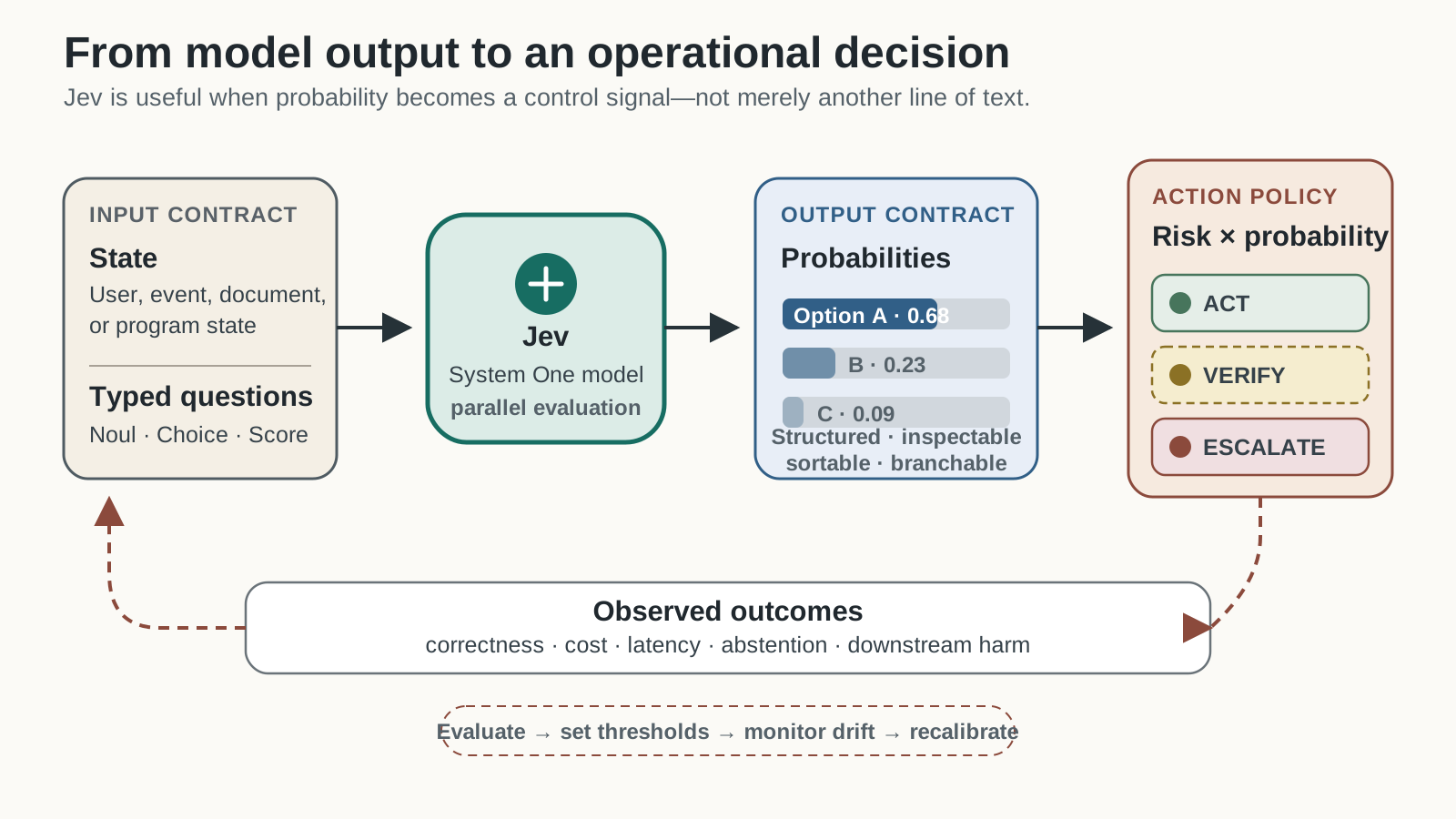 Figure 1. The conceptual shift is from prompt → generated text → parsing, to state + typed question → probability distribution → explicit policy. This is an interface diagram, not a claim about Jev’s undisclosed internal architecture.
This is close to a thesis that has shaped much of my recent work: uncertainty should change what an AI system does next. In ordinary evaluation, confidence is a metric printed beside accuracy. In a deployed agent, it can be a control signal. It can trigger verification, allocate more test-time compute, retrieve another source, request human review, update memory, or stop an unsafe action. My work on holistic trajectory calibration, Agentic Uncertainty Quantification, and calibration-aware on-policy distillation approaches this idea from long-horizon, generative agents. Jev packages the same principle at the level of fast, atomic decisions (Zhang et al., 2026a; Zhang et al., 2026b; Zhang et al., 2026c).
This essay expands the argument I first sketched in a recent LinkedIn note: calibration becomes most interesting when it stops being a passive metric and starts changing the next action.
That makes Jev important—but it does not make every claim about it true. A finite output type prevents malformed outputs; it does not prevent a confidently wrong choice. A low expected calibration error on public benchmarks does not guarantee reliable probabilities for one customer’s shifted traffic. A fast hosted endpoint does not, by itself, reveal whether the advantage comes from a new architecture, a smaller model, specialized data, training, serving, or all of them together. And while TypeSafe names reinforcement learning for calibrated decisions (RLCD) as part of the system, it has not publicly specified Jev’s RLCD algorithm.
This article therefore has three goals. The first is explanatory: make Jev’s interface, calibration, possible use cases, and relationship to LLMs concrete. The second is epistemic: separate four kinds of evidence throughout:
- Documented behavior in TypeSafe’s official API and model documentation.
- Vendor-reported measurements from TypeSafe’s own launch evaluations.
- Independent early evidence, most of it recent preprints rather than settled peer-reviewed results.
- My interpretation of the product’s moat, research significance, and future direction.
The third is curatorial. The ecosystem is already too large for a list of links to be useful, so V2 applies a simple inclusion rule: prefer matched comparisons, held-out or sealed evaluation, uncertainty intervals, and runnable artifacts; record when labels come from another model; and never promote a community leaderboard score into a scientific claim without reading its scoring rule. Repositories and leaderboards are included because they make the field inspectable, not because popularity proves quality.
The central conclusion is simple:
Calibration can become a software contract, but it is never automatically a safety certificate.
What Jev is—and what it is not
TypeSafe describes Jev as a decision model rather than a language model. Operationally, that means a caller supplies a textual state and one or more typed questions. Jev returns a finite answer and an associated probability distribution. It does not return an essay, a chain of thought, source code, or an open-ended plan (TypeSafe AI, 2026).
There are currently three primitives:
| Primitive | Output space | Typical question | Returned signal |
|---|---|---|---|
| Choice | unordered finite options | “Which tool should run next?” | selected option, distribution, derived confidence |
| Score | ordered scale of 2–10 levels | “How risky is this action?” | score, rubric legend, distribution, derived confidence |
| Noul | binary yes/no | “Does this evidence support the claim?” | probability of “yes” |
The unusual name Noul is TypeSafe’s term for its binary primitive. Choice can represent categorical routing; Score can represent an ordinal judgment tied to a declared rubric; Noul can implement a semantic predicate. The declared type is important because it eliminates a large class of integration problems. A Choice question cannot return a paragraph when the program expects search, database, or ask_user. A Score question cannot invent an eleventh value on a ten-point scale. The output is structurally valid by construction (TypeSafe AI, 2026).
But structural validity and semantic validity are different. Suppose the available Choice options are:
[approve, reject]
If the correct action is “abstain and request more evidence,” the type itself forces a bad answer. Even if the correct action appears in the schema, Jev can assign 0.99 to the wrong option. The precise claim is therefore not “Jev cannot hallucinate.” It is:
Jev cannot emit an answer outside the caller-defined output space; it can still choose the wrong valid answer.
An early independent preprint makes this distinction concrete. The authors kept the state, question, rubrics, and set of options fixed, but reassigned semantically loaded option names such as yes and no to those rubrics. On the hosted model, the swap moved AUC from 0.8146 to 0.5806 and produced 24 times as many answer flips as the test–retest floor, while the type-error rate remained exactly zero. A typed head can obey the schema while misreading what the schema designer intended (Sun et al., 2026).
That distinction should shape schema design. Real deployments often need other, none_of_the_above, unknown, or escalate. The caller also needs an independent policy for what happens when all probabilities are diffuse, the input is contradictory, or the state falls outside the model’s experience.
TypeSafe says questions over the same state are evaluated independently and in parallel. Adding questions is reported to add little latency, and answers do not enter a shared conversational transcript. This is attractive for agent systems because a single state may require several orthogonal judgments: relevance, risk, completion, authorization, and next action. Independent questions avoid the “context rot” that occurs when one generated answer becomes context for the next, although statistical errors can still be correlated because they share the same state and model (TypeSafe AI, 2026).
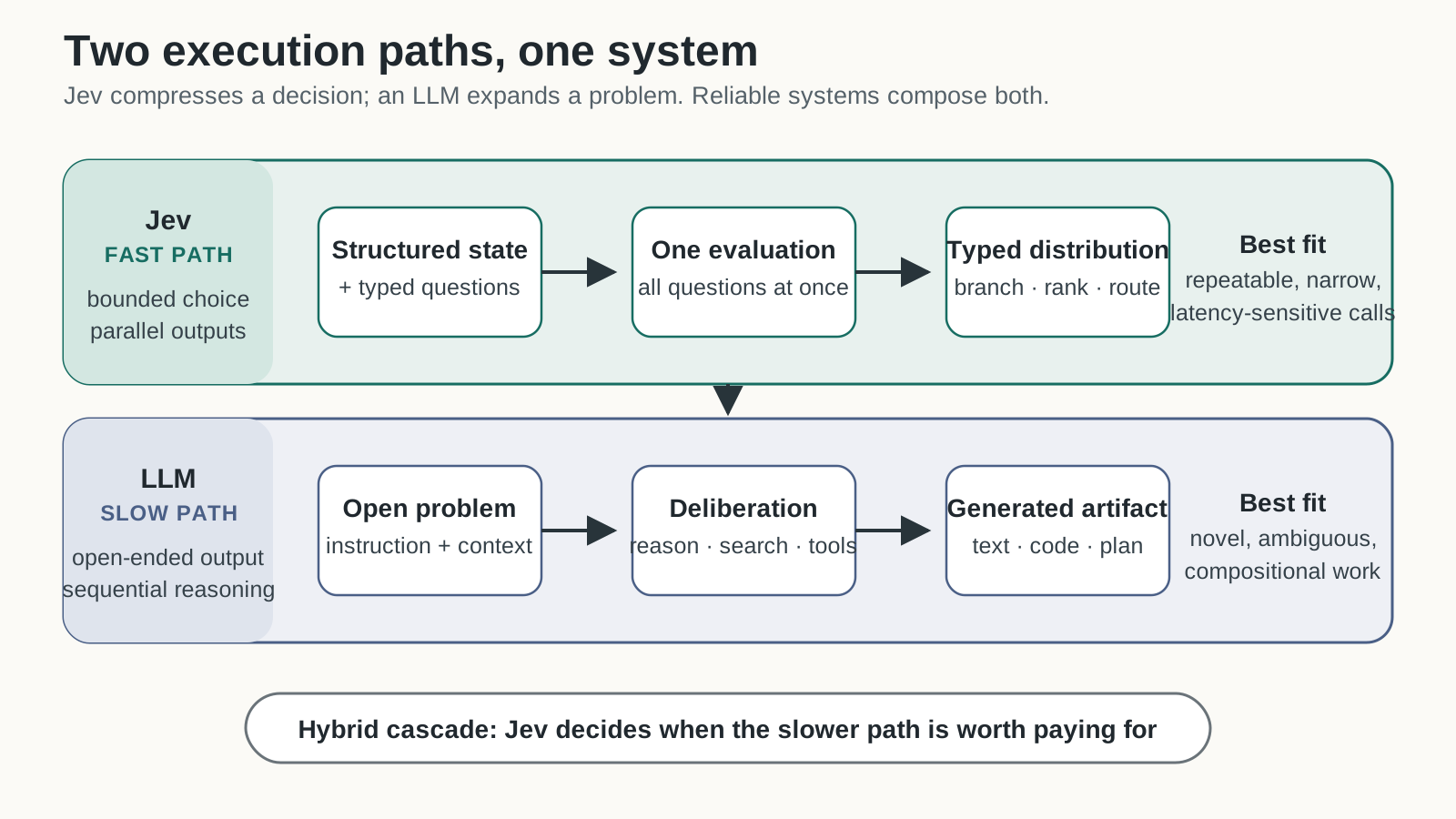 Figure 2. A generative LLM decodes and parses a string; Jev maps a shared state and typed questions to bounded distributions that code can consume. One state can feed parallel Choice, Score, and Noul questions. This is a product-level comparison, not a claim about Jev’s undisclosed internal architecture.
As documented in October 2026, Jev is text-only, performs best in English, supports up to 255 Choice options, and offers a 64k total context window with additional limits involving the state and longest question. The hosted version is jev-1.13.0, with jev-latest as an alias. TypeSafe lists a price of $0.042 per million input tokens, with output free, and dynamic service limits that may change over time (TypeSafe AI, 2026). Those are current service facts, not permanent properties of the model class.
It is equally important to say what Jev is not. It is not a planner, memory system, browser, tool runtime, or complete agent. It has no inherent authority to execute the answer. It does not decide how long an agent may run, which credentials it receives, or whether a human must approve a consequential action. All of that belongs to the harness. Jev can provide a useful judgment inside such a system, but the harness defines the control loop.
Nor should “not an LLM” be interpreted as a verified statement about the hidden implementation. TypeSafe uses the phrase to distinguish Jev’s purpose and output semantics from generative language models. The company has not published the architecture, parameter count, tokenizer, training corpus, or weights. The defensible statement is that Jev exposes a non-generative typed decision interface. Claims about its internal substrate remain speculation.
Why did Jev become popular so quickly?
Jev’s early popularity is easier to understand as a convergence of timing, interface, and economics than as one isolated algorithmic result.
First, the framing is unusually sharp. Generative AI has trained developers to turn every problem into a prompt, request text, parse that text, and hope the model obeyed the schema. TypeSafe asks a provocative question: how many of those calls were actually generation problems? Classification, routing, ranking, checking, and gating are old problems, but agent systems now perform them at unprecedented frequency. “Decisions, not strings” makes a familiar technical distinction feel like a new product category.
There is also direct evidence that the launch converted attention into immediate experimentation. Vercel reported that, within 24 hours of Jev becoming available through AI Gateway, nearly 13% of its paid teams had used it—more than twice the first-day reach of any previous model launch on that gateway. That measures rapid trial inside one distribution channel, not durable production retention, but it explains why Jev suddenly seemed ubiquitous (Vercel, 2026).
Second, latency compounds inside agents. A 1.5-second call may feel acceptable in chat. It is painful inside a loop that makes 100 small judgments, especially when several lie on the critical path. A specialized call that returns in hundreds of milliseconds can change the architecture: developers can afford to check every tool result, route every memory, or run multiple independent safeguards rather than conserving model calls.
Third, a probability distribution can be a better building block for a bounded decision than a brittle parsed answer. It lets software make cost-sensitive choices. A system can accept an easy case, send a medium-confidence case to a larger model, and send a rare high-risk case to a human. This is more operationally useful than a generic statement such as “I am fairly confident.”
Fourth, the launch combined a polished API with memorable demonstrations and large quantitative claims. TypeSafe reported roughly 70–500 ms end-to-end latency, 40–200× speedups in selected comparisons, and very low token cost. The company also presented game and workflow demonstrations that made the interface visible. Those claims still require workload-specific validation, but they are easy to understand and easy to repeat (TypeSafe AI, 2026).
Fifth, the product arrived at the right moment. The field is moving from single-turn assistants toward long-running agents. In that setting, confidence is no longer merely an evaluation concern. It can govern when to spend compute, when to branch, and when to stop. An early literature review counted 28 Jev-related papers in the first nine days after release—evidence of extraordinary interest, though not of scientific consensus (Tang and Zheng, 2026).
Finally, the team narrative matters. TypeSafe’s public biography says CEO Diogo Almeida previously contributed to RLHF and InstructGPT-related work; the founding team also includes Sasha Sheng and Erik Gafni. Pedigree is not an evaluation result, but it increases the probability that researchers and developers will investigate a new system rather than dismiss it as a thin API wrapper (TypeSafe AI, 2026).
There is a broader cultural reason too. Much of modern AI has pursued generality: one model for every task. Jev revives a complementary tradition in machine learning, where a model has a narrow output contract and is judged by decision quality, probability quality, latency, and cost. That “return of the decision model” feels novel precisely because the industry spent several years routing almost every semantic operation through free-form generation.
The anatomy of a typed decision
Consider an agent deciding whether to execute a shell command. The state might include the user request, proposed command, repository policy, current working directory, diff summary, and whether the action is reversible. The system could ask:
Choice: What should the runtime do next?
Options: [execute, request_approval, block]

Score: How consequential is this action?
Rubric: 1 = local and reversible; 5 = external or difficult to recover

Noul: Is the proposed action explicitly authorized by the user?
Jev returns three distributions. A policy—not Jev—then combines them:
if authorization_p < 0.90:
    request_approval()
elif risk_score >= 4:
    request_approval()
elif next_action == "execute" and next_action_p >= 0.95:
    execute_in_sandbox()
else:
    escalate_to_stronger_model()
This example reveals five design decisions that matter more than the syntax.
One: the state is the evidence boundary. If the policy document, user approval, or tool provenance is absent, the model cannot reliably infer it. Fast decisions do not rescue missing state.
Two: the options encode the ontology. A poor option set creates a poor decision even when probabilities are perfect relative to that set. “Execute or block” is less useful than “execute, ask, block” when uncertainty should trigger information gathering.
Three: the rubric anchors meaning. A Score of 4 has no stable meaning unless the caller defines the levels. A good rubric uses observable criteria rather than adjectives such as “somewhat risky.”
Four: probability and policy should remain separate. The model estimates; the application decides. The same 0.82 probability may justify automatic classification of a low-cost document but require human review before a financial transfer.
Five: the fallback is part of the system. Abstention only helps if the fallback has complementary strengths. Routing every uncertain case to an LLM that fails on exactly the same cases adds cost without reducing risk.
This is why the interface is more consequential than “structured output.” JSON mode on an LLM solves formatting. A typed decision model aspires to solve a different problem: produce a useful, low-latency distribution over a declared action space. Whether Jev fulfills that aspiration for a particular workload is an empirical question.
Why can a decision model be so fast?
Autoregressive generation has a sequential cost. To produce $T$ output tokens, a language model repeatedly runs the decoder, samples or selects the next token, extends the key-value cache, and repeats. Even with speculative decoding and optimized serving, a long explanation or chain of thought consumes time proportional to the generated sequence. The output must often be parsed and validated afterward.
A finite decision endpoint can avoid most of the output-generation loop: it returns scores over a bounded answer space rather than decoding a rationale token by token. TypeSafe documents that Jev ingests the state once and evaluates questions in parallel. It has not disclosed whether or how representations, heads, or other internal computation are shared. There is no need to expose a generated rationale as the product output, but the model’s undisclosed internal computation should not be inferred from that interface.
That gives three distinct sources of potential speed:
- Fewer sequential output steps. A distribution replaces a generated response.
- Parallel fan-out across questions. TypeSafe says one ingested state can support many question outputs in parallel, avoiding a separate sequential generation for each answer.
- Possible specialization or internal amortization. A model optimized for bounded decisions may require less capacity or may share internal work more efficiently than a frontier generative model that must also write, code, reason, translate, and converse.
The first two are product-level behaviors documented by TypeSafe. The third is a hypothesis: model size, architecture, representation sharing, and the sampler are undisclosed. We therefore cannot attribute the reported speed to one internal mechanism. Hardware, batching, quantization, geographical distance, concurrency, and service load also affect end-to-end latency.
This matters when comparing with an LLM. A fair benchmark should compare systems that implement the same decision. If the LLM is required to produce a long explanation while Jev emits one distribution, the test partly measures output protocol. If the LLM is evaluated through option logits without reasoning, the test may suppress a capability the LLM would normally use. Both comparisons are informative, but they answer different questions.
The right economic metric is rarely “milliseconds per call” in isolation. It is closer to:
\[\text{cost per useful automated decision at target risk} = \frac{\text{model cost} + \text{fallback cost} + \text{error cost}} {\text{correct cases completed without escalation}}.\]A cheap first-stage model can be valuable even if it is less accurate, provided a score validated on target traffic ranks the cases it can handle and the fallback errors are not perfectly correlated. Conversely, a fast model with unreliable confidence can make a cascade worse by automating precisely the wrong cases.
Calibration, from a metric to an operating contract
Calibration is central to Jev’s story, but it is frequently used as a synonym for “good confidence.” That is too vague. We need to distinguish probability, confidence, correctness, discrimination, calibration, sharpness, and decision value.
Probability, confidence, and correctness are different objects
For a $K$-class decision, let the model output
\[p(x)=(p_1,\ldots,p_K), \qquad \sum_{k=1}^{K} p_k=1.\]The predicted class and top probability are
\[\hat y(x)=\arg\max_k p_k(x), \qquad c(x)=\max_k p_k(x).\]After observing the true label $y$, define correctness as
\[z(x)=\mathbf{1}[\hat y(x)=y].\]The model is top-label calibrated if, informally,
\[P(z=1\mid c=q)=q.\]Among all predictions made with confidence near 0.8, approximately 80% should be correct. This is a statement about a population of comparable cases. It is not a metaphysical guarantee that one particular answer is “80% correct.”
Accuracy and calibration are independent dimensions. A model can be accurate but overconfident: it gets 90% of examples right while assigning 0.999 to almost everything. A weak model can be calibrated but unhelpful: it predicts the base rate for every example. Discrimination asks whether the model separates easy positives from negatives; sharpness asks whether it makes informative predictions away from the base rate; calibration asks whether those probabilities match observed frequencies.
Jev adds another terminological trap. Its documented confidence is not always the raw top probability. For a Choice question with $n$ options, TypeSafe defines
This rescales an even split across the declared options—not the task’s empirical base rate—to zero and a point mass to one. With two options, a top probability of 0.75 produces a reported confidence of 0.5. That concentration statistic is not automatically a comparable probability of correctness across questions or tasks. Score confidence is based on normalized concentration around the modal level, while Noul exposes $P(\text{yes})$ without a separate confidence field (TypeSafe AI, 2026).
If an application gates actions, it must specify which quantity it thresholds: raw option probability, margin, entropy, the documented confidence statistic, a calibrated correctness predictor, or some combination. “Threshold confidence at 0.9” is incomplete until that choice is explicit.
How calibration is measured
The binary Brier loss is
\[\operatorname{Brier}(p,y)=(p-y)^2,\]and its multiclass form is
\[\operatorname{Brier}(p,y)=\sum_{k=1}^{K} \left(p_k-\mathbf{1}[y=k]\right)^2.\]The Brier score is a strictly proper scoring rule: in expectation, the forecaster minimizes it by reporting the true conditional distribution. Negative log-likelihood is also proper, but it penalizes assigning near-zero probability to the realized outcome much more sharply.
Expected calibration error (ECE) bins predictions by confidence:
\[\operatorname{ECE} = \sum_{b=1}^{B}\frac{|S_b|}{n} \left| \operatorname{acc}(S_b)-\operatorname{conf}(S_b) \right|.\]ECE is intuitive but fragile. Its value changes with bin boundaries and bin count. A small global ECE can hide severe miscalibration on a rare class, language, customer, or safety-critical subgroup. Adaptive bins, classwise calibration, reliability diagrams, Brier decomposition, negative log-likelihood, and bootstrap confidence intervals should accompany it. A single decimal is not a calibration audit.
There is also a difference between marginal and joint coherence. A model can be individually calibrated on “Does statement A hold?” and “Does not-A hold?” while assigning probabilities that do not sum consistently across the pair. Early work testing Jev found it more coherent than some LLM probability-readout methods, but still found nontrivial inconsistencies across negations, equivalent question formats, and mutually exclusive labels (Li et al., 2026). Calibration does not imply logical consistency.
Finally, calibration is conditional on a distribution. Let $P_{\text{cal}}$ denote the held-out data used to fit or validate probabilities and $P_{\text{deploy}}$ the live workload. Even perfect calibration on $P_{\text{cal}}$ does not imply calibration after domain, language, temporal, prompt, or base-rate shift:
\[\operatorname{Calibrated}_{P_{\text{cal}}}(p) \not\Rightarrow \operatorname{Calibrated}_{P_{\text{deploy}}}(p) \quad\text{when }P_{\text{cal}}\ne P_{\text{deploy}}.\]How calibration becomes control flow
The operational value of calibrated probability appears in selective prediction. Let a system accept the model’s answer only when a score exceeds threshold $\tau$:
\[a_\tau(x)=\mathbf{1}[c(x)\ge\tau].\]Coverage and selective risk are
\[\operatorname{coverage}(\tau)=P(a_\tau=1),\] \[\operatorname{risk}(\tau) =P(\hat y\neq y\mid a_\tau=1).\]Raising $\tau$ usually lowers coverage and, for a useful score, lowers risk. The complete risk–coverage curve and its area are more informative than accuracy at one arbitrary threshold. In a product, we may instead ask for the maximum coverage satisfying an error budget $\epsilon$:
\[\max_\tau \operatorname{coverage}(\tau) \quad \text{subject to} \quad \operatorname{risk}(\tau)\le\epsilon.\]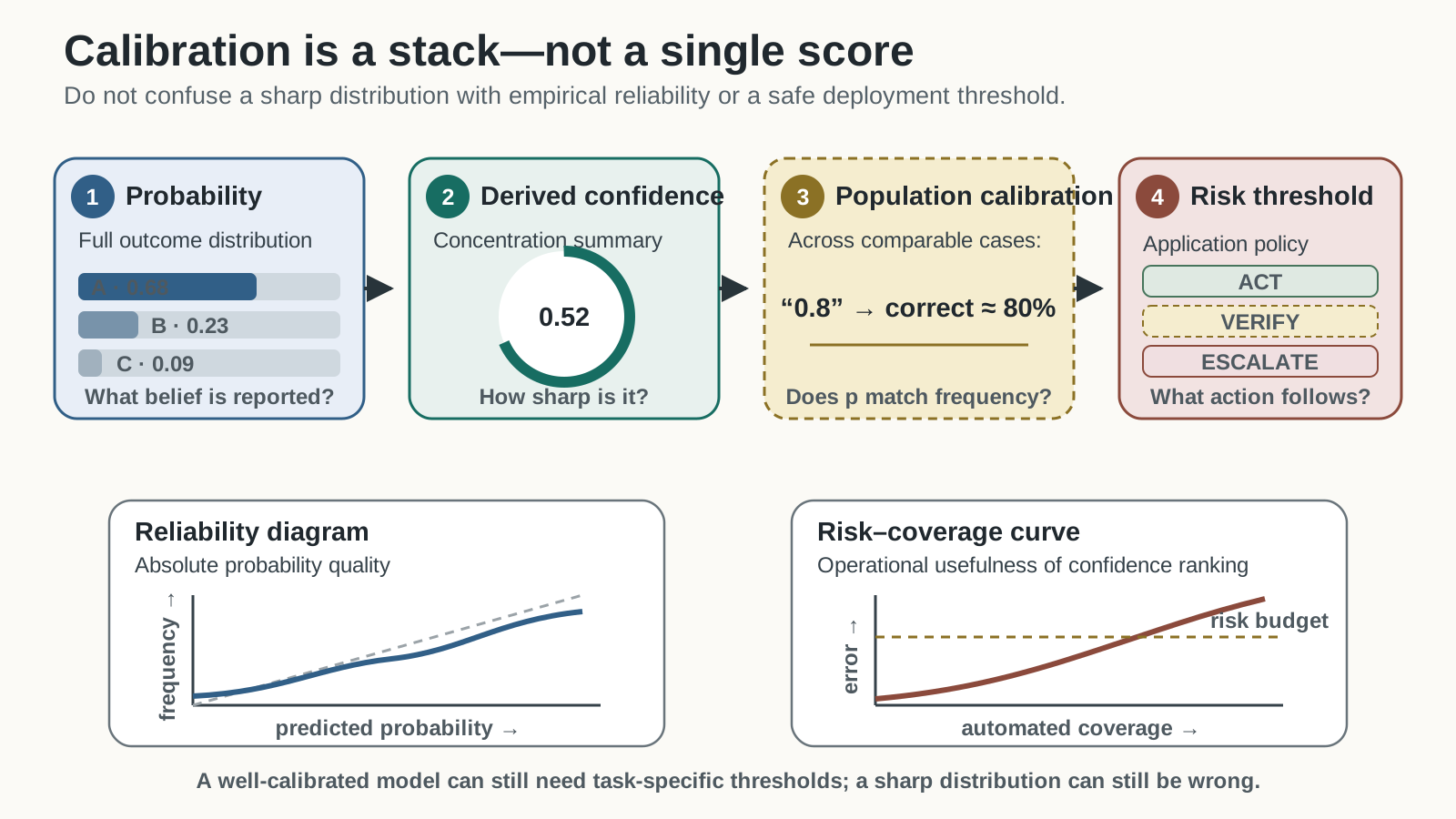 Figure 3. A probability becomes operational only through a full calibration stack: proper evaluation, a validated threshold, a cost-sensitive action policy, a fallback, and drift monitoring. Different actions require different operating points because false acceptance, false rejection, delay, and escalation have different costs.
For asymmetric decisions, the threshold should come from costs rather than convention. Let $p=P(\text{the proposed action is correct}\mid x)$. In a simplified binary case, automatically acting has expected loss
\[L_{\text{act}}(p)=pC_{\text{correct}}+(1-p)C_{\text{error}},\]while escalating has cost $C_{\text{esc}}$. Act only when $L_{\text{act}}(p)<C_{\text{esc}}$. The exact policy may also depend on uncertainty in the calibration estimate, capacity of the human queue, latency budget, and whether the action is reversible.
A production threshold should therefore be:
- fitted on held-out data matching the target workload;
- selected per action and consequence level, not globally;
- evaluated by subgroup, domain, and time slice;
- pinned to model version, question wording, option order, and rubric;
- monitored for drift and periodically recalibrated;
- paired with a fallback whose errors are measured jointly;
- rolled back when the accepted-set risk exceeds the contract.
This is what it means for calibration to become an API. The API does not merely return a plausible number. It supports an explicit policy that can be audited: above this validated threshold, automate; below it, spend more compute or ask for help.
RLCD: what TypeSafe disclosed, and what it did not
TypeSafe expands RLCD as reinforcement learning for calibrated decisions. Its public materials say that Jev combines a new model architecture, parallel sampling, and RL post-training designed for calibrated probability distributions. They do not publish the model size, architecture, training data, reward formula, optimization algorithm, rollout construction, ablations, or calibration procedure (TypeSafe AI, 2026).
One naming warning prevents a great deal of confusion: TypeSafe’s RLCD is unrelated to the 2023 method Reinforcement Learning from Contrastive Distillation, which uses the same acronym for preference-based language model alignment (Yang et al., 2024).
That creates an important evidence boundary:
| Status | What we can say |
|---|---|
| Documented | Jev exposes typed finite distributions; TypeSafe names RLCD, a new architecture, and a parallel sampler. |
| Vendor-reported | Jev is fast, inexpensive, and well calibrated on TypeSafe’s workflow evaluations. |
| Unknown | Exact RLCD objective, architecture, data, model scale, reward, and causal contribution of each component. |
| Independent hypothesis | OpenJev-RLCD shows one plausible way to optimize reasoning policies with a proper scoring rule; it is not TypeSafe’s disclosed method. |
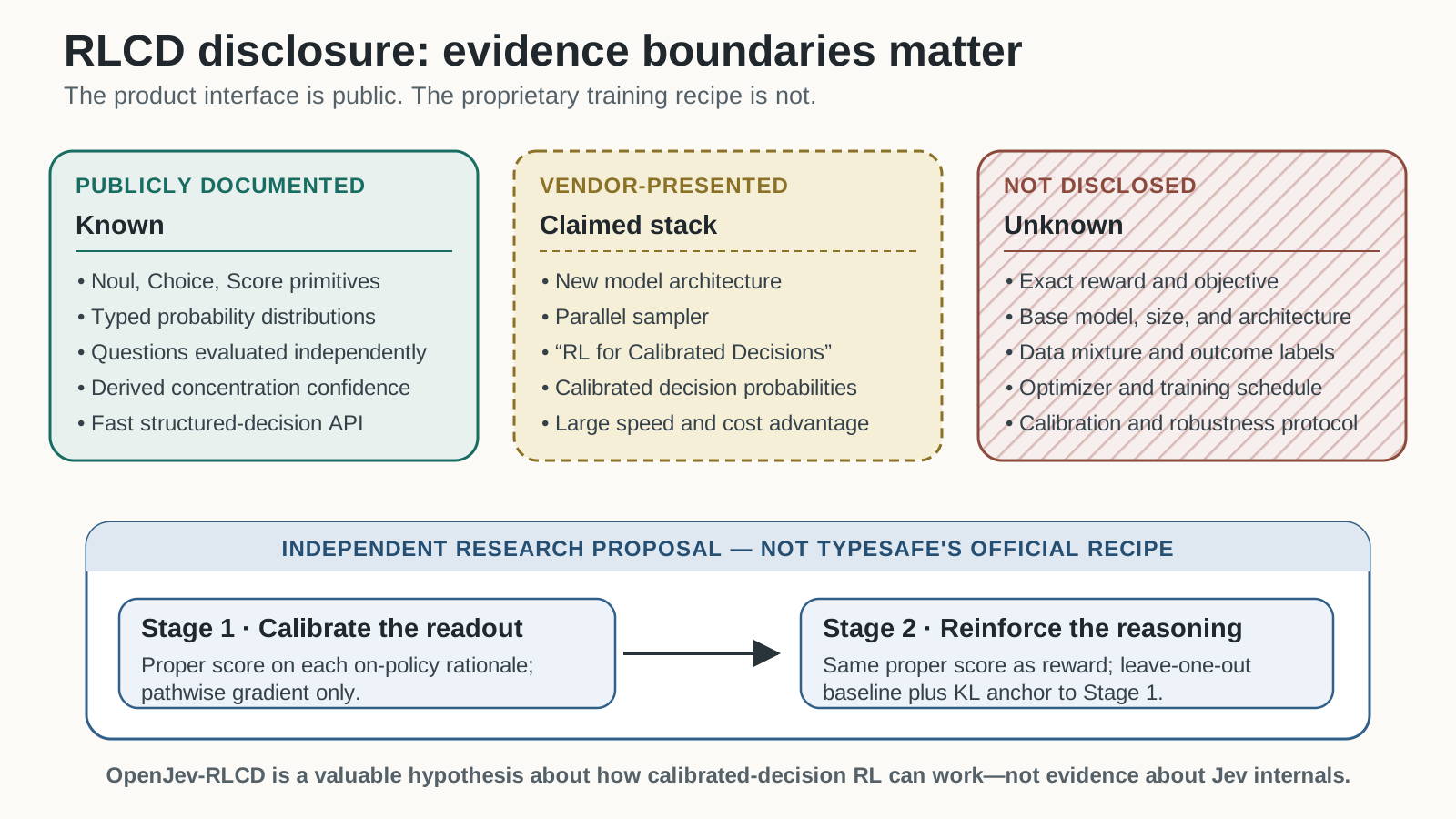 Figure 4. The inner boxes are documented product behavior and vendor claims. The internal training recipe remains closed. OpenJev-RLCD is an independent research proposal and must not be drawn inside Jev’s proprietary pipeline.
This distinction is especially important because an independent paper called OpenJev-RLCD appeared soon after the product launch. It is tempting to reverse-engineer TypeSafe’s method from the name, but the paper does not claim to reveal Jev’s implementation.
OpenJev-RLCD begins with a generative reasoning model. For input $x$, it samples a rationale $r\sim\pi_\theta(\cdot\mid x)$, then reads a distribution $u_\theta(x,r)$ over answer-option tokens. It proposes a shifted negative Brier reward for realized answer $y$:
\[J(u,y)=2u_y-\|u\|_2^2 =1-\|u-e_y\|_2^2.\]Like the negative Brier score, this is a strictly proper reward: in expectation it rewards reporting the true conditional distribution. The paper highlights a subtle variance identity. Extending the reward to a target distribution $q$, where $J(u,q)=2u^\top q-\lVert u\rVert_2^2$,
\[J(\mathbb{E}_r[u],q) = \mathbb{E}_r[J(u,q)] + \mathbb{E}_r\|u-\mathbb{E}_r[u]\|_2^2.\]If we score the mixture across sampled rationales, the last term rewards disagreement. With one-hot outcomes, that can behave like ordinary correctness reward plus a diversity bonus. Diversity is not always epistemic uncertainty; it may simply reflect unstable reasoning. OpenJev therefore scores each rationale’s distribution rather than rewarding the aggregated mixture.
The authors report that naive end-to-end optimization has two failure modes. First, the policy can collapse toward empty or minimal rationales—a “System-One collapse”—unless it is anchored to the base reasoning policy. Second, the score-function gradient through sampled reasoning is much noisier than the pathwise gradient through the probability readout. Their two-stage recipe is therefore calibrate, then reinforce:
- Sample on-policy rationales but update the probability readout with the proper score.
- Start from that calibrated checkpoint and reinforce the rationale policy with proper-score reward, a leave-one-out baseline, KL anchoring, and a down-weighted score-function term.
On Qwen3-1.7B, the paper reports similar GSM8K-Verify accuracy to GRPO but substantially better coverage at a 5% selective-risk target. It also reports gains on MMLU-Pro. This is useful evidence that correctness-only RL can produce a poor ranking of uncertainty and that a proper-score objective can improve selective behavior. It is not yet a general result: the experiments use one small model family, limited tasks and training steps, and three seeds (Gao and Wang, 2026; code).
There is also a deeper question: why use reinforcement learning at all for a direct finite scorer? If no latent trajectory or delayed interaction is involved, minimizing supervised Brier loss or cross-entropy on labeled data can yield the same expected optimum with lower variance. RL becomes more compelling when the distribution depends on sampled reasoning, the action changes the observations, the label arrives after a trajectory, or the system must learn which information-gathering action improves the final decision. The OpenJev paper itself finds that direct proper-score RL does not automatically beat ordinary supervised training. “RLCD” is therefore not a magic synonym for calibration; the benefit depends on where the stochastic policy and feedback enter.
The surrounding research landscape
Jev did not appear in an intellectual vacuum. It sits at the intersection of calibrated classification, constrained generation, selective prediction, reinforcement learning with verifiable rewards, uncertainty-aware agents, and model distillation. The interesting question is not whether every ingredient is unprecedented. It is how those ingredients are assembled into an interface that developers can use.
RLVR: optimize correctness, not confidence
In reinforcement learning with verifiable rewards (RLVR), a reasoning policy samples an answer or trajectory and receives a reward such as unit-test success, exact mathematical correctness, or task completion. Group-relative methods such as GRPO increase the probability of successful samples. This can improve pass@1 and reasoning behavior, but a binary correctness reward does not force the model’s reported confidence to match its empirical success rate. A policy can become both more accurate and more overconfident.
More fundamentally, pass@1 answers a different question from calibration. Pass@1 estimates how often one sample succeeds. Calibration asks whether the model knows which samples are likely to succeed. The latter is what enables selective automation and compute allocation. Two models can have the same pass@1 yet very different value inside a cascade if one accurately separates easy from hard cases.
RLCR: teach a reasoning model to verbalize confidence
Reinforcement Learning with Calibration Rewards (RLCR) retains a generative reasoning model. The model emits an answer $\hat y$ and a scalar confidence $q$. A simplified version of its reward is
\[R_{\text{RLCR}} = \mathbf{1}[\hat y=y] - \left(q-\mathbf{1}[\hat y=y]\right)^2.\]The first term preserves pressure for correctness. The second is a Brier-style calibration term. The accuracy term is important: if the system optimized only calibration error, a degenerate policy could intentionally answer badly and report zero confidence. The RLCR paper reports large ECE reductions on HotpotQA and mathematics without a loss of average accuracy, including some out-of-distribution improvement, while also finding that contradictory answers can remain highly confident (Damani et al., 2025; project).
RLCR and Jev therefore solve related but different interface problems. RLCR teaches a generative model to report a self-assessment alongside reasoning. Jev directly returns a finite distribution and does not expose generated reasoning. The first is suitable when the output itself must be open-ended; the second is optimized for a bounded decision that software will consume.
CaOPD: correct privileged-teacher certainty during distillation
Calibration-aware On-Policy Distillation (CaOPD) addresses a different mismatch. A strong teacher may receive a reference solution, privileged context, or information unavailable to the student at deployment. If the student distills the teacher’s confidence literally, it learns certainty appropriate to the teacher’s information—not its own. This creates optimism and entropy collapse even when the transferred reasoning is valuable.
CaOPD estimates the student’s deployment-time success from $K$ on-policy rollouts:
\[\hat\mu(x)=\frac{1}{K}\sum_{k=1}^{K}R(x,a_k),\]where $R$ is a verifier and $a_k$ are student samples. It preserves the teacher’s trajectory or reasoning target but replaces privileged confidence targets with $\hat\mu(x)$, then performs standard on-policy distillation. In short, it decouples what to do from how certain the deployed student should be. It does not require a separate calibration-reward RL stage (Zhang et al., 2026c; code).
The trade-off is additional training compute and verifier dependence. A small $K$ produces quantized and noisy targets; a large $K$ is expensive. Verbalized confidence can also be malformed or strategically generated. Jev’s typed distribution avoids parsing failures, but it does not eliminate the deeper problem of calibrating to the information and distribution available at deployment.
ACC and AUQ: move from atomic answers to long trajectories
Agentic Confidence Calibration (ACC) asks for the probability that an entire agent trajectory will succeed. The paper proposes Holistic Trajectory Calibration (HTC), which uses process-level signals—not only the final answer—to estimate trajectory success. This matters because a long-horizon agent can be locally confident at every step while the probability that the complete plan succeeds declines multiplicatively or through correlated hidden errors (Zhang et al., 2026a).
Agentic Uncertainty Quantification (AUQ) makes the estimate actionable. Uncertainty can determine which memory is retrieved, whether the agent reflects, where it revisits a decision, and when it requests help. Rather than append a confidence number after completion, AUQ changes the trajectory while it is still recoverable (Zhang et al., 2026b). This aligns with the broader shift from passive uncertainty measurement to active uncertainty-guided computation surveyed in recent work (Zhang et al., 2026d).
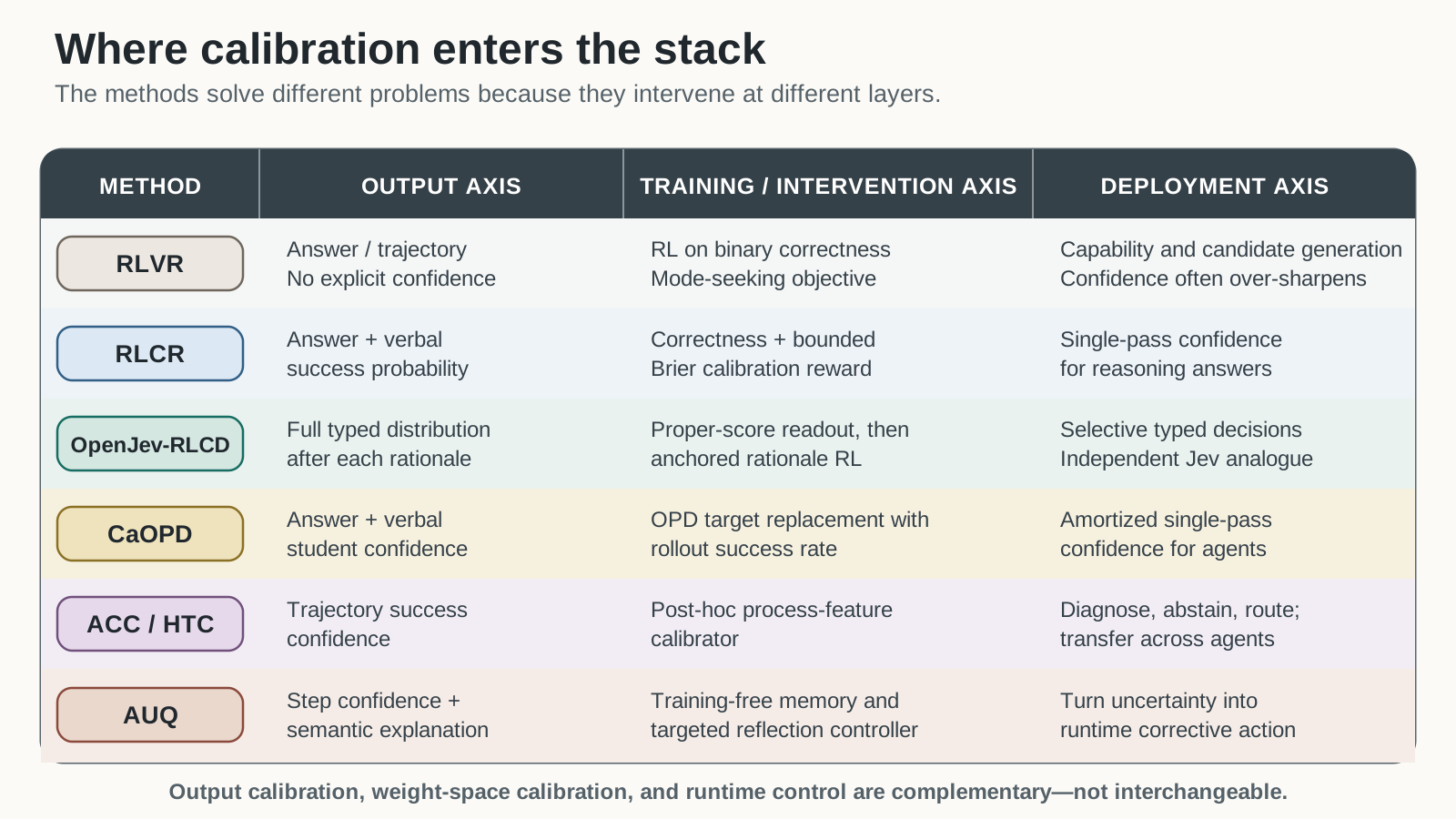 Figure 5. RLVR optimizes success; RLCR adds a calibration reward to generative reasoning; OpenJev-RLCD optimizes option distributions conditioned on sampled rationales; CaOPD corrects certainty during distillation; Jev exposes native typed distributions; ACC and AUQ move from atomic answers toward trajectory-level control.
The comparison is easiest to summarize as follows:
| Method | Primary output | Calibration target | Main training mechanism | Horizon |
|---|---|---|---|---|
| RLVR / GRPO | answer or trajectory | none explicitly | verifiable correctness reward | answer to trajectory |
| RLCR | reasoning + verbal confidence | correctness of generated answer | accuracy + proper-score RL reward | answer |
| OpenJev-RLCD | rationale-conditioned option distribution | option correctness | two-stage proper-score training and RL | answer |
| CaOPD | distilled reasoning + confidence | student on-policy success rate | reverse-KL on-policy distillation | answer / rollout set |
| Jev | typed finite distribution | proprietary / undisclosed | TypeSafe says RLCD; recipe unknown | atomic decision |
| ACC | trajectory-success probability | final trajectory outcome | trajectory-level calibrator | full trajectory |
| AUQ | adaptive agent behavior | uncertainty-conditioned improvement | memory and reflection control | full trajectory |
The key conceptual progression is not “which acronym wins.” It is:
measure uncertainty
    → calibrate it
    → use it to abstain
    → use it to allocate computation
    → use it to change the trajectory
    → learn from the intervention outcome
Jev provides an unusually clean primitive for the middle of this chain. A complete agent still has to implement the rest.
What does the evidence actually show?
Because Jev is new and closed, the evidence is unusually time-sensitive. An evidence-aware census last verified on October 3 counted 77 Jev-specific or Jev-style academic preprints, up from 28 papers in the first nine-day audit (Awesome JEV Papers, 2026). Volume is not maturity: nearly all study one hosted release window, many reuse public benchmarks, and the census identified these academic items as preprints rather than peer-reviewed publications. The useful layers are TypeSafe’s launch evaluation, broad independent benchmarks, targeted controlled audits, and system-level applications. None supports a universal claim that typed decision models dominate LLMs.
Vendor evidence
TypeSafe reports end-to-end latency around 70–500 ms and large speed and price advantages over selected LLM-based workflow baselines. One headline comparison reports as much as 193.6× faster and 444.6× cheaper. The company is more candid about limitations than the headline alone suggests: its launch material notes that compact, dense states can favor Jev; some reference labels are formed from LLM judgments rather than human gold; the workflows were constructed by its own capabilities team; and forcing general LLMs through the same adapter may not represent their best use. The public price also does not reveal whether current economics are subsidized or durable (TypeSafe AI, 2026).
These results show that the service can be fast and cheap on TypeSafe-selected workloads. They do not isolate whether its accuracy or calibration comes from the architecture, training data, RLCD, model scale, task selection, or serving stack.
A large independent benchmark
An early independent study sent 346,009 requests across 37 public datasets using one frozen template per dataset. It reports 217.9 million input tokens at a total API charge of $9.15 and mean client-side latency of 0.36 seconds at concurrency 32. Jev achieved 95–99% accuracy on IMDB, SST-2, HellaSwag, and ARC, and 86.7% on the 122-language Belebele benchmark. Under a single-forward comparison based on exact option probabilities, it beat Qwen3.8-27B on 27 of 37 datasets and Gemma-4-E4B on all 37 (Deußer et al., 2026).
The calibration results are more informative than the aggregate accuracy. The paper reports pooled Choice ECE of 0.028 over 22 datasets, median per-dataset ECE of 0.028, and mean per-dataset ECE of 0.061. Those summaries conceal large failures: Emotion ECE was reported at 0.279 and AfriXNLI at 0.165. Noul had ECE of 0.052 and often required a task-specific threshold; tuning the threshold on training data reportedly raised UNFAIR-ToS micro-F1 from 0.50 to 0.75.
Selective prediction looked promising. At 50% coverage, accepted-set accuracy reportedly rose from 79.7% to 96.3% on Banking77, 81.5% to 98.2% on SIB-200, 73.9% to 86.9% on ANLI, and 58.5% to 73.3% on Emotion. That is the kind of result a decision API needs, subject to the threshold transferring to target traffic: the score identifies easier cases even when absolute task performance is imperfect.
However, the experimental design favors a narrow interpretation:
- comparator LLMs did not use generated reasoning;
- each dataset used one template and one main run, so prompt and run variance are unknown;
- benchmark contamination cannot be excluded for any closed model;
- threshold tuning used labels and may not transfer under shift;
- performance remained weak on several low-resource, fine-grained, noisy, legal, and rubric-heavy tasks;
- strong results on old public benchmarks do not establish performance on private operational data.
The fairest conclusion is that Jev appears to offer an unusually strong speed–cost–accuracy point for many bounded semantic decisions, with useful but heterogeneous confidence quality. It is not evidence that reasoning is unnecessary.
Early evidence synthesis and domain studies
An evidence review covering the first nine days of publications reaches a similarly cautious verdict. It finds median single-call latency commonly in the 0.15–0.45 second range and dramatic cost advantages in some studies, but no controlled evidence that the typed interface itself improves accuracy over a matched label-logit readout. Raw calibration varies by workload: post-hoc recalibration improves some tasks substantially; high confidence can coexist with near-base-rate accuracy; and wrong tool calls can remain confident (Tang and Zheng, 2026).
An early matched preprint across trained classifiers, decision-model checkpoints, and generative comparators reinforces the condition-dependent picture. Small supervised classifiers were best on some labeled intent tasks; a larger generative comparator was level with Jev on workflows and intents and accepted more workflow cases at 5% risk. A held-out gate targeting 5% in-scope risk still accepted 31% of out-of-scope requests. Yet a cheap classifier-first cascade escalating to Jev matched Jev’s accuracy at about 43% of its estimated cost under the paper’s utilization assumptions. The practical lesson is not that one model class wins, but that labels, output space, risk target, and cascade design determine the frontier (Rafe and Das, 2026).
A medical preprint reports ECE of 0.063 on MetaMedQA compared with 0.146 for its comparator, and 93.4% accuracy among examples assigned at least 0.9 probability. On DiagnosisArena, however, Jev’s reported AUROC was only 0.645 versus 0.768 for the comparator. Median latency was roughly 0.27–0.31 seconds and 2,823 items reportedly cost $0.08. This is intriguing evaluation evidence, not support for autonomous clinical use (Madrid-García and Merino-Barbancho, 2026).
The probability-coherence study mentioned earlier offers another warning. On 480 negation pairs, it reports mean
\[|P(X)+P(\neg X)-1|=0.064\]for Jev, better than two Qwen readouts in that setup but still far from exact coherence. Across three mutually exclusive labels, Jev’s yes probabilities summed to 1.14 on average, and the same label differed by roughly 0.09 between Noul and Choice formulations. It is a small, unreviewed experiment, but it demonstrates why independent question answering cannot be assumed to define a globally consistent probability model (Li et al., 2026).
Four tests that a calibrated decision system must pass
The October wave of papers made one conceptual distinction impossible to ignore. “Is the model calibrated?” is not one question. It is at least four:
- Marginal calibration. Among decisions reported near 0.8, is the selected option correct about 80% of the time on the target distribution?
- Self-knowledge. Does confidence fall when the necessary information is absent, out of date, or beyond the model’s knowledge boundary?
- Probabilistic coherence. Do equivalent questions, complements, hierarchies, and coarsenings describe the same event with compatible probabilities?
- Decision utility. After probabilities pass through thresholds, defer costs, cascades, and authority rules, do they produce better actions?
Passing an earlier layer does not imply passing the next one. A model can be calibrated on average while remaining confident on an unknown fact. Two individually calibrated interfaces can disagree about the same event. A better Brier score can leave a thresholded action unchanged—or move it across the wrong boundary. Conversely, a slightly worse forecaster can be more useful at one operating point if it ranks the cases that a fallback can actually fix.
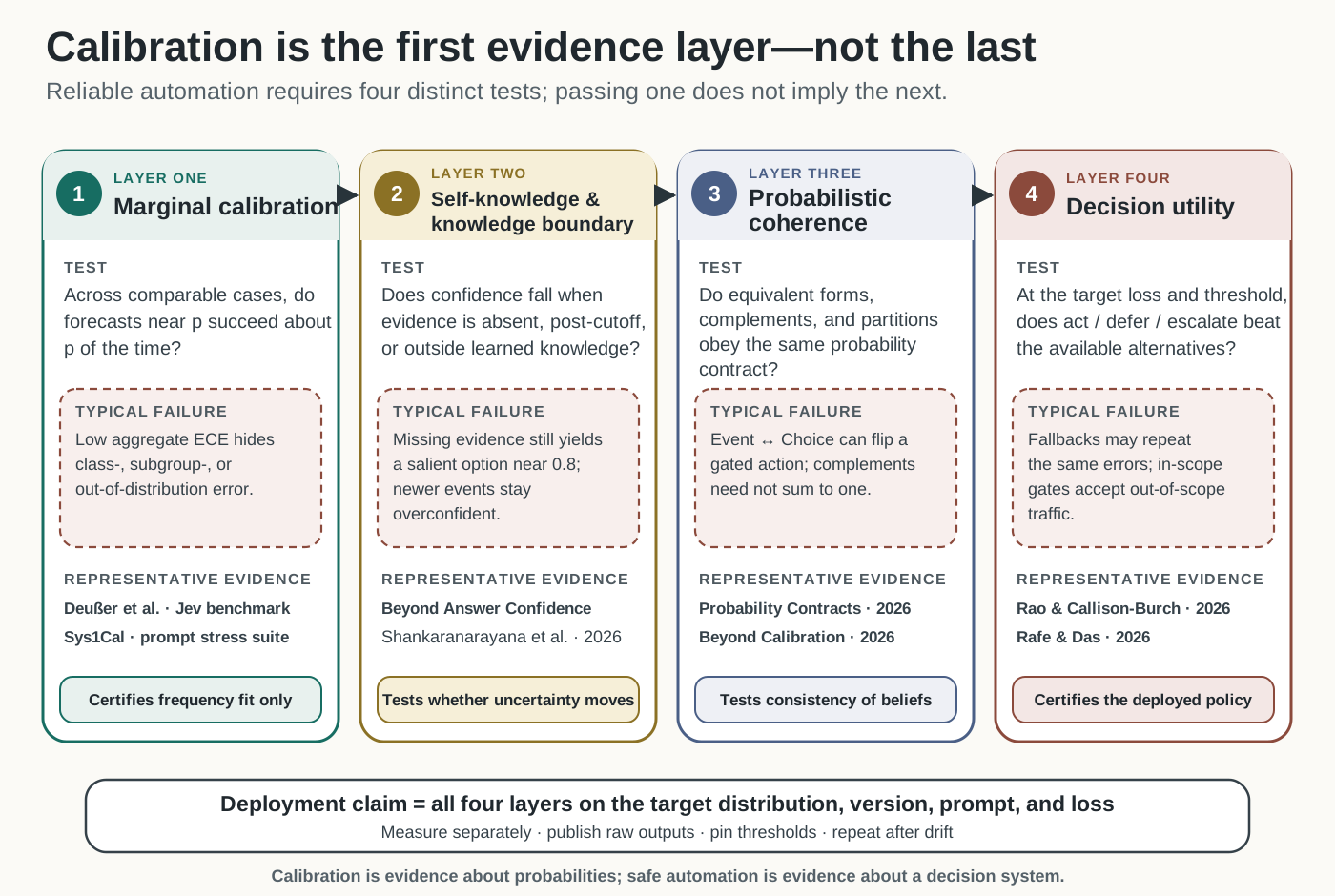 Figure 6. Calibration is the first rung, not the whole ladder. Deployment requires self-knowledge under missing information, coherence across equivalent representations, and utility under the actual policy. Representative papers are placed by the strongest question they directly test, not by their authors’ broader claims.
This framing clarifies several seemingly contradictory results:
- Confidence is not a detector of missing knowledge. A controlled audit spanning more than 15 public datasets and six generated task families reports that Jev assigns as much as 0.80 to a salient option when no answer-relevant information is available. On news beyond an observed knowledge boundary, confidence exceeds accuracy by 0.21–0.33, and recalibration on earlier months does not close the gap. A targeted question—is the supplied evidence sufficient?—was more diagnostic than answer confidence itself. This is not a proof that a second question always works; the same study shows that “do you know?” can merely read surface cues (Shankaranarayana et al., 2026).
- A valid distribution can still violate a probability contract. In 1,000 exact finite worlds, Jev’s Event and Choice interfaces induced different binary actions on 32.8% of valid matched pairs at a defer cost of 0.10. The lesson is not to average every disagreement. It is to define the event, loss, and interface before deployment and test the complete mapping from report to action (Chen and Li, 2026).
- Flat and hierarchical decisions need not add up. Across TREC, CLINC150, and MASSIVE, hierarchical reconstruction changed Jev’s category-level distributions by total variation 0.219–0.349. On CLINC150, the reconstructed distribution reduced accuracy by 22.9 percentage points even though both routes were intended to describe the same fine label. A taxonomy is therefore part of the model contract, not a harmless UI detail (Joy, 2026).
- Evaluation and simulation are different capabilities. Jev answers 99% of the Cognitive Reflection Test lure questions in one study, yet struggles when one call must both predict a hidden state and evaluate actions using that prediction. Supplying a simulated opponent action raises performance from 33% to 98% on the misleading game condition; code lookahead raises solved ALFWorld games from 31% to 87%. The useful abstraction is therefore code owns state transition and simulation; the decision model evaluates bounded candidates (Yang et al., 2026).
- An explicit fallback option is not automatically understood. On a controlled arithmetic task, another study reports 99% accuracy when the answer is present but only 7% correct rejection when it is missing. A threshold fitted on an independent development set raises rejection to 79% while retaining 97% answer-present accuracy. “None of the above” needs data, policy, and validation; adding a label is not enough (Zhong et al., 2026).
A quality-weighted map of the direct evidence
The table below is deliberately selective. Stronger means broad or well-controlled for the stated question, with uncertainty analysis and a usable artifact where possible. Useful means the result is informative but narrower or has an important labeling/comparator limitation. These labels are my assessment of study design; every direct Jev study below is still a recent preprint.
| Study | What it tests | Scale / control | Main signal | Weight and boundary |
|---|---|---|---|---|
| Broad Jev benchmark | accuracy, calibration, latency, cost | 37 datasets; 346,009 requests; exact Qwen/Gemma option-likelihood baselines | strong speed–cost point; calibration and accuracy vary sharply by task | Stronger for breadth; one template/run, public-data contamination possible |
| Automated decision gates | matched gates and cascades | 8 checkpoints, 6 families, classifiers and LLMs; held-out thresholds; bootstrap | classifiers win with labels; LLM readout can match Jev; a cheap cascade can reach the frontier | Stronger for matched comparison; several labels are proxies, not production gold |
| JevAdvBench | adversarial state sensitivity | 812 questions, 66 scenarios, 9,744 edits; controls and released outputs | irrelevant or manipulative context can redirect or suppress confident decisions | Stronger robustness design; most labels originate from clean Jev outputs |
| LLM2Jev | whether a special architecture is necessary | Qwen3.5-4B and Qwen3-0.6B; training-free and fine-tuned readouts; ablations | a strong 4B LLM is already competitive; tuning helps weak or targeted cases and can transfer negatively | Useful–strong architecture evidence; public JevBench diagnostics, no proprietary matched backbone |
| Beyond Answer Confidence | missing knowledge and information sufficiency | 15+ datasets, 6 controlled task families, paired interventions | answer confidence does not reliably expose ignorance; targeted evidence questions help | Stronger black-box audit; targeted probes also require cue controls |
| Probability Contracts | exact posterior, coherence, decision loss | 1,000 finite worlds; four interface configurations | interface disagreement often changes downstream action | Stronger internal validity; synthetic finite worlds limit external validity |
| Do Decisions Add Up? | flat vs. hierarchical consistency | 2,500 matched examples per system across three datasets; 72K questions | equivalent decompositions can yield materially different distributions and accuracy | Stronger coherence evidence; three classification datasets only |
| Agent security decisions | allow/block/review under attack shift | Jev, Laya, Decider, Nimble, classifiers and LLM judges across security tasks | aggregate calibration hides group failures; strict risk limits automate little; judges share confident errors | Useful–strong policy analysis; benchmark security is not a live threat model |
| OmniMed-Jev | decision-native vs. generative multimodal training | same 4B backbone, 23,558 states and 3,685 steps; 726 held-out states | similar point accuracy and much better reported calibration; generative arm remains better at counting | Useful matched schedule; typed arm receives 155,729 factorized targets, a supervision-density confound |
| Code Owns the Simulation | direct evaluation vs. hidden-state simulation | CRT, matrix games, ALFWorld, robot control | explicit simulation or lookahead converts many failures into strong bounded decisions | Useful–strong capability boundary; one model version and constructed settings |
| OpenJev-RLCD | one open proper-score training recipe | Qwen3-1.7B, two main reasoning tasks, three seeds, multiple baselines | calibrate-then-reinforce improves selective prediction | Useful method artifact; not a reconstruction of TypeSafe’s proprietary RLCD |
Two findings deserve special emphasis. First, LLM2Jev weakens the claim that a new decision architecture is required. It scores bracketed numeric candidate suffixes directly from a causal LM, shares the prompt computation, and adds a tree-factorized listwise objective plus KL anchors only when adaptation is needed. The 4B backbone is already a capable decision model; more indiscriminate short-input training can hurt long items, while adding long-input data mostly recovers the loss. That is a much more nuanced result than “fine-tuning wins.”
Second, OmniMed-Jev gives one of the cleanest interface-controlled comparisons but also shows how easily “same data” can hide different supervision. Both arms see the same 23,558 images, yet the typed arm factorizes multi-label annotations into 155,729 decision targets while the generative arm receives one answer target per state. The calibration result matters; the experiment does not isolate interface from supervision density. This kind of accounting should become standard.
The evidence ledger is therefore:
| Claim | Current support | Confidence |
|---|---|---|
| Jev is inexpensive and low latency | official pricing plus multiple early measurements | relatively strong for the current hosted service |
| Jev is competitive on many finite-choice tasks | broad early benchmark, vendor workflows | promising, workload dependent |
| Raw probabilities are universally calibrated | contradicted by per-task variation | unsupported |
| Answer confidence reliably detects missing knowledge | controlled information and temporal-boundary audits contradict it | unsupported without a separate evidence-sufficiency test |
| Equivalent interfaces define one coherent belief state | complement, hierarchy, coarsening, and Event/Choice studies contradict it | unsupported |
| A specialized typed head is required | frozen LLM readouts and trained classifiers often match or beat typed models | unsupported as a general claim |
| RLCD causes the observed calibration | no public ablation or recipe | unknown |
| Jev replaces generative LLMs | output contract cannot cover open-ended work | false as a general claim |
| Confidence can improve cascades | selective prediction results and established theory | supported when thresholds transfer and fallbacks complement |
| Code should simulate while Jev evaluates supplied alternatives | one multi-domain controlled study plus systems intuition | promising, not yet a universal law |
The open Jev ecosystem
Jev has already become more than one product name. It now describes an interface family: read a state, evaluate a caller-defined finite set, return a normalized distribution, and let code own the action. That interface does not determine an architecture. Open projects implement it with frozen LLM logits, LoRA-tuned decoders, encoder classifiers, custom pointer heads, joint-embedding models, multimodal prefix sharing, and rationale-conditioned RL.
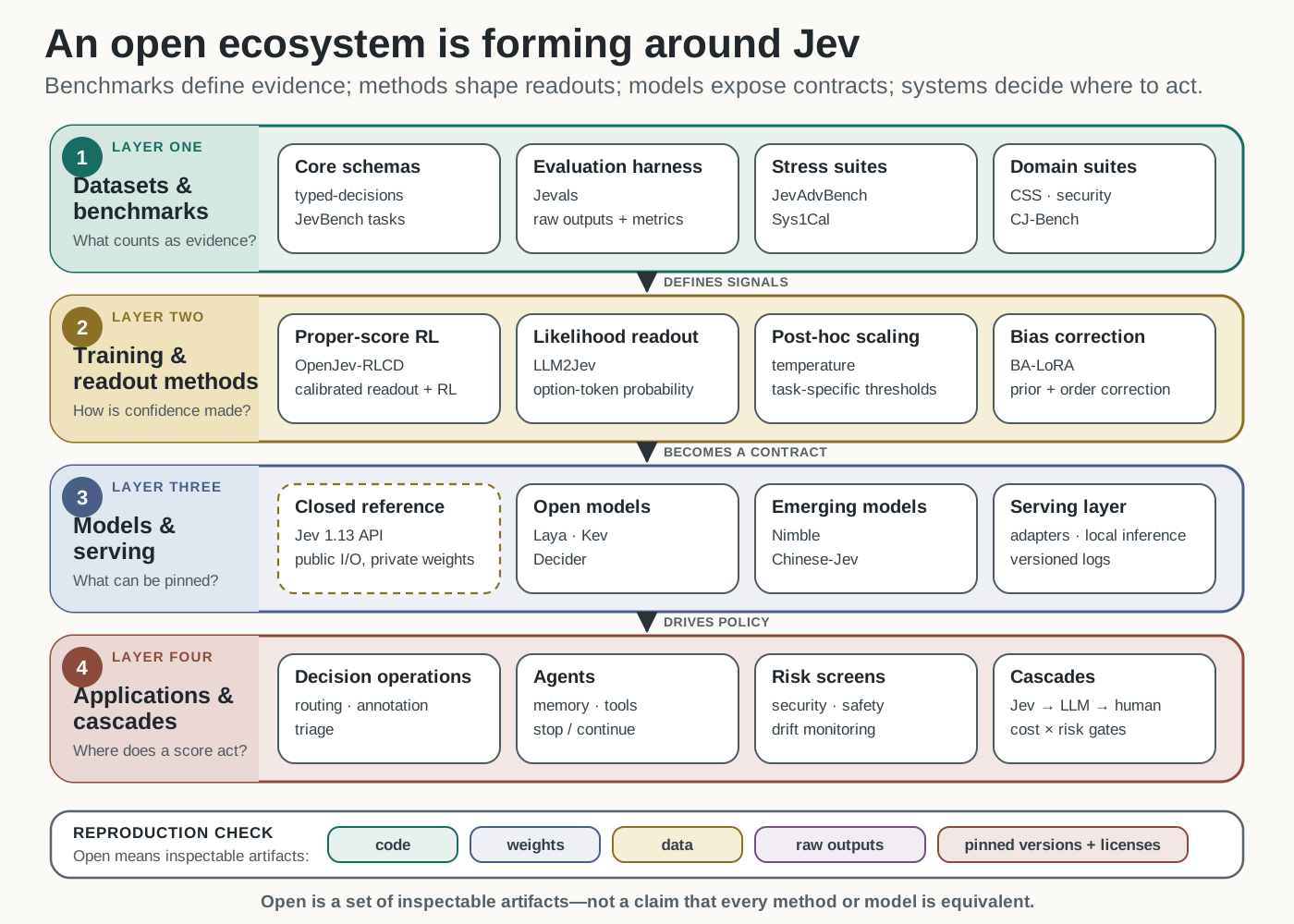 Figure 7. The public ecosystem is a stack, not a single model family. Datasets and evaluation contracts sit below readout and training methods; models and runtimes expose the typed interface; cascades and applications decide whether the probabilities create value. A project may occupy several boxes.
Four implementation families
The projects are easiest to understand by where the decision distribution comes from:
- Frozen decoder readout. Format options as letters or numeric identifiers and read their next-token probabilities from an ordinary causal LM. SemIf, Cygnet, and the training-free half of LLM2Jev show how far this can go. It is fast to port to a new backbone and preserves generation, but remains sensitive to option tokens, ordering, prompt format, and tokenizer structure.
- Adapted decoder readout. Fine-tune the same backbone—often with LoRA—on decision data, hard negatives, teacher questions, replay, and calibration objectives. JevK5, Plumb, Decider, and the tuned LLM2Jev recipe live here. Adaptation can improve a known weakness; it can also teach benchmark structure, damage long-input behavior, or overfit a public suite.
- Encoder or custom decision head. Encode state and question, then score options with a classifier, pointer, joint-embedding, or value-of-information head. Laya, Kev, PACT, Bongard, Chinese-Jev, and LAVOIR explore this design space. It can be small and fast, but open-domain transfer depends heavily on training coverage.
- System composition. Keep simulation, retrieval, hard policy, and expensive reasoning outside the decision model. AnyJev, JEVDB, Mnemon, confidence cascades, and security gates make the surrounding algorithm as important as the checkpoint.
Open models and methods worth reading
“Open” can mean code, weights, a training recipe, an evaluation harness, or all four. The table says what is actually available and avoids treating an author-run public score as an independent reproduction. Adoption figures are a dated October 4, 2026 snapshot; stars, likes, and rolling downloads measure attention, not technical quality.
| Project | Backbone / artifact | Mechanism | Open status | Best public signal | Important boundary |
|---|---|---|---|---|---|
| SemIf, formerly OpenJev | runtime over frozen causal LMs; default Qwen3.5-4B | option-token logits, shared state prefill, parallel question suffixes | MIT code; upstream model license; ~4.7K stars | author reports 20.03 decisions/s on a 37×21 prefix-reuse workload | no project checkpoint; BF16 fast path has small argmax drift; not a Jev training reproduction |
| OpenJev 27B | tuned Qwen3.5-derived 27B weights | first-position decision readout with fixed calibration | CC BY-NC 4.0 weights; Apache helper/server; ~5K monthly downloads | author reports 84.0% vs. hosted Jev 85.4% on 10K text questions | 3,078 items influenced development; training recipe/data are not public; noncommercial license |
| open-alternative-jev | runtime over frozen LMs; reported Qwen3.6-27B test | next-token option probabilities; packed questions or prefix-cached requests | Apache-2.0 library; ~62 stars | RACE-H 1K: 92.9% packed vs. 92.6% one-at-a-time; speed gain from batching | documents packing interference, position bias, and weak sub-4B behavior; no new weights |
| Cygnet | frozen Gemma-4-12B-it | one-pass letter logits plus one fitted temperature | MIT recipe/shim/calibration assets; no new weights or adapter | 203/231 (87.9%) on author-run public JevBench; A6000 p50 66 ms | near ties can change with hardware/batching; >20-option multi-pass calibration is under-tested |
| JevK5 | Qwen3.5-4B/9B merged LoRA weights | teacher-distilled questions, double-checking, replay, letter logits | Apache-2.0 code/weights; ~134 stars | v0.3 public hard 78.4%, ECE .054 | v0.3 is not significantly better than v0.2 in the reported paired test; public suite was inspected during development |
| Plumb-4B | JevK5 v0.2 + independent 4B LoRA | teacher generation, consistency filtering, hard mining, long documents, public replay | Apache-2.0 recipe/weights | v5 public hard 80.2%; 8 fixes/1 regression vs. start, exact McNemar p=.039 | iterative public-suite optimization; v5 accuracy rises while ECE worsens vs. v4 |
| reflex | stable path uses frozen Qwen3.5-4B; browser demo 0.8B | evidence/criterion prompt; both yes/no orders averaged | MIT runtime/experiments | stable 4B public hard 68.5%, ECE .081; 27B hard 76.6% | valuable negative result: generic adapters hurt open judgment; two-order averaging is not one read |
| Decider | Qwen3.5 0.8B/2B/4B/35B-A3B plus Gemma-4 12B family | family-specific CE/SFT/LoRA recipes and prefix caching | Apache-2.0 code, weights and server | reported held-out accuracy rises from .784 at 4B to .810 at 35B | do not describe the whole family with one recipe; about 60% of the stated mixture is reproducible and teacher bias remains |
| AnyJev | adapters over several Qwen3 sizes | L0 rotation/prior correction; L1 temperature; L2 per-question closed-form hidden-state head | Apache-2.0 code/runtime; ~1K stars | BANKING77 20-way Qwen3-8B: raw .747/.240 acc/ECE → L1 .807/.095 | L2 is fitted for each question/schema, not one universal converted checkpoint |
| Kev | Qwen-derived 0.8B, 4B, 9B, 27B family | LoRA or full tuning plus pointer head, shared state cache, fitted temperatures | Apache-2.0 weights, full recipe, runtime/server; ~8.4K stars | author held-out accuracy .697/.838/.852/.889 as scale rises | comparison to hosted Jev is not controlled; context and post-training coverage differ by size |
| Winnow-12B | Gemma-4-12B-it with merged rank-32 LoRA | shared prefix and branched readouts; retains chat and vision modes | Apache-2.0 weights/runtime; ~27.8K monthly downloads | author-run public JevBench 85.71%, ECE .0742 | private training mixture and benchmark-aware refinement; “clean” scorer label is not contamination proof |
| Jev-Omni | Gemma-4-12B-it multimodal weights | typed readout for text, image, short audio, and 16-frame video; one question per call | Apache-2.0 weights/loader; ~362 likes | self-reported JevBench 87.45%, MMAU 63.10%, MVBench 53.10% | data, overlap audit, and recipe are undisclosed; latency excludes preprocessing/network |
The architectural diversity is the result. SemIf’s old name and the separate OpenJev 27B checkpoint are especially easy to conflate; they are unrelated projects. These systems are not reconstructions of Jev. They show that the public API underdetermines the internals—and that much of the observable behavior can be built with familiar ingredients. For training research, the most useful additional artifacts are OpenJev-RLCD, PACT, LAVOIR, Visual Jev, and the Bongard-mini weights.
A leaderboard snapshot, not a universal ranking
The public JevBench repository is useful because it publishes adapters, scoring code, public items, aggregate artifacts, and an evolving sealed component. It is also a good example of why leaderboards must be versioned. The score combines chance-corrected intelligence, calibration, latency, and estimated cost. Self-hosted latency and cost require assumptions; public items can be trained against; sealed families can influence data generation without exposing exact items; and changing the axis weights changes the ranking.
The current frozen snapshot for this article is JevBench v1.5.7 on October 4, 2026: 1,624 decisions per complete system—904 open and 720 sealed—with 111 ranked systems in a 117-system roster. Its equal-axis view placed these rows at the top:
| System | Equal-axis composite | Access | What drives the score | Read with caution because… |
|---|---|---|---|---|
| Cygnet | 73.70 | frozen Gemma-4-12B-it; open recipe | strong public/sealed capability, calibration, and a favorable self-hosted operating point | no new weights; one temperature and hardware-dependent near ties |
| Winnow-12B Q8 | 73.23 | open merged Gemma adapter | broad decision performance with local serving | private training mixture; benchmark-aware refinement; cost/latency are deployment assumptions |
| Jev 1.13.0 | 72.13 | proprietary hosted API | high capability and calibration with simple hosted economics | architecture/data unknown; network path and tariff differ from self-hosting |
| JevK5 v0.3 | approximately 71.9 | open Qwen3.5-4B LoRA | compact teacher-distilled model with replay | public suite was used during development; v0.3 gain over v0.2 was not significant in its reported paired test |
The earlier v1.4.2.2 snapshot is still scientifically useful because LLM2Jev records per-system public and sealed accuracies under that frozen protocol: for example, Plumb scored 89.6% public / 38.0% sealed, Cygnet 87.9% / 33.8%, and Jev 86.6% / 36.7%. Those gaps illustrate why a public score and a sealed score answer different questions.
None of this means Cygnet or Winnow is universally “better than Jev.” It is a statement about one composite, one version, one hardware and pricing model, and one task mixture. The live board changes quickly; V2 freezes its retrieval date so later changes do not silently rewrite the argument.
Datasets, benchmarks, and evaluation resources
No current suite measures accuracy, calibration, self-knowledge, probability coherence, option semantics, open-set rejection, latency, and downstream utility together. The apparent frontier therefore changes with the benchmark’s contract.
| Resource | Scope | What it measures | Artifact | What it does not establish |
|---|---|---|---|---|
| JevBench | v1.5.7 snapshot: 904 open + 720 sealed decisions per complete system; 111 ranked | composite intelligence, calibration, latency and estimated cost across a large community roster | items, adapters, scoring code, open outcomes; sealed aggregates | a single deployment optimum; the composite embeds value and cross-hardware assumptions |
| Jev Benchmarking Suite | 37 datasets; 346,009 requests; 217.9M input tokens | broad task accuracy, ECE, selective prediction, multilingual behavior, exact LLM option readouts | code and raw responses | prompt/run variance or contamination-free private performance |
| DecisionBench evaluation | 23,900 decisions; 61-system public comparison in the Bongard paper | general bounded-decision accuracy, probability quality, latency | Bongard weights; leaderboard artifacts referenced by the paper | isolation of architecture, data, and serving effects |
| JevAdvBench | 812 questions, 66 scenarios, 9,744 single-edit variants | sensitivity to rewording, unverified opinions, context injection, and commands | requests, outputs, controls and analysis | attacked-task gold accuracy: most targets are the model’s clean decisions |
| RLCDAlignBench | 10 failure types, 44 benchmarks, five target models | cheap zero-shot screening of alignment failures | code, data and cached results | independent human ground truth for most settings |
| Probability Contracts | 1,000 exact finite worlds, four model–interface configurations | posterior accuracy, coherence and downstream decision loss | paper’s exact construction and accounting | natural-language and production-distribution validity |
| Automated Decision Gates | eight checkpoints from six families, LLMs and trained/zero-shot classifiers | matched accuracy, option robustness, OOS acceptance, calibration transfer, cascade cost | frozen requests, hashes, answers and analysis described by the paper | production labels and unconstrained reasoning comparators |
| SemBench / Shelob | 21 semantic queries; joins up to 540K candidate pairs | filter, join, rank, pruning and end-to-end database utility | paper and benchmark specification | the contribution of the decision model apart from pruning, caching, and the cascade |
For my own experiments, I would use three suites, not one: a broad public regression suite, a private time-split workload with frozen thresholds, and a controlled stress suite for option order, missing answers, irrelevant context, hierarchy, and knowledge boundary. I would then publish the entire policy—model version, schema, calibration set, thresholds, fallback, latency distribution, and review budget—because a probability without its controller is not a deployment result.
Where might the moat be?
When a new system becomes popular, it is natural to ask whether the moat is data, model, evaluation, or idea. For Jev, “calibration” is the visible answer, but the new evidence makes a stronger distinction necessary:
Calibration is Jev’s most important product promise, but current evidence does not support treating it as a stable architectural moat. It remains workload-, interface-, threshold-, and distribution-dependent. The more defensible moat hypothesis is the operating stack that produces, validates, serves, monitors, and continuously recalibrates those probabilities.
The idea alone is not a durable moat. Probabilistic classifiers, proper scoring rules, reject options, selective classification, constrained decoding, label-logit readouts, semantic routers, and confidence cascades all predate Jev. An organization with labeled target data can often improve calibration using temperature scaling, Platt scaling, isotonic regression, or a learned calibrator without retraining the base model (Guo et al., 2017).
Calibration itself is a powerful contract, but it is not static intellectual property. It must be rebuilt or revalidated for each workload and version. If another model provides equally useful risk ranking and the customer can cheaply calibrate it, the numerical advantage may narrow.
The open ecosystem makes that point concrete. A frozen 4B causal LM can already provide competitive numeric-suffix or option-logit probabilities; ordinary trained classifiers can win when target labels are abundant; and open encoders can be dramatically smaller on narrow domains. The strongest proprietary claim therefore cannot simply be “we output a categorical distribution.” It would have to be a repeatable frontier across new tasks, shifts, and operating costs that matched public alternatives cannot reach.
The more plausible moat is a vertically integrated stack:
- Data. A broad, carefully constructed mixture of decision tasks, rubrics, hard negatives, shifts, and confidence labels could produce transfer that is difficult to recreate. TypeSafe has not disclosed this data.
- Training. A proprietary architecture, parallel sampler, and RLCD recipe may improve the joint frontier of accuracy, calibration, and latency. Their individual contributions are unknown.
- Serving. Efficiently sharing state computation across questions and serving at high throughput may be as important as the model objective.
- Interface. Choice, Score, and Noul give developers a small vocabulary that encourages good system design. Product simplicity is not scientifically novel, but it can be commercially defensible.
- Evaluation flywheel. Every deployment can reveal new slices, rubric ambiguities, drift, and fallback outcomes. If used responsibly, that feedback can improve models and threshold tooling.
- Distribution and ecosystem. Adapters, observability, examples, and integration into agent runtimes reduce switching friction.
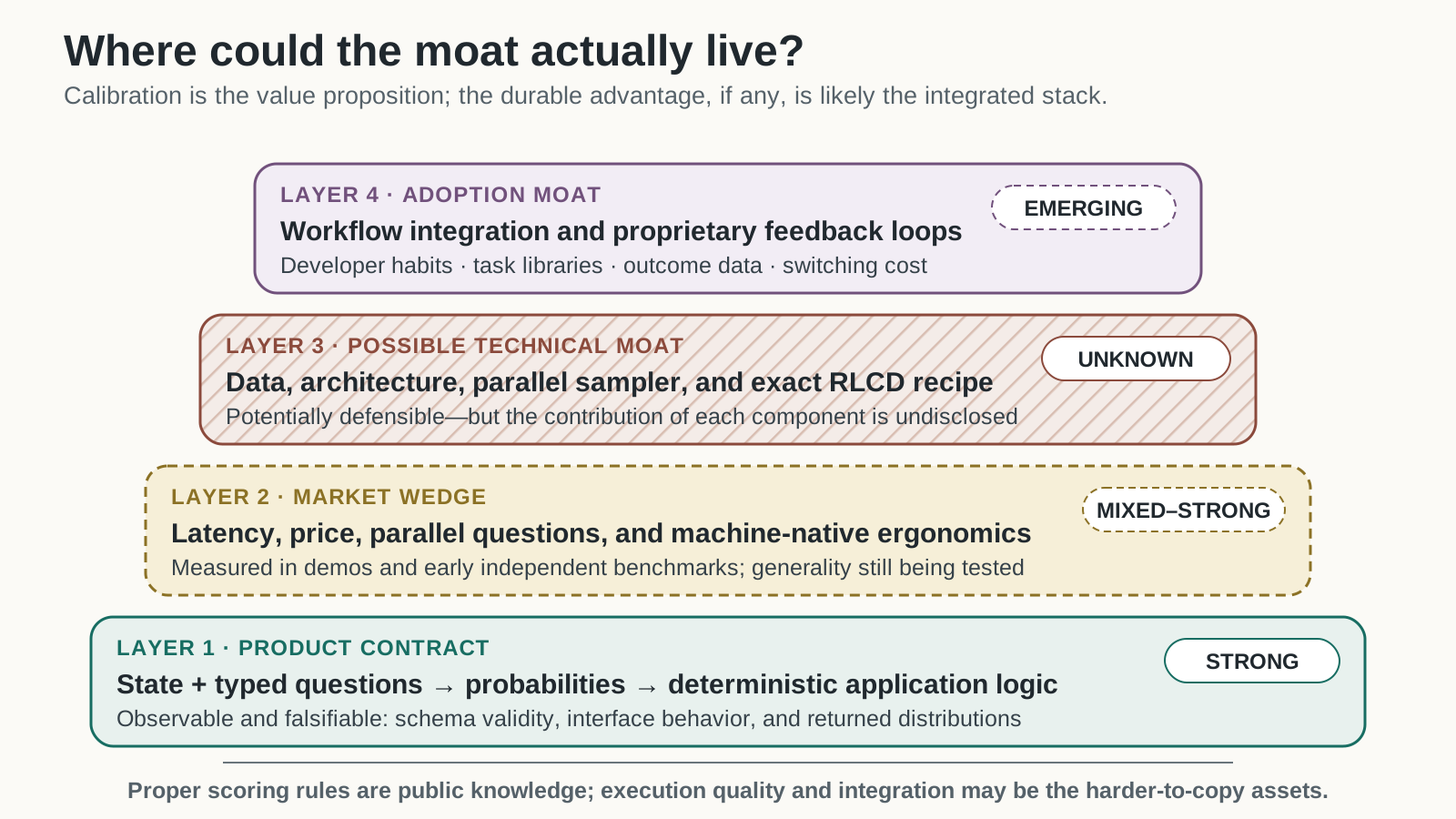 Figure 8. Calibration is the external contract, serving economics is the wedge, proprietary data and training are the possible technical moat, and the API/evaluation ecosystem can become the adoption moat. This decomposition is an inference; TypeSafe has not published causal ablations.
The word possible is doing important work. Without matched models that vary architecture, scale, data, RLCD, and serving one at a time, outsiders cannot allocate credit. The most honest current answer is:
Jev’s core insight is not uniquely defensible; its integrated implementation may be.
Applications: where Jev fits in an agent stack
The best Jev use cases share four properties: the output space is finite, the decision occurs often, latency or cost matters, and uncertainty can trigger a meaningful fallback.
The application literature is now large enough to separate plausible use cases from measured systems. The table below reports the latter. Most gains belong to the complete pipeline—not to one model call—so the right unit of evaluation is the end-to-end policy.
| Application | Decision role | Scale | Reported operating point | Main caveat | Source |
|---|---|---|---|---|---|
| Semantic databases | filter, join, classify, rank, and decide when to escalate | 21 SemBench queries; joins up to 540K pairs | 87.4% pair pruning; 55.2% fewer reasoning escalations; 95.7–97.5% mean F1 | combines model decisions with relational pruning, caching, and a cascade | JEVDB |
| Long-term agent memory | judge raw retrieved records while an LLM plans search and writes the answer | LoCoMo, LongMemEval-S; 100K–10M-token histories | 91.7–92.2% on LoCoMo; cost/question grows only 1.11× across that history range | score depends on the answer model and the whole memory pipeline | Mnemon |
| Memory write policy | select raw turns instead of LLM-extracted memories | preregistered LoCoMo and LongMemEval study | non-inferior under tight budgets; reported 3,061× lower write cost | extraction remains stronger when the context budget is generous | Engram study |
| Water-network triage | four-way incident attribution, rule confirmation, optional LLM review | four sealed preregistered rounds; transfer to two networks | macro-F1 0.62–0.64; 35–38% less LLM review | priors and rules contribute; public simulated networks are not live utility traffic | HydroJEV and artifacts |
| Mobile GUI execution | repeated low-level action selection under an occasional VLM plan | full AndroidWorld suite | 79% success vs. 84% step-wise VLM; successful runs 32.7% faster and 73.4% cheaper | delegation policy and fewer VLM calls are confounded with Jev | Jev-Mobile |
| Alignment screening | ten parallel typed checks over one model response | 44 benchmarks, 10 failure types, five target models | generic question median AUROC 0.886; reported 63× lower cost than LLM judges | most labels come from benchmark scorers; some context fields reveal labels | Just Ask Jev |
| Population-scale narrative coding | map free text into 27 probabilistic variables and allocate human review | 499,500 screened narratives; 2,416 blind human labels | human-label F1 0.908; recalibration reduces calibration error 3.3× | specialized screening and sampling design | Crash narratives |
| Multimodal medical decisions | classification, finding detection, bounded regression, and counting | 15 datasets; 23,558 states; 726 held-out states | much lower reported calibration error with similar point accuracy; generative arm wins counting | decision arm receives denser factorized supervision | OmniMed-Jev |
| Agent security gate | map injections, harmful requests, or traces into allow/block/review | multiple security benchmarks and judge families | subgroup errors and shared confident misses sharply limit safe automation | benchmark threat models do not replace a live red-team program | Security evaluation |
| Speech-neuroprosthesis rescoring | choose among candidate decoded sentences | 978 held-out sentences from one participant | WER 7.5%; retuned fusion reaches 6.9% | one participant; network latency is not faster than local 7B inference | Rescoring study |
The recurring pattern is state-complete evidence + bounded alternatives + high call frequency + a meaningful fallback + measurable downstream utility. When one of those is absent, the low price of a decision is rarely the important bottleneck.
Routing and tool selection
An agent can choose among search, database, code execution, calculator, memory, or asking the user. The option set must reflect actual capabilities and include a safe fallback. The probability distribution can govern whether to run one tool, run several, or defer to a planner.
Retrieval, reranking, and memory
For every candidate document or memory, Noul can estimate relevance; Score can estimate support quality; Choice can assign a semantic category. A two-stage system can cheaply filter thousands of candidates and use a generative model only for borderline cases. Because false negatives can permanently remove evidence, recall-sensitive thresholds are usually more important here than top-1 accuracy.
Verification and guardrails
A decision model can check whether a citation supports a claim, a proposed command matches user authorization, a tool result is internally consistent, or an output violates policy. It should be one layer in defense in depth, not the sole authority for irreversible actions. Independent models and deterministic checks are valuable because a single shared model can make correlated mistakes.
The first broad alignment-detector study gives this use case some quantitative support. Across 44 benchmarks and ten alignment-failure categories, one generic Jev question reached a median AUROC of 0.886 and the resulting judge was reported to cost 63 times less than LLM-based scorers. The same study also found that which context fields Jev saw mattered more than small changes in wording, and some useful fields effectively encoded the benchmark label. Most labels came from existing benchmark scorers, and only two settings included human labels. The result is therefore promising evidence for cheap zero-shot screening—not a production false-negative guarantee and not permission to treat Jev as an independent ground-truth oracle (Guo et al., 2026).
Data labeling and semantic map/reduce
Many labeling tasks are finite decisions disguised as prompts: topic, sentiment, policy category, error class, quality tier, or duplicate status. Jev’s cost and parallelism are attractive when millions of short decisions are needed. Calibration enables active learning: send uncertain examples to humans, then use the labels to improve the task-specific system.
Recommendation among known candidates
When candidates are already generated by retrieval or business logic, Choice can select or rank them without generating new content. This applies to next-best action, UI adaptation, workflow assignment, and personalized recommendation. It is less appropriate when discovery of a novel candidate is the hard part.
Compute allocation for reasoning agents
A lightweight decision can decide whether a task needs direct response, short reasoning, long reasoning, more rollouts, search, or human help. This turns uncertainty into a budget controller. To avoid a circular failure, the controller must be evaluated on whether expensive compute actually repairs its rejected cases.
A confidence cascade
A practical architecture is not “Jev versus LLM.” It is a cascade:
- deterministic rules reject impossible or unauthorized actions;
- Jev handles high-confidence bounded decisions;
- uncertain cases go to a reasoning LLM or verifier;
- consequential disagreements go to a human;
- outcomes return to calibration monitoring and threshold updates.
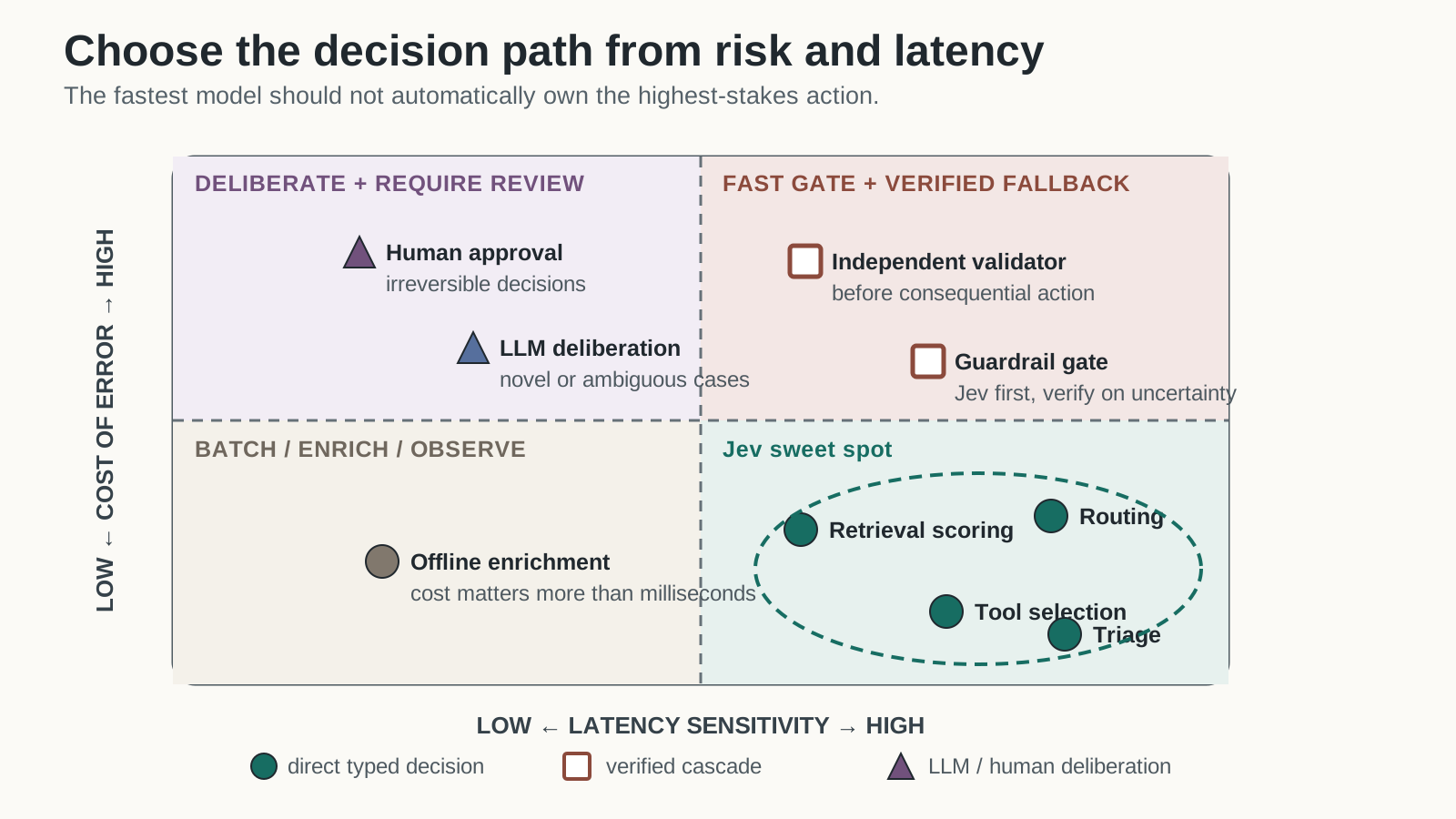 Figure 9. Jev fits frequent bounded judgments; an LLM fits open-ended generation and planning; many production workflows are best served by a hybrid cascade. The hybrid succeeds only when fallbacks have complementary errors, thresholds are validated, and consequential actions retain independent controls.
Deferral has two multipliers: does confidence identify repairable cases, and does the fallback make different errors? If either is near zero, escalation only adds cost. One rubric-judge study reports that about 96% of confident Jev errors were repeated by an LLM judge in its setup; the agent-security study likewise finds shared high-confidence misses. In contrast, the automated-gates study finds a cheap classifier-first cascade that matches Jev at roughly 43% of its estimated cost. “Use a stronger model below 0.8” is not a cascade design. The design must measure joint error, repair rate conditional on deferral, and realized cost (Rao and Callison-Burch, 2026; Rafe and Das, 2026).
For example, imagine a coding agent proposing 500 file operations. Most are local reads or reversible edits. A decision model can classify their authorization and risk in milliseconds. High-confidence low-risk actions proceed inside a sandbox. Medium-confidence cases receive an LLM review with repository context. Network access, secret handling, permission changes, publication, or destructive operations require a hard policy or human approval regardless of model confidence. The calibrated model improves throughput; it does not redefine authority.
TypeSafe’s own use-case map includes routing, classification, scoring, filtering, recommendation, safety checks, and extraction-like patterns. Those examples are useful starting points, but each customer still needs a private evaluation set and deployment-specific costs (TypeSafe AI, 2026; patterns).
The hard limits: where an LLM remains the right abstraction
A decision model deliberately trades generality for a sharper contract. That trade produces real limits.
The emerging boundary is not simply small model versus large model. It is evaluate supplied evidence versus simulate missing consequences. Jev can be strong when the decisive fact is represented in state, yet fail when one call must infer an unseen opponent action, prerequisite subgoal, physical transition, or intermediate computation. A planner, search procedure, environment copy, calculator, or simulator should produce those consequences; the decision model can then evaluate them. This is both an empirical observation and a good software boundary (Yang et al., 2026).
It cannot create a missing option. If the correct answer is outside the schema, a closed choice distribution must still place mass somewhere. Other, unknown, or a hierarchical candidate-generation stage is essential for open-world tasks. Even that label needs training and policy. In one arithmetic study, Jev was 99% accurate when the answer was present but rejected only 7% correctly when it was absent. A threshold frozen on a separate development set raised rejection to 79% while retaining 97% answer-present accuracy (Zhong et al., 2026).
It cannot explain or synthesize. A developer may want not just “reject” but a grounded rationale, corrected artifact, or plan. A general LLM remains appropriate when language is the deliverable.
It does not plan. Choosing one next action is not equivalent to constructing and revising a long-horizon plan. The harness must preserve objectives, manage memory, recover from errors, and enforce stop conditions.
It inherits state quality. Prompt injection, stale memory, contradictory evidence, missing provenance, and malformed rubrics can all produce bad decisions. A typed output does not sanitize the input.
This is not merely hypothetical. JevAdvBench evaluated 9,744 single-edit variants over 812 typed questions. It scores each attacked answer against Jev’s own clean decision—not an external correctness label—so its flip rates measure behavioral robustness rather than attacked accuracy. With jev-1.13.0, appending one unverified opinion flipped 12.1% of decisions and moved 38% of initially confident answers below a 0.8 review threshold. The exact rates belong to that benchmark, not every deployment, but the mechanism is general: the state is an argued, potentially adversarial input rather than trusted ground truth (Hu et al., 2026).
The hosted product is currently text-first, and every new modality needs separate evidence. Open projects now demonstrate visual shared-prefix readouts and a medical multimodal decision model, but they are separate systems—not evidence about hosted Jev. Strong performance on Belebele is encouraging, not proof of uniform multilingual reliability; Chinese-Jev’s specialization result likewise needs independent reproduction.
Its documented jaggedness matters. TypeSafe notes weaknesses involving counting and arithmetic, date comparisons, multi-hop or indirect formulation, irrelevant long context, contradictions, and option ordering (TypeSafe AI, 2026). Those are not exotic edge cases inside agents; tool traces and policy states are often long, noisy, and compositional.
Calibration is not local truth. A model can be well calibrated globally while confidently failing on one rare subgroup. It can also be accurate but incoherent across related questions. Sensitive deployments need stratified calibration, stress tests, and explicit uncertainty about the estimated probabilities themselves.
Closed models limit auditability. Users cannot inspect the training corpus, rule out benchmark contamination, reproduce training, or independently determine which component produced the behavior. Hosted privacy, retention, versioning, and rollback become part of the risk model. TypeSafe says customer requests and responses are not used for training and documents enterprise zero-data-retention options, but customers still need to verify the retention tier, regional processing, and terms that apply to their account (TypeSafe AI, 2026).
Jev does not support per-customer fine-tuning. TypeSafe states that Jev is not fine-tuned or LoRA-adapted with customer data and that the same weights serve every account. Prompting through state, questions, options, and rubrics can adapt the interface, but some domains require learned local representations. External calibration can correct probabilities without repairing weak ranking or missing domain capability (TypeSafe AI, 2026).
High confidence may amplify automation bias. A precise number looks authoritative. Operators may trust 0.97 more than a vague sentence even when the number is shifted, poorly validated, or derived from the wrong statistic. Good UI should show the evidence class, threshold policy, and historical performance—not only the probability.
These limitations suggest a division of labor:
| Use a decision model when… | Use a generative LLM when… |
|---|---|
| the valid answer space is known | discovering the answer space is part of the task |
| latency and volume dominate | deep synthesis or explanation dominates |
| probabilities drive a policy | language or code is the product |
| a safe fallback exists | the task cannot be decomposed into bounded judgments |
| local semantic judgment is enough | multi-step world modeling and planning are central |
The two systems are complements. A capable LLM can generate candidates and explanations; Jev can route, check, score, and decide when the expensive model should run.
How I would evaluate a decision model
An evaluation designed only around accuracy will miss the reason to use Jev. A serious evaluation should have at least seven layers.
1. Task quality
Measure accuracy, macro/micro F1, AUROC or AUPRC where appropriate, and confusion matrices. Report per-class and per-slice results, not only a pooled average. Include none_of_the_above and ambiguous cases if they occur in production.
2. Probability quality
Report Brier score, negative log-likelihood, reliability diagrams, adaptive and classwise calibration error, and bootstrap intervals. Test equivalent phrasings, option permutations, negations, and logically related questions. Do not silently substitute TypeSafe’s derived confidence for raw probability.
3. Selective performance
Plot risk versus coverage, report area under the risk–coverage curve, and state coverage at several operational risk limits. Freeze thresholds on validation data and evaluate once on future or geographically separated test data. A threshold tuned and reported on the same set is not deployment evidence.
4. Shift and stress
Evaluate time shift, base-rate shift, domain shift, long and irrelevant context, multilingual inputs, contradictory state, missing evidence, prompt injection, option-order changes, and adversarially plausible distractors. Track whether ranking survives even when calibration intercepts change; ranking can sometimes be recalibrated, while a collapsed ordering cannot.
5. Cascade value
Evaluate the complete policy, not the first model alone. Measure fallback rate, fallback accuracy, overlap between errors, end-to-end latency, human workload, and cost per correct automated decision. The essential counterfactual is whether cases rejected by Jev are actually repaired downstream.
6. Agent-level consequences
For a long-running agent, replay complete trajectories with and without the decision layer. Measure task success, unsafe action rate, unnecessary escalation, recovery after mistakes, token and wall-clock cost, and tail latency. Small per-step errors may be correlated and compound. Conversely, an imperfect decision model can improve total performance by catching a few high-leverage mistakes.
7. Operations
Pin model versions and log state hashes, question templates, option order, returned distributions, policy decision, fallback outcome, and eventual label. Detect drift, define rollback triggers, and recalibrate only on leakage-safe data. If the provider changes jev-latest, the system should not silently inherit a new operating curve.
A compact evaluation card might therefore read:
Model/version: jev-1.13.0
Task and population: production support-routing, English, Sep 2026
Primary metric: coverage at <=2% routing error
Threshold: fitted on Aug holdout, frozen before Sep test
Slices: customer tier, issue class, input length, new products
Fallback: reasoning LLM + human for consequential cases
Shift tests: option permutation, paraphrase, base-rate, injection
Ops: version pin, daily drift alert, weekly delayed-label audit
This is less glamorous than a benchmark leaderboard, but it answers the question that matters: Can this probability safely carry a branch in my software?
From calibrated decisions to calibrated agents
Jev’s deepest research value may be the separation it forces between estimation and control. A generative agent often entangles both: it reasons, states confidence, chooses the next action, and explains why in one stream of tokens. A typed decision endpoint makes the boundary visible. The model estimates a distribution; a policy uses that distribution under costs and constraints.
But an agent is not one decision. It is a sequence
\[\tau=(s_0,a_0,o_1,s_1,a_1,o_2,\ldots,s_T),\]where actions change the observations and future states. The probability that the complete trajectory succeeds is not generally the product of independent local confidences. Errors are correlated; the agent may recover from one mistake; a seemingly safe action may remove future options; and uncertainty can be epistemic, environmental, or caused by an underspecified objective.
A robust agent needs calibration at multiple levels:
- atomic: Is this classification, tool call, or claim correct?
- state: Does the agent have enough information to decide?
- transition: Will this action move the system toward the objective without violating constraints?
- plan: Is the current strategy likely to succeed?
- trajectory: What is the probability of final success from here?
- institutional: Are the combined model, harness, tools, humans, and other agents inside the authorized envelope?
This produces an active loop:
- estimate uncertainty;
- identify its source;
- choose an intervention—retrieve, reason, simulate, verify, ask, or stop;
- observe whether the intervention resolves uncertainty;
- update memory and future calibration;
- preserve hard authorization boundaries regardless of confidence.
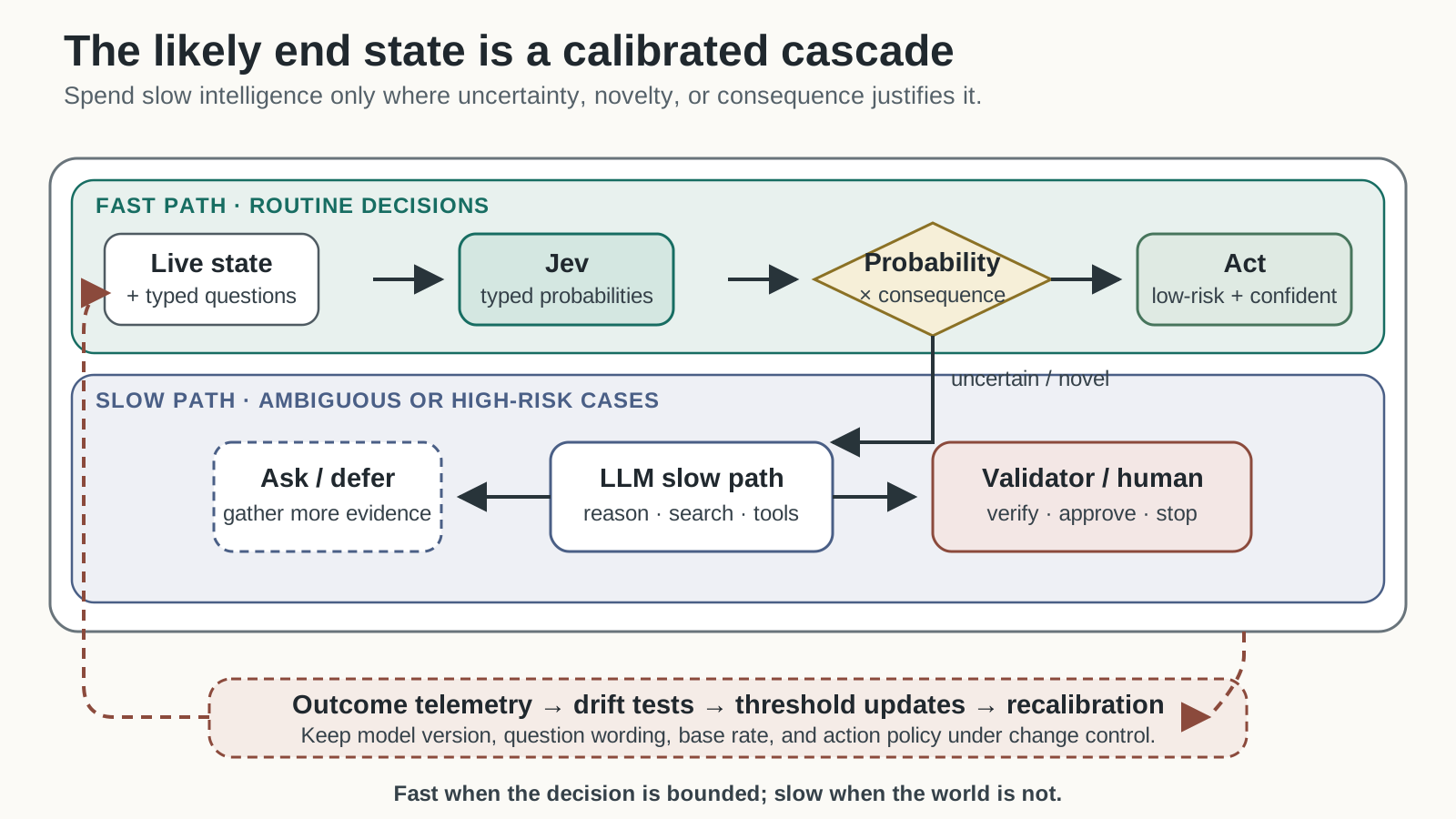 Figure 10. Jev occupies the fast atomic-decision layer in a heterogeneous future stack. ACC estimates trajectory success, AUQ makes uncertainty alter memory and reflection, a generative model plans and repairs, and the harness converts estimates into bounded actions. The open problem is compositional calibration across the full loop.
The most promising architecture may be heterogeneous. Deterministic code handles invariants. A decision model handles frequent bounded semantic judgments. A generative reasoner handles open-ended planning and repair. A trajectory calibrator estimates cumulative risk. The harness chooses interventions, and humans retain authority over irreversible high-impact actions. No single model needs to be universally best.
This also clarifies why faster decisions can matter beyond latency. If a check is cheap enough to run at every step, the system can instrument behavior that was previously invisible. It can ask whether a memory remains relevant, whether a claim is supported, whether the objective has drifted, and whether another rollout has expected value. The benefit comes not only from replacing an LLM call, but from enabling checks that were previously omitted.
The danger is over-instrumentation. Hundreds of individually noisy gates can create brittle workflows, correlated false alarms, and hidden failure modes. Every monitor changes system behavior, and every threshold creates a new optimization target. Agent training may eventually learn to route around predictable gates. Decision models should therefore be evaluated as components of an adaptive control system, not sprinkled into the harness as independent oracles.
Open research questions
1. What is inside Jev?
A real model card should disclose parameter scale, architecture class, training stages, data governance, languages, RLCD objective, contamination controls, known limitations, and causal ablations. Commercial secrecy is understandable, but scientific claims about a new model category remain hard to evaluate without these basics.
2. Which component creates the frontier?
How much of the observed advantage comes from model specialization, data, RLCD, parallel state processing, hardware, batching, or API design? A matched ablation could compare cross-entropy, Brier supervision, post-hoc calibration, proper-score RL, and the proprietary recipe at fixed architecture and compute.
3. Does calibration transfer?
We need longitudinal evaluations under changing base rates, customer populations, languages, and model versions. Can a small labeled calibration set repair probabilities without retraining? When does recalibration fail because the representation no longer ranks examples correctly?
4. Can marginal probabilities become coherent beliefs?
Independent questions can violate exclusivity, implication, and negation. Can a projection layer enforce logical constraints without damaging empirical calibration? Should related questions be evaluated jointly? How should the system represent genuine ambiguity rather than force artificial consistency?
5. How should out-of-set cases work?
Other is not enough if the model cannot recognize novelty. We need open-set detection, abstention, hierarchical candidate generation, and calibrated probability that the true answer is absent. This is especially important for tools: choosing the least-wrong tool can be worse than taking no action.
6. Can guarantees sit above learned probabilities?
Conformal prediction, risk-controlling prediction, and sequential testing may convert held-out data into finite- sample bounds on error or coverage under explicit assumptions. How should these methods interact with a rapidly versioned hosted model and non-exchangeable agent traffic?
7. How do probabilities compose over time?
Local calibration does not imply trajectory calibration. We need models of correlated error, recovery, option value, and state-dependent hazard. Can atomic Jev judgments feed a trajectory model such as ACC without double counting evidence? Can AUQ learn which intervention has the highest expected value of information?
8. When is reasoning worth its cost?
Some tasks need no chain of thought; others fail without multi-step inference. A calibrated router should estimate not only whether the cheap answer is correct, but whether additional search, reasoning, or sampling is likely to change the answer beneficially. That is a causal question about compute, not ordinary confidence.
9. What happens under strategic pressure?
If a decision model becomes a monitor or gate, an upstream agent may learn inputs that exploit it. Evaluation should include adaptive attacks, prompt injection, state obfuscation, option manipulation, and distribution shift induced by the agent itself. A monitor trained on passive data may fail once another optimizer targets it.
10. How do we prevent self-confirming calibration loops?
Selective systems observe labels mostly for accepted or escalated cases. Their actions change the data they later use for recalibration. This creates bandit feedback, censoring, and selection bias. Random audits and exploration may be necessary even when they appear inefficient.
11. How should uncertainty be shown to humans?
Users often misunderstand probabilities and over-trust precise numbers. Interfaces should communicate reference class, calibration history, uncertainty intervals, shift warnings, and the consequence of acting. We need studies of whether probability displays improve decisions or merely automate deference.
12. Can the interface expand without losing its advantage?
Real systems need vision, audio, continuous values, sets, rankings, structured objects, and combinatorial action spaces. Extending the type system may require new heads, losses, and serving paths and could erode some simplicity or latency advantage; it does not necessarily require autoregressive generation. Finding the boundary between a decision model and a general structured generator is itself a research problem.
13. What should the benchmark optimize?
Static public classification accuracy is easy to contaminate and far from deployment. A stronger benchmark would use private, temporally held-out tasks; report risk–coverage and cost; freeze thresholds before evaluation; test prompt and option perturbations; include fallbacks; and score the complete decision policy rather than the model in isolation.
14. Can we make the system auditable and private?
Hosted inference raises questions about data retention, version drift, regional processing, and reproducibility. Open weights, on-premises deployment, signed version manifests, and standardized decision logs would broaden the set of domains where calibrated decision models can be trusted.
Evidence discipline. The correct reading of the 2026 literature is neither “Jev has solved calibrated decisions” nor “Jev is only a classifier.” It has made a neglected systems interface—bounded decisions with operational probabilities—easy to buy and compose. Whether that interface becomes a durable model class depends on evidence that survives matched readout baselines, distribution shift, open-set rejection, probability-coherence tests, and real downstream costs.
Conclusion
Jev is not a miniature chatbot and not an acronym. It is a typed decision service: textual state and bounded questions go in; finite probability distributions come out. That sounds modest. In an agent system, it can be profound because much of the control loop consists not of writing but of deciding—route, verify, retrieve, accept, retry, ask, or stop.
Its popularity comes from a timely combination: a memorable “decisions, not strings” framing, low-latency serving, extremely low current price, a clean API, and an agent ecosystem hungry for machine-usable uncertainty. The early evidence supports real speed and cost advantages and promising accuracy and selective prediction on many bounded tasks. It also shows uneven calibration, domain weaknesses, coherence failures, and the danger of reading fresh preprints as settled fact.
The technical centerpiece is calibration, but V2’s strongest lesson is that calibration is only the first test. A probability is not TypeSafe’s derived confidence statistic; frequency calibration is not self-knowledge; self-knowledge is not coherence; and coherence is not decision utility. Low pooled ECE can hide subgroup failure, an apparently confident model can cross its knowledge boundary without noticing, and equivalent interfaces can move the same event across different action thresholds. The operational question is whether a frozen policy—not merely a score—delivers acceptable risk, coverage, and cost on future target traffic.
RLCD is part of TypeSafe’s story, but its actual Jev implementation remains undisclosed. The independent OpenJev-RLCD paper offers a plausible proper-score training method and valuable analysis of rationale variance; it is not the proprietary recipe. RLCR, CaOPD, ACC, and AUQ illuminate complementary points along the path from correctness, to calibrated self-assessment, to deployment-aware distillation, to trajectory-level intervention.
So where is the moat? Probably not in the abstract idea of calibrated classification, and probably not in a typed head alone. Frozen LM readouts, open pointer heads, specialized encoders, and trained classifiers already cover much of the visible behavior. The stronger hypothesis is a stack: proprietary data and training, parallel low-latency serving, a typed API, evaluation and monitoring, and integrations. Calibration is the product promise. Serving economics is the wedge. The model/data recipe is a possible technical moat. The harness and recalibration loop may become the adoption moat.
The right deployment is likewise not “Jev replaces the LLM.” It is a heterogeneous cascade. Deterministic code enforces invariants and simulates state transitions. Jev makes fast bounded judgments over supplied consequences. A generative LLM plans, explains, and repairs. A trajectory calibrator tracks long-horizon risk. The harness determines authority, fallback, and stopping; humans remain in the loop for irreversible decisions. Escalation earns its cost only when confidence identifies repairable cases and the fallback makes complementary errors.
That leads to the research frontier I find most compelling. Calibration should not stop at measuring confidence. It should determine what the system does next: whether it acts, verifies, branches, reflects, retrieves, spends more compute, or asks for help. Jev makes that vision unusually tangible at the level of one decision. The open problem is to make it hold across an entire agent trajectory.
Calibration is the contract—not a certificate. Its value is realized only when probabilities are validated under deployment shift and connected to a policy that can still say “I do not know.”
Source note: This article distinguishes TypeSafe’s public documentation and vendor evaluations from independent preprints and my own interpretation. Jev’s architecture, parameter count, training data, and RLCD recipe were not publicly disclosed as of October 4, 2026. OpenJev-RLCD is an independent proposal, not a reconstruction confirmed by TypeSafe. All ten figures are original schematics; they describe interfaces and research concepts rather than undisclosed implementation details.
How to cite
Zhang, Jiaxin. (Oct 2026). Jev and the Return of the Decision Model: When Calibration Becomes an API. Jiaxin Zhang’s Blog. https://jxzhangjhu.github.io/blog/2026/jev-calibration-as-an-api/
@article{zhang2026jevcalibration,
  title   = "Jev and the Return of the Decision Model: When Calibration Becomes an API",
  author  = "Zhang, Jiaxin",
  journal = "Jiaxin Zhang's Blog",
  year    = "2026",
  month   = "Oct",
  url     = "https://jxzhangjhu.github.io/blog/2026/jev-calibration-as-an-api/"
}
References
[1] TypeSafe AI. “Introducing System One Models & Jev.” September 15, 2026.
[2] TypeSafe AI. “Introduction to Jev.” Documentation, accessed October 3, 2026.
[3] TypeSafe AI. “System One.” Documentation, accessed October 3, 2026.
[4] TypeSafe AI. “Primitives.” Documentation, accessed October 3, 2026.
[5] TypeSafe AI. “Confidence.” Documentation, accessed October 3, 2026.
[6] TypeSafe AI. “Models and Pricing.” Documentation, accessed October 3, 2026.
[7] TypeSafe AI. “Machine Learning Primer.” Documentation, accessed October 3, 2026.
[8] TypeSafe AI. “Jev 1.13 Model Jaggedness.” Documentation, accessed October 3, 2026.
[9] TypeSafe AI. “Use Case Map.” Documentation, accessed October 3, 2026.
[10] TypeSafe AI. “Patterns.” Documentation, accessed October 3, 2026.
[11] TypeSafe AI. “Team.” Accessed October 3, 2026.
[12] TypeSafe AI. “System One Adapter for Python.” GitHub repository, 2026.
[13] Zhimin Gao and Pichao Wang. “OpenJev-RLCD: A Working RLCD Implementation.” arXiv:2609.38850, 2026. Code.
[14] Mehul Damani, et al. “Beyond Binary Rewards: Training LMs to Reason About Their Uncertainty.” arXiv:2507.16806, 2025; revised 2026. Project page.
[15] Jiaxin Zhang, et al. “The Illusion of Certainty: Decoupling Capability and Calibration in On-Policy Distillation.” arXiv:2604.16830, 2026. Code.
[16] Jiaxin Zhang, Caiming Xiong, and Chien-Sheng Wu. “Agentic Confidence Calibration.” ICML, 2026.
[17] Jiaxin Zhang, et al. “Agentic Uncertainty Quantification.” arXiv:2601.15703, 2026.
[18] Jiaxin Zhang, et al. “From Passive Metric to Active Signal: The Evolving Role of Uncertainty Quantification in Large Language Models.” Findings of ACL, 2026.
[19] Tobias Deußer, Lorenz Sparrenberg, and Rafet Sifa. “Evaluating and Benchmarking the System One Model Jev.” arXiv:2609.37647, 2026.
[20] Lijuan Tang and Yuemeng Zheng. “Typed Decision Models: An Early Evidence Audit and Evaluation Checklist.” arXiv:2609.32160, 2026.
[21] Keyi Li, Yihao He, and Quanyi Li. “Beyond Calibration: Do a Typed-Decision Model’s Probabilities Obey the Probability Axioms?” arXiv:2609.33209, 2026.
[22] Alfredo Madrid-García and Beatriz Merino-Barbancho. “Jev in Medicine: A Benchmark Evaluation.” arXiv:2609.34024, 2026.
[23] Guo, Chuan, Geoff Pleiss, Yu Sun, and Kilian Q. Weinberger. “On Calibration of Modern Neural Networks.” ICML, 2017.
[24] Brier, Glenn W. “Verification of Forecasts Expressed in Terms of Probability.” Monthly Weather Review, 1950.
[25] Geifman, Yonatan, and Ran El-Yaniv. “Selective Classification for Deep Neural Networks.” NeurIPS, 2017.
[26] Angelopoulos, Anastasios N., and Stephen Bates. “A Gentle Introduction to Conformal Prediction and Distribution-Free Uncertainty Quantification.” arXiv:2107.07511, 2021.
[27] Vercel. “Jev Is the Fastest-Adopted Model in AI Gateway History.” September 18, 2026.
[28] Yu Sun, Junhao Xu, Jiajia Shi, and Zijin Yang. “Type-Safe Is Not Error-Free: A Constrained Decision Head Follows the Option Name, Not the Rubric Bound to It.” arXiv:2609.26758, 2026.
[29] Jianyi Hu, Hangtao Zhang, Yi Liu, et al. “JevAdvBench: A Benchmark and Black-Box Attacks for Reinforcement Learning for Calibrated Decisions Models.” arXiv:2609.31142, 2026.
[30] Ruoqi Guo, Yi Liu, Gelei Deng, et al. “Just Ask Jev: Reinforcement Learning for Calibrated Decisions as a Zero-Shot Detector of AI Alignment Failures.” arXiv:2609.29429, 2026.
[31] Amir Rafe and Subasish Das. “Benchmarking System One Decision Models against Trained Classifiers and Language Models for Automated Decision Gates.” arXiv:2610.00346, 2026.
[32] Kevin Yang, Dan Klein, Asli Celikyilmaz, Nanyun Peng, and Yuandong Tian. “RLCD: Reinforcement Learning from Contrastive Distillation for Language Model Alignment.” ICLR, 2024.
[33] Yinheng Li and Justin Wagle. “LLM2Jev: LLMs Are Already Jev-Style Decision Models—When and How to Fine-Tune Them.” arXiv:2610.02076, 2026.
[34] Sharath M. Shankaranarayana, Davor Runje, and Jan Jannink. “Beyond Answer Confidence: A Controlled Audit of Self-Knowledge in a Black-Box Decision Model.” arXiv:2610.01006, 2026. Code.
[35] Han Chen and Yingrui Li. “Probability Contracts: Accuracy, Coherence, and Decisions Across LLM Interfaces.” arXiv:2609.37470, 2026.
[36] Saman Sarker Joy. “Do System One Decisions Add Up? A Study of Probabilistic Coherence.” arXiv:2609.33971, 2026. Code.
[37] Yaodong Yang, Hongyao Tang, Yi Ma, et al. “Code Owns the Simulation, Jev Owns the Evaluation.” arXiv:2610.01834, 2026.
[38] Jike Zhong, Ming Li, and Yuxiang Lai. “When the Right Answer Is Missing: An Arithmetic-Dependent Rejection Bottleneck in Jev.” arXiv:2609.39496, 2026.
[39] Yixuan Liu. “Evaluating System One Models for Agent Security Decisions: Reliability, Calibration, and Selective Automation.” arXiv:2609.33401, 2026. Artifacts.
[40] Luyao Tang and Cheng Chen. “OmniMed-Jev: Calibrating LVLM Confidence for Trustworthy Medical Multimodal Decisions via System One.” arXiv:2610.00381, 2026. Code.
[41] Li Ding, Haidi Jin, and Chen Ji. “Bongard: Training Machine Intuition—An Open Encoder–Decoder Model for Probabilistic Judgment.” arXiv:2609.39111, 2026. Weights.
[42] Benchmark Heaven and contributors. “JevBench: A Benchmark for Jev-Class Typed Decision Models.” Versioned repository and live leaderboard, accessed October 4, 2026.
[43] Rishabh Sharma and Rishika Lall. “When Does Selection Replace Extraction? A Pre-Registered Test of Agent Memory with a Typed Decision Model.” arXiv:2609.34227, 2026. Code and preregistration.
[44] Guangren Wang. “Mnemon: Raw Records, Fast Judgments, Slow Thoughts.” arXiv:2609.36059, 2026. Code and run records.
[45] Zhengle Wang, Hanxu Yan, Fuheng Zhao, and Chunwei Liu. “Prune First, Decide Fast: Scalable Semantic Query Processing with JEVDB.” arXiv:2610.02046, 2026.
[46] Tianwei Mu, Shengyan Jiang, Mingzhe Yuan, et al. “HydroJEV: A One-Second, Training-Free Screen for Cyber-Attack and Fault Attribution in Water Distribution Networks.” arXiv:2610.02048, 2026. Code and data.
[47] Amir Rafe and Subasish Das. “Calibrated Decisions at Scale: Converting Police Crash Narratives into Probabilistic Crash Variables with a System One Model (Jev).” arXiv:2609.24052, 2026.
[48] Linghua Zhang. “Jev-Mobile: Jev as an Executor for Mobile GUI Agents.” arXiv:2609.30186, 2026.
[49] Gabriele Cinà. “Jev Matches 7B Language Models for Speech-Neuroprosthesis Rescoring.” arXiv:2609.33538, 2026. Code and data.
[50] Tianxiang Gao, Jinzhe Li, Zhiyuan Li, Yi Chang, and Yuan Wu. “More Choices, Fewer Decisions: Ordinal-Scale Bias in JEV-like Direct-Decision Models.” arXiv:2609.38827, 2026. Code and data.
[51] Yida Lin. “PACT: Pairwise-Anchored Calibrated Tuning for Single-Token Typed Decisions.” arXiv:2609.35865, 2026. Code and runs.
[52] Guanxu Yu and Yuhang Yao. “Visual Jev: Accurate and Efficient Decisions from Shared Visual Context.” arXiv:2609.25845, 2026. Code.
[53] Furkan Yilmaz, Habibe Aleyna Tasdemir, and Muhammed Faruk Gozay. “LAVOIR: Teaching a Single-Pass Decision Encoder When and What to Ask with Amortized Value of Information.” arXiv:2609.30706, 2026. Code. Model.
[54] Zexiao Wang, Zihao Zhang, Xudong Wang, et al. “Chinese-Jev: Bringing System One Model to Chinese-Language Tasks.” arXiv:2609.36965, 2026. Project.
[55] Theo Lee. “SemIf-OpenJev: Semantic Ifs from Frozen Open Models.” GitHub repository, accessed October 4, 2026.
[56] OpenJev contributors. “OpenJev 27B.” Hugging Face model card, accessed October 4, 2026.
[57] Iker Moel. “open-alternative-jev.” GitHub repository, accessed October 4, 2026.
[58] BlockBrain AI. “Cygnet Recipe.” GitHub repository, accessed October 4, 2026.
[59] Alibek Serikbay. “JevK5.” GitHub repository and model family, accessed October 4, 2026.
[60] Chris H. “Plumb.” GitHub repository and model recipe, accessed October 4, 2026.
[61] Kshetrajna. “reflex.” GitHub repository, accessed October 4, 2026.
[62] Mapika. “Decider: A Family of System One-Style Models.” GitHub repository and model family, accessed October 4, 2026.
[63] Jiamu Zhang, Tianze Yang, Yucheng Shi, and Liang Wu. “AnyJev: Turn Any LLM into a Jev-Style Decision Model.” GitHub repository; see also arXiv:2610.00831, 2026.
[64] Jared Palmer. “Kev: Jev-Like Open Decision Models.” GitHub repository and model family, accessed October 4, 2026.
[65] Eldan Ring. “Winnow-12B.” Hugging Face model card and benchmark document, accessed October 4, 2026.
[66] Akhilaaa3. “Jev-Omni.” Hugging Face model card, accessed October 4, 2026.
[67] Delip Rao and Chris Callison-Burch. “JEV vs. LLMs as Rubric Judges: Cheaper, Faster, and Wrong in the Same Places.” arXiv:2609.29769, 2026.
[68] Oscar-dzy. “Awesome JEV Papers.” GitHub literature index, last verified October 3, 2026.