Calibrating Long-Horizon Agents: Confidence and Uncertainty at Inference Time
Table of Contents
- 10.5 Update on Reflection Beam
- Why long-horizon agents need calibrated uncertainty
- Problem setup: a formal vocabulary for agentic uncertainty
- Measure and calibrate trajectory uncertainty
- Act on uncertainty
- Self-improve and self-evolve with uncertainty
- Evaluate agentic calibration
- Open challenges
- Summary
- How to cite
- References
For a single language-model answer, “confidence” is a number: how likely is this output to be correct? You can compute it, calibrate it with temperature scaling, and move on.
For a long-horizon agent, confidence is not a number you report — it is a control variable you act on. At every step the agent faces a decision that has nothing to do with the next token and everything to do with reliability: should I commit this action, ask the user a question, call a verifier, reflect, stop, escalate to a human — or remember this moment as a failure to learn from later? The quality of those decisions, accumulated over dozens of steps, is what separates a demo from a deployable system.
This shift is easy to underestimate because the agent still looks like a model emitting text. But the failure modes are different. An early mistake does not stay local: once it is written into the trajectory, it becomes part of the context the agent reasons from at every later step. A 90%-reliable step, repeated twenty times, is a ~12%-reliable task. And the agent will often be most confident exactly when it has quietly gone off the rails, because the local reasoning looks fluent inside a mistaken world.
So the single-turn question — is the final answer calibrated? — is the wrong size. For agents, reliability is a trajectory-level, propagating, and actionable property.
This post is about the inference-time view: the base model is frozen. We are not changing weights. We build reliability around the model — measuring uncertainty over the trajectory, calibrating it so it is trustworthy, acting on it, and feeding it back into the agent’s memory and skills. The companion post takes the post-training view: how to bake calibrated confidence into the weights.
Thesis. With the model frozen, uncertainty is the control plane for a reliable — and self-improving — long-horizon agent: measure it over the trajectory, calibrate it, act on it, and let it drive self-evolution.
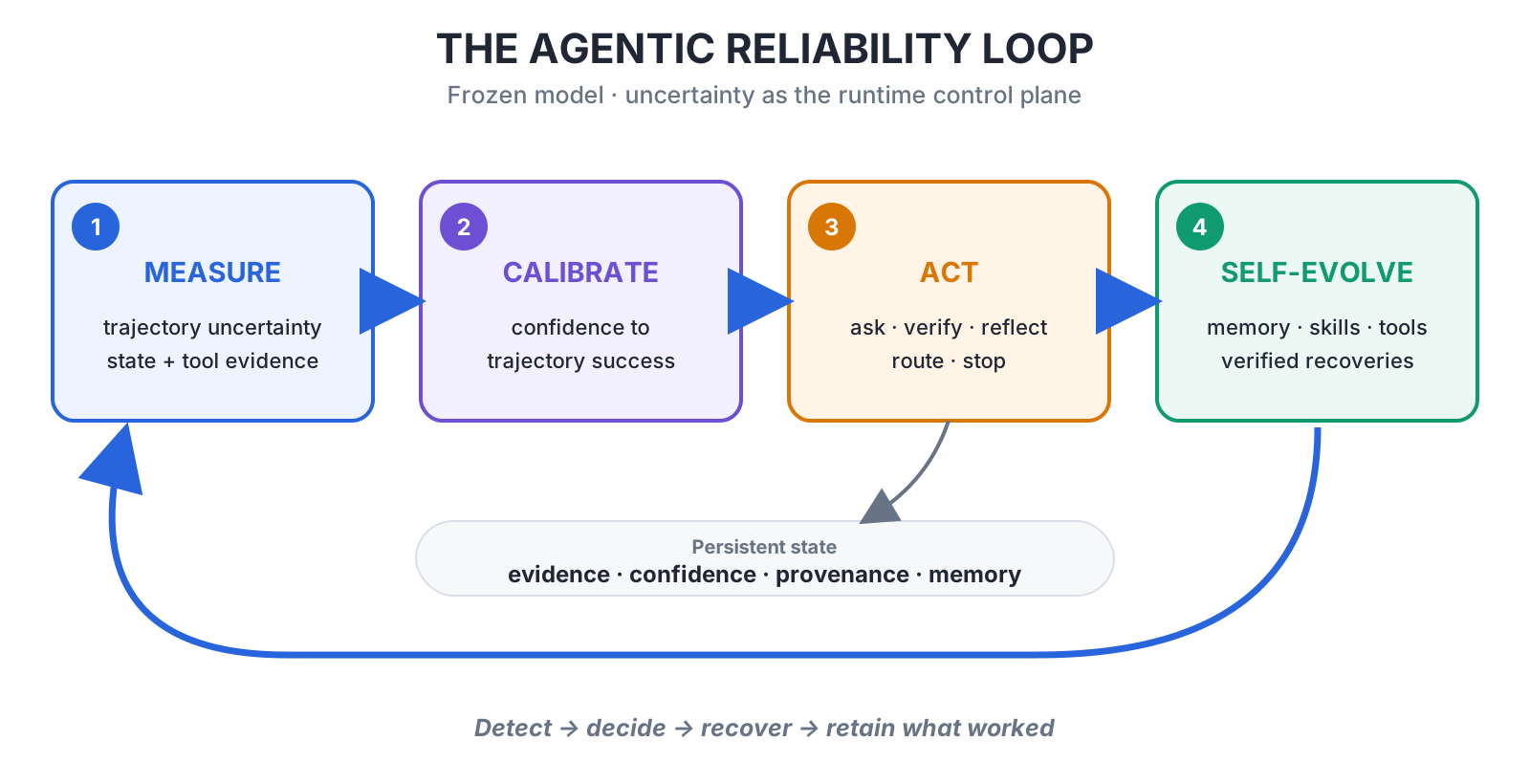
Three running examples. We carry these through the whole post to keep the abstractions concrete:
- E1 — Deep research (in the style of GAIA / enterprise deep research). An agent must answer an open-ended research question by searching, reading, and synthesizing a report over many steps. State: external evidence (web/docs). Verifier: report-quality rubric / reference answer — often non-verifiable.
- E2 — Retail tool agent (in the style of τ²-bench). A customer wants to return an item; the agent follows a written policy, calls typed tools over an order database, and converses with a simulated user. State: SQL database. Verifier: database end-state + policy/communication checks — verifiable.
- E3 — Coding / SWE agent (in the style of SWE-bench). The agent localizes a bug across a repo, edits files, and runs tests. State: repository + filesystem. Verifier: fail-to-pass tests — verifiable, but only where tests exist.
Why long-horizon agents need calibrated uncertainty
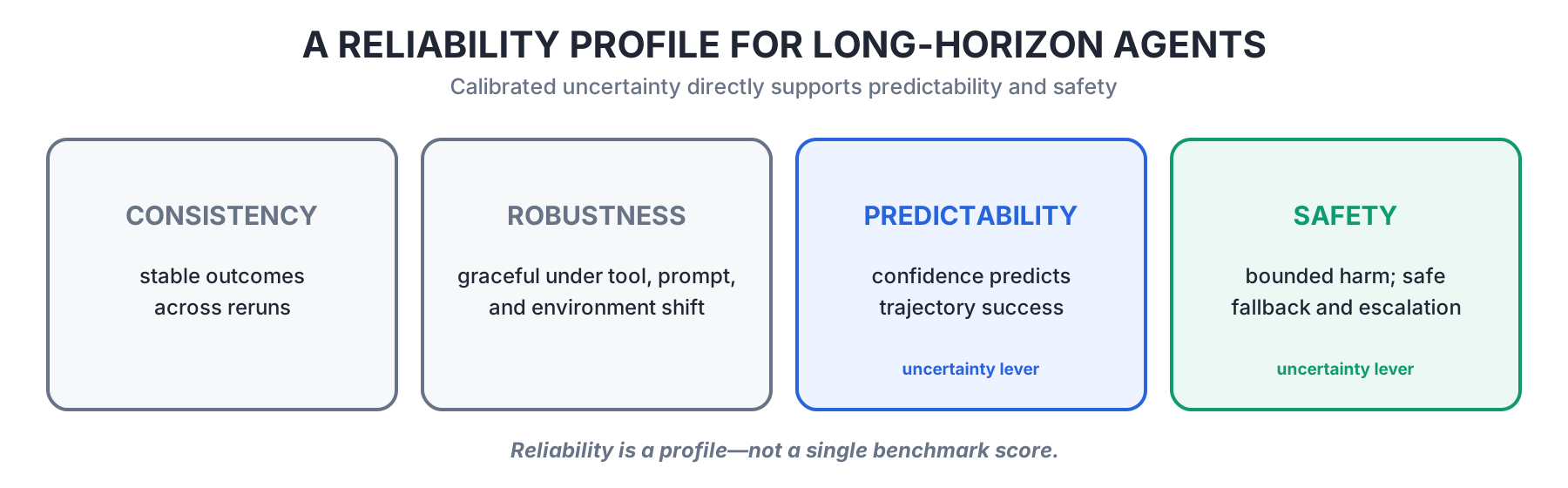
Benchmark accuracy is not agent reliability. A benchmark asks one question — did the final answer match a label? A deployed agent has to answer harder ones: Will it behave consistently across reruns? Degrade gracefully when a tool fails or evidence is stale? Notice that a task is underspecified? Pause before an irreversible action? Surface a warning mid-trajectory instead of wasting forty more tool calls? Will its confidence predict trajectory success rather than token fluency?
Reliability, in other words, is better described as a profile than a scalar. A useful one has four parts — consistency, robustness, predictability, and safety (Rabanser et al., 2026). Confidence and uncertainty mostly attack the last two: can the system predict its own failure, and can it route risky cases to safe fallback behavior?
Errors compound over a horizon
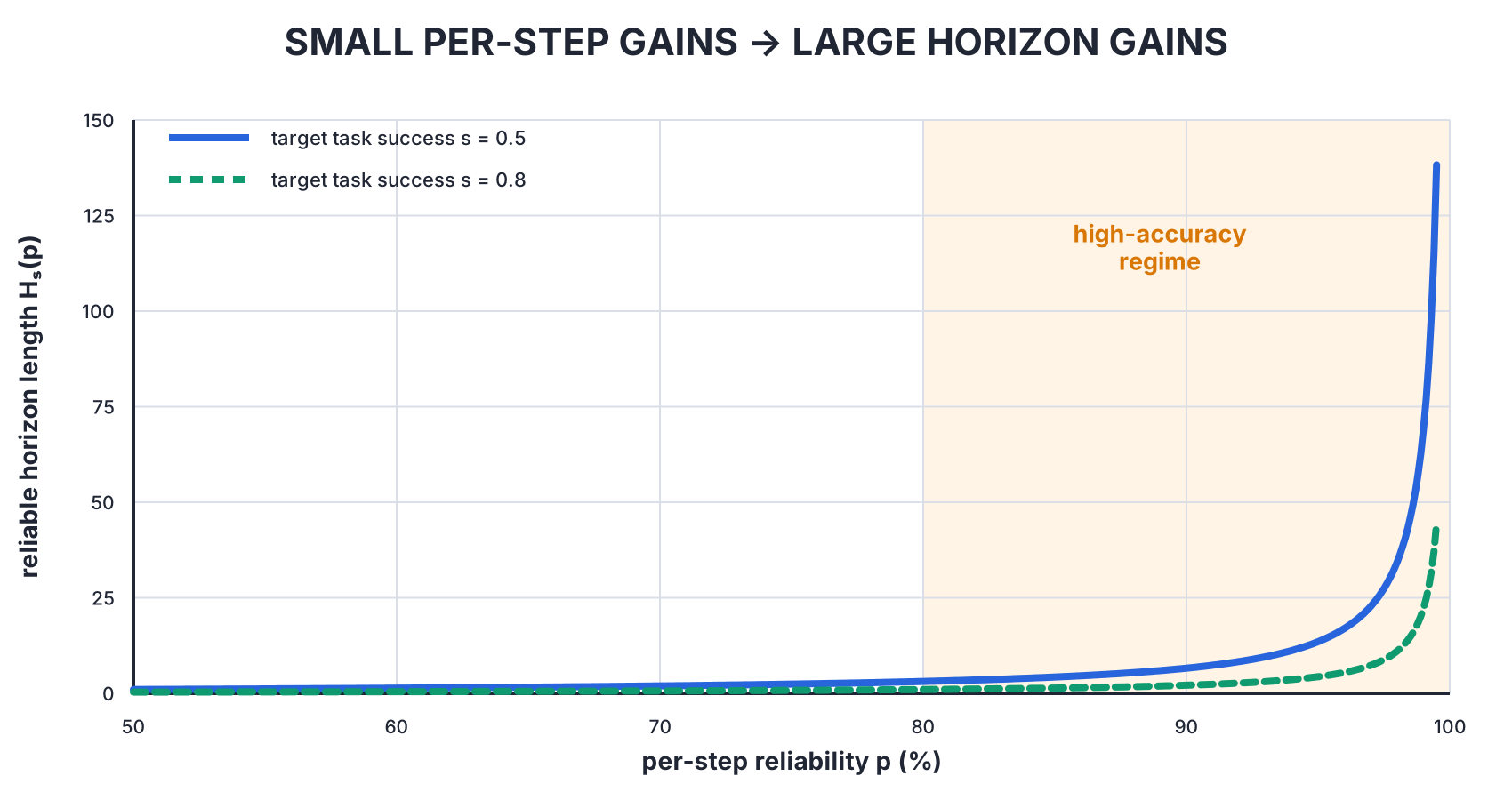
Start with the simplest possible model. Suppose each step succeeds independently with probability \(p\), and the task needs \(T\) correct steps with no self-correction. Then
\[P(\text{task success}) \approx p^{T},\]and the horizon length the agent can sustain at a target success rate \(s\) is
\[H_s(p) \;\approx\; \frac{\ln s}{\ln p}.\]This is the point of The Illusion of Diminishing Returns (Sinha et al., 2025): because \(H_s\) grows hyperbolically as \(p \to 1\), a small gain in per-step reliability buys a large gain in reliable horizon length once you are past ~80%. The flip side is the warning for this post: a confident final step says little about a long trajectory, because \(P(\text{success})\) was set by the weakest steps, not the last one.
History becomes future context
The independence assumption above is charitable. Real agents self-condition on their own history. If the agent writes a wrong intermediate result into memory, every later step is conditioned on that wrong result, so the per-step error rate rises as the trajectory grows — the opposite of a human, who tends to improve with practice (Sinha et al., 2025).
AUQ names this the Spiral of Hallucination: an early epistemic error becomes part of the effective environment for later steps (Zhang et al., 2026a). History-Echoes gives a complementary, mechanistic view — prior hallucinations geometrically trap later generations by biasing the hidden-state trajectory (Simhi et al., 2026). It is the same failure across substrates:
- E1: the agent misreads one source early and builds the whole report around it.
- E2: it assumes the wrong order ID, after which every “correct” tool call operates on the wrong object.
- E3: it misdiagnoses the failing test and edits the wrong module.
Insight — the unit of reliability is the trajectory. A single overconfident intermediate step can be more damaging than an overconfident final sentence, because the intermediate step gets written into the context that everything downstream depends on.
Multi-source uncertainty
In a single-turn model, uncertainty is about the model’s own output distribution. In an agent, the environment is a second source. A tool can fail (auth, rate limit, timeout), return noisy or stale data, or be silently wrong. The agent’s next-token uncertainty over its own text is simply not the same object as the reliability of an external tool result — and conflating them is a common bug. MESA-S makes this split explicit, separating self-confidence (parametric certainty) from source-confidence (trust in retrieved/external evidence) (Unlu, 2026).
Single-turn UQ does not transfer cleanly
The LLM uncertainty toolbox — token probabilities, semantic entropy, self-consistency, verbalized confidence, hidden-state probes, conformal wrappers — is a good foundation, but agentic settings stress it in four concrete ways:
- No logprobs. Many frontier models expose no token probabilities, ruling out probability-based methods for the strongest agents.
- Length dilution. A low-probability token in a critical tool argument is averaged away by hundreds of fluent reasoning tokens.
- Sampling cost. Sampling 10 answers to one question is cheap; sampling 10 complete tool trajectories is often prohibitive.
- Heterogeneous observations. Inputs arrive from users, APIs, web pages, filesystems, and other agents, each with its own distribution.
Two position papers now make this case directly: Kirchhof et al. argue the aleatoric/epistemic dichotomy must be reassessed for interactive agents (Kirchhof et al., 2025), and Oh et al. give a general formulation of agent UQ and flag the lack of fine-grained benchmarks (Oh et al., 2026). A companion survey frames the broader arc this post builds on: uncertainty moving from a passive metric to an active control signal (Zhang et al., 2026c).
Confidence is not action
Finally, even a calibrated number is useless if the agent ignores it — and the raw number is often not calibrated to begin with. Agentic Overconfidence elicits an agent’s self-estimated success probability before, during, and after execution and finds a large overconfidence gap: agents stay confident on tasks they go on to fail (Kaddour et al., 2026). RiskEval shows the second half of the problem: even when models verbalize uncertainty, their decisions are often not faithful to it — they fail to abstain when abstention is utility-optimal (Wang et al., 2026a), a point echoed by work showing confidences do not align with actions (Pal et al., 2025).
That gives us the spine of the post: measure → calibrate → act → feed back.
Takeaway. Long-horizon agents need calibrated uncertainty because errors compound, history traps later reasoning, the environment is a second source of uncertainty, single-turn confidence breaks under interaction, and a score only matters when it changes what the agent does.
Problem setup: a formal vocabulary for agentic uncertainty
Before methods, we need definitions precise enough to compare them. This section is the one place we lean on notation; the rest of the post stays in plain language.
The agent as a partially observed process
Model a single agent as a partially observable Markov decision process (POMDP) with state space \(\mathcal{S}\), actions \(\mathcal{A}\), observations \(\mathcal{O}\), transition kernel \(\mathcal{T}(s_{t+1}\mid s_t,a_t)\), and a reward/verifier \(R\). The agent never sees \(s_t\) directly; it acts on the history
\[h_t = (o_0, a_0, o_1, a_1, \dots, o_t),\]through a history-conditioned policy \(\pi(a_t \mid h_t)\). Because it cannot observe the true state, it maintains an implicit belief \(b_t(s_t) = P(s_t \mid h_t)\).
This gives a crisp definition of what “reliability failure” even means: it is when the belief \(b_t\) diverges from the true state \(s_t\) while the policy keeps acting as if it had not (Zhang et al., 2026a). The job of agentic uncertainty quantification is to estimate how much to trust \(b_t\), and how that trust propagates over time.
One generalization matters in practice. In customer-service settings (E2) the user is also an actor with their own tools and policy, so the right model is a dual-control decentralized POMDP (Dec-POMDP), which τ²-bench formalizes (Barres et al., 2025). Dual control is strictly harder: now the agent is uncertain about the user’s state and actions too.
Aleatoric, epistemic, and why they entangle
Classical UQ splits uncertainty into two kinds (Kendall & Gal, 2017):
- Aleatoric — irreducible randomness in the environment (a flaky tool, a stochastic user). More data does not remove it.
- Epistemic — the agent’s own ignorance (a knowledge gap, a reasoning error). Reducible with better information or reasoning.
In a one-shot prediction these are stable categories. In an agent they entangle over time. Suppose E2’s agent is unsure which item the user means — that is epistemic. If it guesses and writes the guess into \(h_t\), then for every later step that guess is part of the “given” context: the agent’s own epistemic error has been promoted into an effective aleatoric constraint on the rest of the trajectory. This temporal coupling is exactly why a per-step scalar is not enough, and it is the formal seed of the Spiral of Hallucination.
This is also why several authors argue the aleatoric/epistemic split is the wrong design vocabulary for agents. A more actionable taxonomy asks what the agent should do next (Ojewale et al., 2026):
- Specification gap — required information about intent is missing. → ask.
- Verification gap — a precondition or outcome cannot be confirmed. → verify.
- Authority gap — the next action is a high-impact/irreversible commitment without authorization. → pause / escalate.
- (and the implicit fourth, tool-failure uncertainty — the tool returned something wrong or empty).
A second axis is distribution shift. A confidence model calibrated on one task mix can break on another: domain shift (QA → coding), tool shift (a search API gets noisier), temporal shift (evidence goes stale), or agent-architecture shift (the same base model under a different planner/memory). We will see this again when we ask whether a calibrator transfers (it sometimes does, Zhang et al., 2026b) and when post-training calibration forgets under shift (the companion post).
Turn-level vs trajectory-level uncertainty
Let \(F_t\) denote the agent’s decision at turn \(t\) (action, or action + observation). For an entropy-based uncertainty measure, the autoregressive chain rule gives an exact decomposition (Malinin & Gales, 2021):
\[H(F_{1:T}) \;=\; \sum_{t=1}^{T} H\!\left(F_t \mid F_{<t}\right).\]Each conditional term mixes the agent’s intrinsic uncertainty at step \(t\) with uncertainty inherited through the history. Other practical scores—verbalized confidence, probe scores, or verifier signals—do not automatically satisfy this equality; they need an explicit aggregation rule and empirical calibration (Oh et al., 2026). This is the cleanest way to see why single-turn UQ is a special case (\(T=1\)) and why agents need something more.
Forward propagation and inverse calibration
AUQ frames the agent-UQ problem as two coupled problems (Zhang et al., 2026a).
Forward problem (propagation). Let \(E_t\) denote a correct local decision and let \(V_t \in \{0,1\}\) indicate that the trajectory through step \(t\) remains valid. Because \(V_t\) is the joint event \(V_{t-1} \cap E_t\), the exact same-history factorization is
\[P(V_t{=}1 \mid h_t) = \underbrace{P(E_t{=}1 \mid V_{t-1}{=}1,h_t)}_{\text{local conditional confidence }c_t} \,\underbrace{P(V_{t-1}{=}1 \mid h_t)}_{\text{historical validity under current evidence}}.\]For an online controller, a useful proxy is the recursion \(q_t \approx c_t q_{t-1}\), hence \(q_t \approx \prod_{i\le t} c_i\), or the conservative weakest-link score \(\min_{i\le t} c_i\). The proxy is monotonically non-increasing and exposes the Spiral of Hallucination: a near-zero step can poison everything downstream. The posterior \(P(V_t\mid h_t)\) need not be monotone, however—new verification evidence or a successful recovery can raise it. That distinction matters whenever the agent can repair an earlier mistake.
Worked example (E2). The retail agent runs six steps to process a return, with local confidences \(c = (0.97,\, 0.62,\, 0.95,\, 0.96,\, 0.98,\, 0.99)\)—one shaky step (step 2, “identify which order the customer means”) hidden among confident ones. The naive average is \(0.91\), which looks safe. But the multiplicative proxy is \(\prod_i c_i \approx 0.53\), and the weakest link is \(\min_i c_i = 0.62\)—both flag the run as close to a coin flip. Without new evidence or an explicit recovery, downstream confidence should not erase the warning from step 2. This is why we aggregate with a product/min, calibrate the result, and gate verification or reflection on it.
Inverse problem (calibration). When the forward estimate drops below a threshold, \(P(V_t\mid h_t) < \delta\), the agent should not just report low confidence — it should act to recover. Treating success as an optimality variable \(\mathcal{O}\), the corrected action solves a posterior optimization,
\[a^\star \;=\; \arg\max_{a}\; \int P(a \mid z, h_t)\,P(z \mid \mathcal{O}{=}1, h_t)\,dz,\]over a latent reasoning path \(z\) — which, in practice, is approximated by inference-time compute (reflection, best-of-\(N\), retrieval expansion). This is the formal bridge from measuring uncertainty to acting on it.
Calibration vs discrimination, defined
Two different things are often both called “calibration.”
Calibration asks whether a confidence of 0.8 corresponds to ~80% empirical success. The standard summary is Expected Calibration Error over \(M\) bins,
\[\text{ECE} \;=\; \sum_{m=1}^{M} \frac{|B_m|}{N}\,\big|\,\text{acc}(B_m) - \text{conf}(B_m)\,\big|.\]Discrimination asks whether the score ranks successes above failures, summarized by AUROC (threshold-free). The Brier score, \(\frac{1}{N}\sum_i (C_i - y_i)^2\), is a proper scoring rule that captures both at once.
The distinction matters because the two can diverge: a model can be calibrated on average yet unable to separate a successful trajectory from a failed one (useless for routing), or sharply discriminative yet numerically miscalibrated (useless for risk budgets). For agents, all of these must be computed at the trajectory level, replacing the per-answer outcome with trajectory success \(y \in \{0,1\}\) and the per-answer confidence with an aggregated trajectory belief \(C(\tau) = \Phi(c_{1:T})\).
The shape of a long-horizon agent
A last piece of vocabulary: what we mean by “agent.” The first wave was the ReAct loop — reason, act, observe, repeat (Yao et al., 2022) — later extended with deliberate search such as Tree of Thoughts (Yao et al., 2023) and verbal self-reflection (Shinn et al., 2023). But the modern landscape is broader, and the useful uncertainty signal differs by type:
| Agent type | Trustworthy signal | Typical action | Self-improvement artifact |
|---|---|---|---|
| Coding / SWE (E3) | tests, symbolic clusters, patch validators | validate, abstain, ask | reusable fix / rubric |
| Tool-use (E2) | verbalized confidence (tool-type dependent), missing params | ask, call, skip, verify | tool-schema memory |
| Reasoning / long-CoT | self-certainty, local confidence, entropy | early-stop, filter, vote | better search policy |
| Computer-use / web | spatial dispersion of click samples | execute, abstain, cascade | UI memory / safer policy |
| Deep research (E1) | calibrated stopping confidence, evidence coverage | continue, stop, verify | research memory / source heuristics |
| Self-evolving | failure / instability / low confidence | write memory, add skill, explore | skill library / agentic memory |
Table 1. The control loop is shared across agent types; the reliable signal is not. Raw token logits are useful for some types and nearly useless for others (code, GUI clicks).
Insight — the substrate determines the signal. A general theory of agent calibration has to respect the agent’s action space. “Just read the logprobs” is good advice for a reasoning agent and bad advice for a browser-clicking one.
Takeaway. Agentic uncertainty is uncertainty over intent, state, tools, action consequences, and trajectory validity — decomposable turn-by-turn, non-increasing in validity, and only meaningful once you fix the granularity (turn vs trajectory) and the metric (calibration vs discrimination).
Measure and calibrate trajectory uncertainty
With the setup in hand, the first half of the loop is: produce a number \(C(\tau)\) that actually tracks trajectory success. This breaks into what to read (signal), how to combine it over time (aggregation/propagation), and how to make it trustworthy (calibration). ACC/HTC is the worked example that ties these together.
What can be a confidence signal?
| Signal | Black-box API? | Agent-ready? | Main failure mode |
|---|---|---|---|
| Verbalized confidence | yes | sometimes | overconfident; can be ignored by the policy |
| Token logprob / perplexity | no (often hidden) | limited | length bias; critical tokens averaged out |
| Semantic entropy | yes (needs sampling) | costly | trajectory-scale sampling is expensive |
| Self-consistency / self-certainty | yes | costly | agreement can reflect shared bias |
| Hidden-state probes | no | promising | model-specific; needs labeled data |
| Process / trajectory features | partial | strong | needs trajectory logs + labels |
Table 2. Single-turn signals, and how they survive the jump to agents.
Verbalized confidence. Ask the model to emit a scalar (and, crucially for agents, an explanation). Formally it is an elicitation map \(\Phi: h_t \mapsto (a_t, \hat{c}_t, \hat{e}_t)\) producing an action, a confidence \(\hat{c}_t \in [0,1]\), and a natural-language reason \(\hat{e}_t\). It works with black-box frontier APIs, which is why it is attractive in production; models can be taught to express calibrated uncertainty in words (Lin et al., 2022), “just ask” strategies are decent for RLHF models (Tian et al., 2023), and the reliability of the elicitation depends heavily on how you ask (Yang et al., 2024). Self-evaluation in the same family — asking for \(P(\text{True})\) — goes back to Kadavath et al., 2022. But it is a model output and can be distorted: TASR finds verbalized 1–5 confidence collapses on RLHF models and instead uses calibrated logit margins for its stopping rule (Kieback et al., 2026).
Token logprobs. When available, a sequence confidence is often the length-normalized log-likelihood \(\frac{1}{L}\sum_{j=1}^{L}\log p(y_j\mid y_{<j})\). Cheap, but frequently misaligned with semantic correctness — most visibly in code, where token confidence poorly predicts correctness and symbolic equivalence classes work far better (Sharma & David, 2025).
Semantic entropy. Sample several answers, cluster them by meaning, and take entropy over the meaning clusters rather than surface strings (Kuhn et al., 2023). Elegant and strong for single-turn QA; the cost multiplies when each “sample” is a full multi-step trajectory.
Self-certainty / self-consistency. Agreement across sampled reasoning paths is an implicit confidence (Wang et al., 2022); self-certainty measures how peaked the output distribution is via its KL divergence from uniform, a reward-model-free quality signal that scales with the number of samples (Kang et al., 2025).
The upshot: an agent needs a signal that is both meaningful and affordable under its interface and cost constraints — and, ideally, that carries enough semantics (\(\hat{e}_t\), not just \(\hat{c}_t\)) to tell the controller what to do about it.
Aggregating step uncertainty into trajectory uncertainty
Given step confidences \(c_1, \dots, c_T\), how do we get a trajectory belief \(C(\tau)\)? The common operators:
- Last-step, \(C=c_T\) — easy to inspect, blind to early failures.
- Average, \(C=\frac{1}{T}\sum_t c_t\) — smooth, but smoothness is a bug here.
- Weakest-link / min, \(C=\min_t c_t\) — conservative; matches the validity recursion.
- Product, \(C=\prod_t c_t\) — the literal \(P(V_T)\) under step independence.
- Learned, \(C=f(\phi(\tau))\) — features of the whole trajectory (next subsection).
Insight — averaging hides decisive failures. Agent failures are sparse but decisive. If one tool call silently poisoned the trajectory, nine confident later steps should not be allowed to wash it out. This is why the validity recursion uses a product/min, not a mean.
E2: if the agent’s confidence cratered at the “look up the order” step, the trajectory belief should crater too, even if the refund-issuing step looks confident.
Propagation: inheriting uncertainty from the past
Aggregation treats steps symmetrically; propagation models how uncertainty is inherited. SAUP propagates per-step uncertainty with situational weights that up-weight pivotal steps, improving failure ranking over final-step-only baselines (Zhao et al., 2024). UProp gives the information-theoretic version, decomposing a step’s uncertainty into an intrinsic term and an extrinsic term inherited from prior steps,
\[U(d_t) \;=\; \underbrace{H(d_t \mid h_t)}_{\text{intrinsic}} \;+\; \underbrace{I(d_t; d_{<t})}_{\text{extrinsic (inherited)}},\]and estimates the mutual-information term over trajectory-dependent decision processes (Duan et al., 2025). This is the formal heart of “distrust this step because of earlier steps.”
Holistic trajectory calibration
Rather than hand-pick one aggregation rule, ACC asks a supervised question: given the whole trajectory, predict whether it will succeed (Zhang et al., 2026b). It names the problem Agentic Confidence Calibration and solves it with Holistic Trajectory Calibration (HTC): turn the raw confidence trace into a compact set of process features in four families,
- Dynamics — how confidence evolves across steps (trend, reversals, gradients).
- Stability — within-step volatility of the token/confidence distribution.
- Position — early and late indicators (first/last-step signals).
- Structure — step counts, token-length patterns (proxies for complexity).
These map through a deliberately simple, interpretable calibrator \(\mathcal{C}_\tau = \sigma(\mathbf{w}^\top \phi(\tau) + b)\) with L2 (full) or L1 (sparse) regularization. The simplicity is a feature, not a limitation: agent trajectory datasets are small and expensive, so a low-capacity model overfits less and — because the weights are inspectable — tells you which signals predict failure.
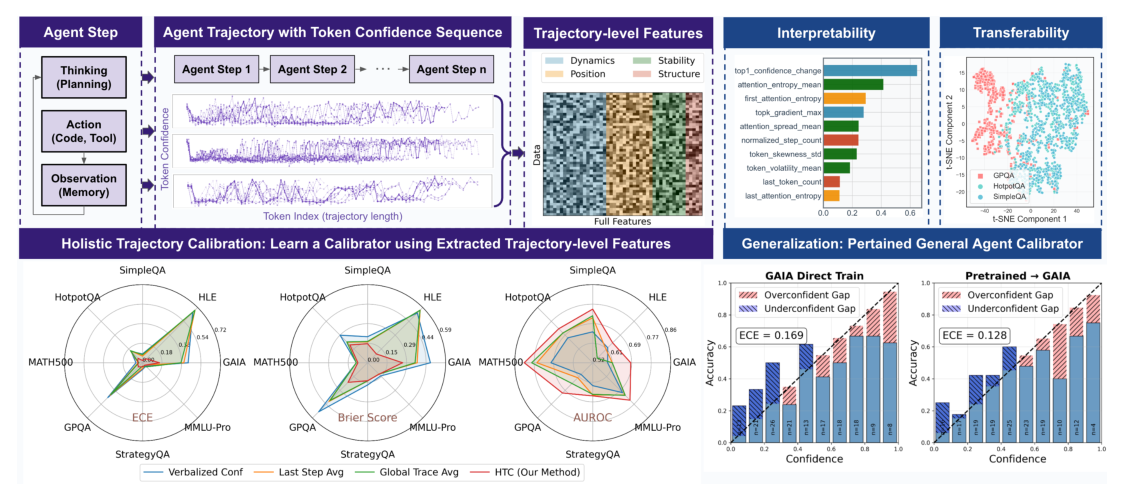
Does seeing the process actually help? Yes — most where it matters. The advantage over last-step confidence widens on the hardest tasks, exactly where overconfidence is most dangerous. On Humanity’s Last Exam (HLE), raw verbalized confidence is essentially noise (ECE 0.656), and even last-step token-probability with temperature scaling only reaches ECE 0.436 — while HTC-Reduced reaches ECE 0.031 (a ~14× reduction over the tuned last-step baseline) at an equal-or-better Brier score.
| Calibration error (ECE ↓) | SimpleQA | GPQA | HLE |
|---|---|---|---|
| Verbalized confidence | 0.121 | 0.454 | 0.656 |
| Last-step token-prob + temperature | 0.071 | 0.139 | 0.436 |
| HTC-Reduced (ACC) | 0.068 | 0.102 | 0.031 |
Table 3. A slice of ACC’s main results (ECE, lower is better): process-level features dominate last-step confidence, and the gap grows on harder tasks. (Source: Zhang et al., 2026b, Table 1.)
Three findings generalize beyond the specific feature set:
- Interpretability. The most predictive signal is task-dependent — positional features dominate long, hard reasoning chains; multi-step QA leans on a more even mix of dynamics/stability/position — but a hierarchy recurs: start/end first, then process stability. Because the calibrator is linear, you can read this straight off the weights.
- Transferability. A calibrator trained on one task transfers to related ones when the output format matches — trained on SimpleQA, it transfers to HotpotQA well enough to beat an in-domain calibrator — but degrades across genuinely different paradigms (e.g., multiple-choice → open-ended).
- Generalization. A pretrained General Agent Calibrator (GAC) gives the best zero-shot calibration on out-of-domain GAIA (ECE 0.118), beating five learning-based baselines (LSTM, Transformer, …) with far lower variance in the small-data regime — a portable “uncertainty grammar.”
The durable claim: calibration should see the process, not just the last token — and a small, legible model is enough to read it.
Tail risk and proper scores
Two refinements close the loop. TRACER argues that since failures are sparse and decisive, you should aggregate with a tail-risk functional (CVaR / max-composite over situational-awareness signals like looping or coherence gaps) rather than an average (Tayebati et al., 2026). And TPS points out that scalar trajectory-ECE is resolution-blind, proposing a strictly proper trajectory score that elicits the full prefix-conditioned success-probability trace (Raghu et al., 2026). The practical stance: use trajectory-ECE/Brier/AUROC for comparison and reliability diagrams for inspection, but do not claim a single scalar “solves” trajectory calibration.
The right signal depends on the agent type
Finally, instantiate Table 1. For coding agents, logits are weak; use tests, symbolic clusters, or patch validators, and prefer validate-or-abstain over editing blindly (Sharma & David, 2025; Cambronero et al., 2025). For tool-use agents, the same verbalized confidence means different things depending on the tool: evidence tools (web search) inject noise and breed overconfidence, while verification tools (a code interpreter) ground the trajectory (Xuan et al., 2026). For computer-use agents, the trustworthy signal is spatial — the dispersion of sampled GUI grounding points — not token confidence (Wang et al., 2026b). For reasoning agents, local confidence drives test-time scaling (Fu et al., 2025). For deep-research agents (E1), the decisive quantity is a calibrated stopping confidence — is the evidence enough to answer? (Kieback et al., 2026).
Takeaway. Trajectory-level, process-aware signals beat last-step confidence; ACC/HTC gives a general, interpretable way to calibrate the whole trajectory; and the local signal that feeds it must be chosen for the agent’s substrate.
Act on uncertainty
A calibrated number is inert until it changes behavior. The agent’s uncertainty policy is much richer than answer/refuse.
The control menu
| Action | Trigger | Cost | Risk if wrong |
|---|---|---|---|
| Continue / commit | high confidence, low risk | low | overconfident failure |
| Ask / clarify | specification gap | user friction | needless interruption |
| Verify / gather | verification gap, shaky tool result | tool cost | verification loop |
| Reflect / self-correct | uncertain reasoning or plan | model calls | delusional confirmation |
| Allocate compute | promising but unresolved | latency / tokens | wasted compute |
| Abstain / defer | low confidence or high risk | lower coverage | over-refusal |
| Escalate | beyond model/tool budget; authority gap | human / strong-model cost | bottleneck |
Table 4. Uncertainty as a typed router. The agentic move is to pick among these by the kind of uncertainty, not a single scalar threshold.
Abstain. AbstentionBench shows abstention is unsolved even for frontier models, and — a warning for the companion post — that reasoning fine-tuning can degrade it (Kirichenko et al., 2025); Abstain-R1 treats abstention and post-refusal clarification as first-class behaviors (Zhai et al., 2026).
Ask. When uncertainty is a specification gap, the right move is to ask, not to silently reflect. UoT chooses what to ask by expected information gain — roughly \(q^\star = \arg\max_q\, \big[H(\text{answer}) - \mathbb{E}_{r\sim q}H(\text{answer}\mid r)\big]\) (Hu et al., 2024); SAGE-Agent moves clarification into tool-parameter space and uses expected value of perfect information to decide when to stop asking (Suri et al., 2025); in coding (E3), Ambig-SWE shows targeted clarifying questions recover a large fraction of underspecified tasks (Vijayvargiya et al., 2025).
Reflect. Reflexion (Shinn et al., 2023) and related self-refinement methods improve agents via verbal feedback — but blind reflection is inefficient or harmful. The question is when to reflect, which is exactly where calibrated uncertainty earns its keep.
Allocate compute / stop. DeepConf spends inference where local confidence is high and early-stops where it is not (Fu et al., 2025); TASR’s calibrated stopping rule governs iterative retrieval without any training (Kieback et al., 2026).
Route / escalate. AutoMix routes uncertain queries to a stronger model via a self-verification meta-controller (Aggarwal et al., 2024); KnowNo gives the robotics version — conformal ask-for-help with a statistical task-completion guarantee, acting only when the prediction set is a singleton (Ren et al., 2023).
Dual-process agentic UQ
ACC tells you how reliable a trajectory is; AUQ turns that signal into action — the cleanest instantiation of “uncertainty as a switch,” and notably training-free (Zhang et al., 2026a). It implements the forward/inverse decomposition from the problem setup with a dual-process controller:
- System 1 — Uncertainty-Aware Memory (UAM). At each step the agent emits \((a_t, \hat{c}_t, \hat{e}_t)\) and writes the confidence and explanation into memory, \(\mathcal{M}_t = \{(o_i, a_i, \hat{c}_i, \hat{e}_i)\}_{i<t}\). Keeping prior doubts in context acts as a soft damper on overconfidence — the forward propagation of uncertainty.
- System 2 — Uncertainty-Aware Reflection (UAR). A switching function \(S(h_t)=\mathbb{I}[\hat{c}_t < \tau]\) triggers reflection only when confidence falls below \(\tau\). Reflection is guided by the explanation \(\hat{e}_t\) (the inverse problem), and the corrected action is chosen by a consistency-weighted vote over \(N\) samples,
with an adaptive memory-expansion fallback when local reflection fails.
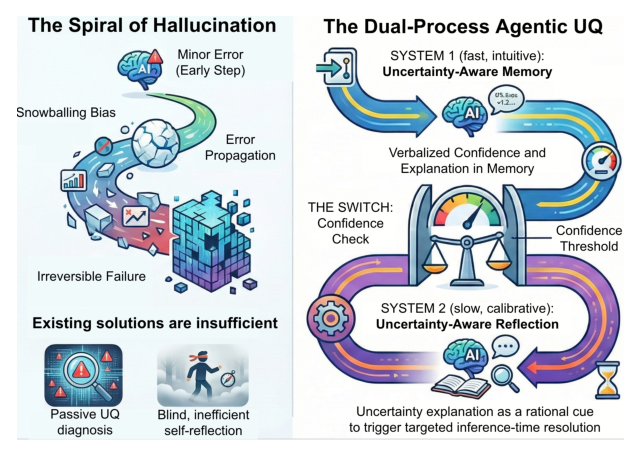
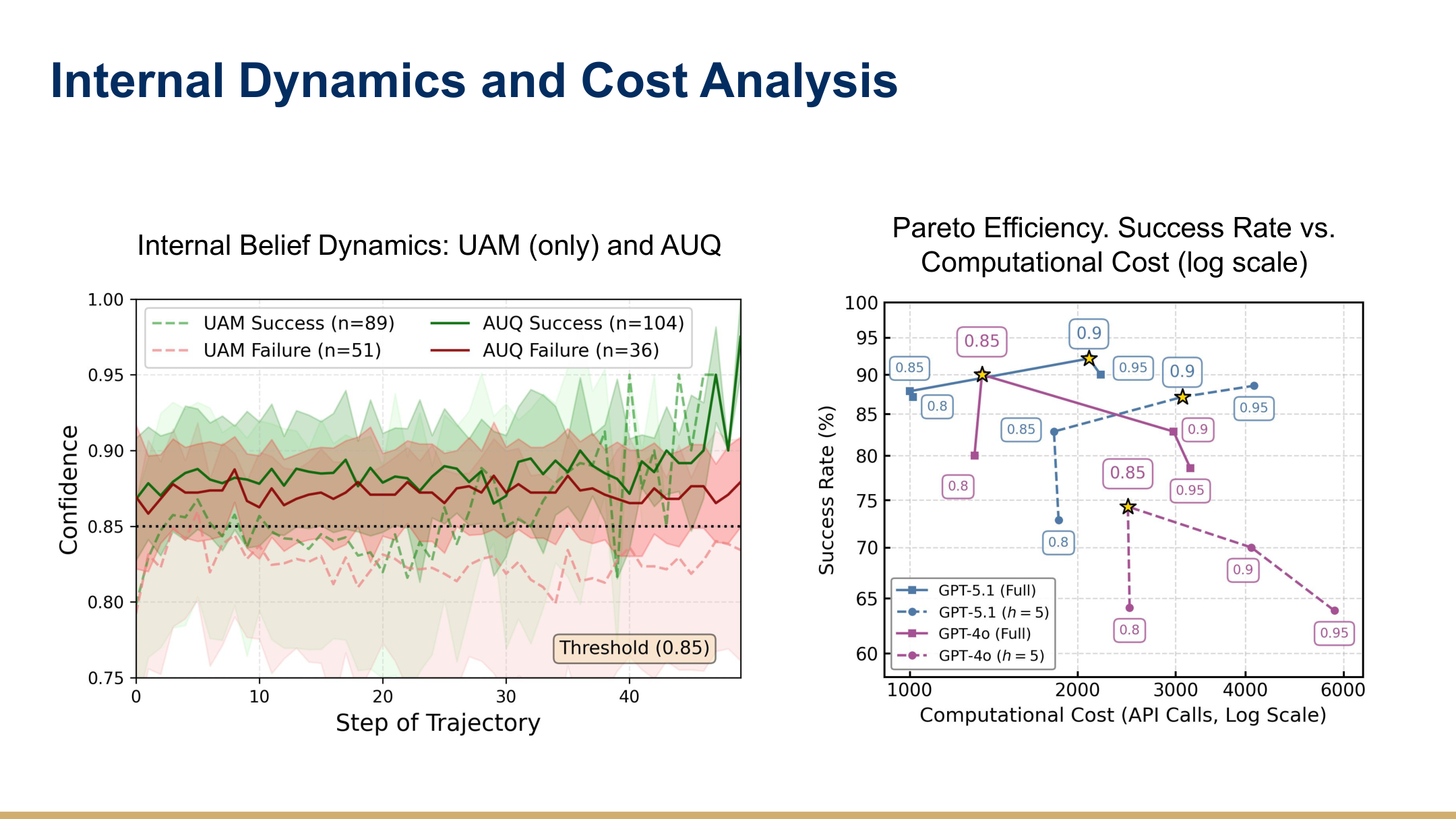
The two halves do different jobs — and the split shows up cleanly in ablation. UAM-only gives the best calibration (lowest trajectory-ECE: it aligns confidence with reality), while UAR-only gives the best resolution (lowest Brier: it actively resolves gaps and polarizes belief toward the truth). AUQ keeps both, and the combination is what pays off downstream:
- On closed-loop tasks it reaches 74.3% success on ALFWorld (+10.7%) and 42.5% on WebShop (+13.6%) over a ReAct System-1 baseline — and beats self-consistency (CoT-SC), so the win is the targeted reflection, not just extra samples.
- On open-ended DeepResearch Bench it scores 52.09 overall, above the strongest deployed closed agent (49.71) and the best open-source framework (50.62).
- Its confidence is also more discriminative (higher AUROC), which is why it spends the System-2 budget on the trajectories that need it instead of reflecting blindly.
The difference from blind reflection is the trigger and the cue. AUQ does not reflect every step (expensive, and prone to “double-checking fatigue”); it reflects when its own uncertainty says a step is risky, and the verbal explanation tells System 2 what to fix. Concretely, in E1 a planner might emit:
Confidence: 0.58. Concern: I haven’t separated Japan’s elderly population forecast from spending per capita; the current plan may conflate demographics with market size.
That is far more actionable than a bare 0.58: it names the query to run and the decomposition to revise.
The economics of reflection
Reflection costs extra inference — but failed trajectories are expensive too. A naive agent that makes a wrong assumption at step 5 can burn 45 more steps chasing it. The right accounting is not raw token cost but effective cost per success,
\[\text{Cost}_{\text{eff}} \;=\; \frac{\text{total cost of all attempts}}{\text{number of successful tasks}} \;=\; \frac{\text{avg cost per trajectory}}{\text{success rate}}.\]Under this metric, spending more per trajectory can lower cost per success, because it converts long futile failures into solved tasks. AUQ quantifies both sides of the ledger: its targeted reflection corrects 14.3% of a ReAct baseline’s failed trajectories with far more repairs than regressions (net-positive), yet the returns are sharply diminishing — past a point, accuracy plateaus while cost grows roughly exponentially, which is exactly why the trigger threshold \(\tau\) has to be chosen, not maximized.
When confidence gates fail
Three honest caveats keep this from being a free lunch.
- Delusional confirmation. Reflection can raise confidence in a wrong plan when the model fabricates a plausible justification; AUQ documents this failure mode, which is why the post-reflection confidence must not be trusted blindly and the trigger should be conservative (net repair \(\gg\) regression).
- Unstable gates. Same Signal, Opposite Meaning shows the same confidence/difficulty signal can predict that extra compute helps in one setting and hurts in another — compute need is not compute suitability (Li et al., 2026).
- Confidence ≠ utility. RiskEval again: a controller that does not weigh the cost of errors will act wrongly even with a correct risk estimate (Wang et al., 2026a).
Insight — more reflection is not better. The goal is not to maximize deliberation; it is to fire the right intervention at the right step. An uncertainty controller is only as good as the calibration of the signal it gates on.
Takeaway. Uncertainty becomes valuable only as an action — ask, verify, reflect, allocate compute, abstain, or route — selected by the kind of uncertainty, and the policy must be conservative because the gate itself can be wrong.
Self-improve and self-evolve with uncertainty
The loop has one more arc. Beyond improving the current decision, uncertainty can make the agent system better over time — without touching weights. This is the application-layer payoff: non-parametric self-evolution through memory, skills, and tools.
Uncertainty-aware memory. AUQ’s UAM is the simplest instance: store metacognitive state \((\hat{c}_i, \hat{e}_i)\), not just observations and actions. The explanation matters because it gives uncertainty semantics — “evidence conflicts” vs “the user didn’t specify a date” lead to different future behavior. Oblivion extends this into self-adaptive memory, where uncertainty gates when to consult memory and how memories decay or are reinforced (Rana et al., 2026). And Confidence Laundering is the systems-level warning: if uncertainty is not carried across component handoffs, downstream modules treat shaky artifacts as clean facts (Shi et al., 2026). The design principle:
uncertainty should be a persistent metadata field in the agent system, not a transient string in one prompt.
Uncertainty-driven exploration. Where should a frozen agent spend its next action? Search more when the expected information gain is high and uncertainty is reducible; stop when more search will not change the answer; abstain or escalate when uncertainty is irreducible under the available tools. UoT is the inference-time version of “what to ask” (Hu et al., 2024); TASR is the version of “when to stop” for deep research (E1) (Kieback et al., 2026).
Skills and tools from failure. Voyager is the canonical non-parametric self-evolving agent: an automatic curriculum plus an ever-growing, self-verified skill library, all on a frozen GPT-4 (Wang et al., 2023). ExpeL distills cross-task experience into reusable natural-language insights (Zhao et al., 2023); A-MEM builds an evolving agentic memory (Xu et al., 2025). The connection to uncertainty is direct: low confidence marks where to gather evidence, repeated failure marks where to write a new skill, and a verified recovery is exactly what to store.
This is also the bridge to the companion post. Once a system repeatedly learns which uncertainties matter, the natural next question is whether to internalize those behaviors into the weights — which is where post-training comes in.
Takeaway. A frozen model can still become a more reliable agent over time, if uncertainty drives what it remembers, asks, verifies, and turns into reusable skills.
Evaluate agentic calibration
Evaluation is the weakest link in the field, and worth a clear-eyed section.
Metrics. Use the trajectory-level versions of ECE, Brier, and AUROC defined in the problem setup, plus risk–coverage curves for selective execution. The trajectory belief \(C(\tau)\) can be \(c_T\), \(\text{mean}_t c_t\), \(\min_t c_t\), or a learned \(f(\phi(\tau))\) — and which one you pick changes the numbers, so report it. A reliability diagram is the most informative single plot.
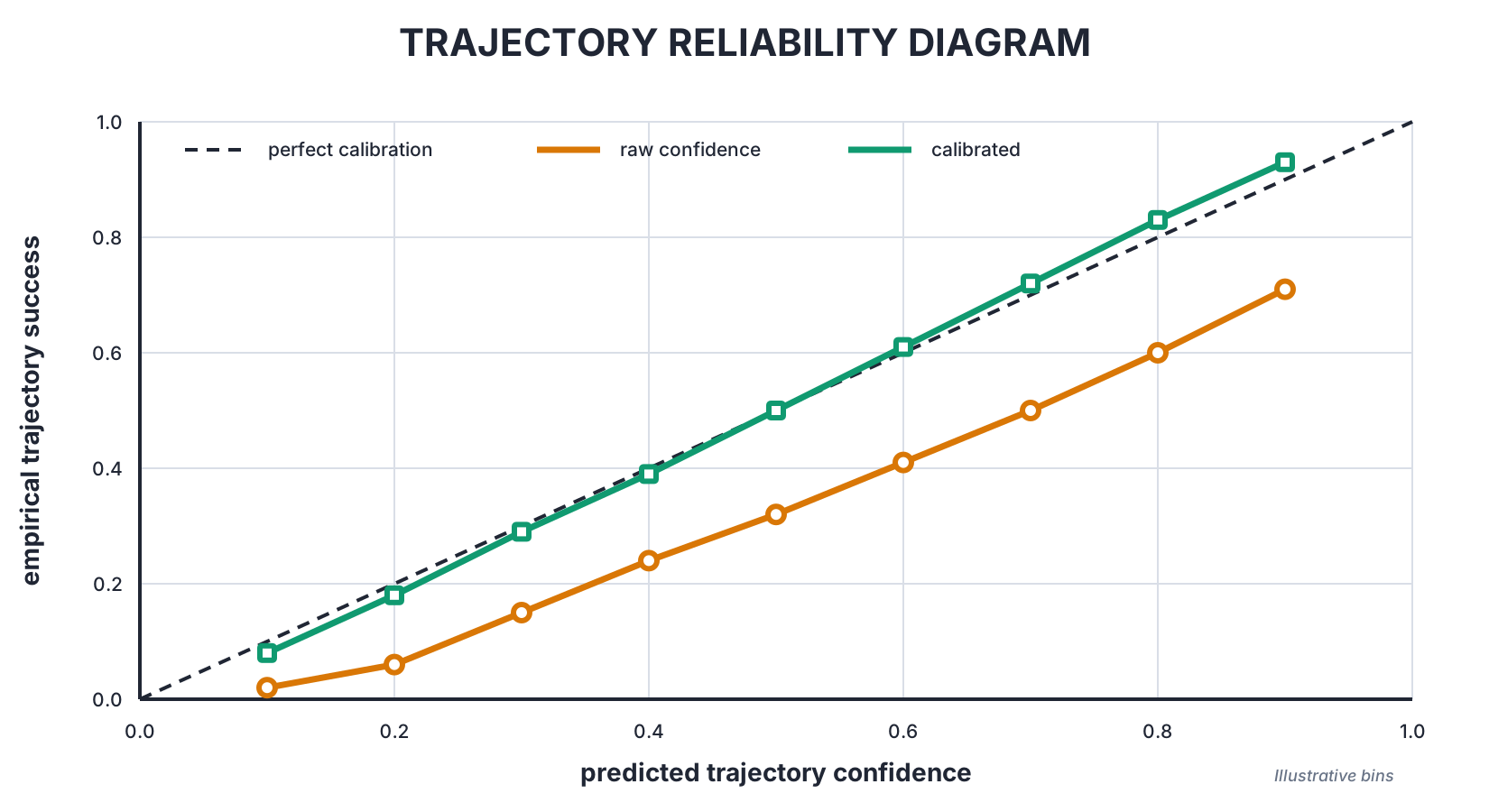
Benchmarks. There is, as of writing, no purpose-built agentic-UQ benchmark; people repurpose agent benchmarks that lack uncertainty labels.
| Benchmark | What it provides | UQ limitation |
|---|---|---|
| τ²-bench | dual-control tool-use tasks | no uncertainty labels (the default substrate) |
| GAIA | deep-research / general-assistant tasks | trajectory-level success only |
| AbstentionBench | abstention scenarios | mostly single-turn |
| Ambig-SWE | underspecified coding tasks | SWE-specific |
| Argus / computer-use UQ (Kumar et al., 2026) | GUI grounding uncertainty | domain-specific |
Table 5. The benchmarks the field calibrates on, and why none of them was built for agentic UQ.
Oh et al. survey dozens of agent benchmarks and find only a small fraction give turn-level labels (Oh et al., 2026). A benchmark built for this should log every observation, action, tool output and failure, the model’s confidence and uncertainty explanation, whether each step was reversible, milestone/partial-success labels, final success, and — the hard part — whether the agent should have asked, verified, or escalated. It should score not just task success but whether the agent made the right uncertainty-controlled decisions along the way.
Takeaway. We can measure final success; we are still learning to measure whether an agent’s confidence tracked the trajectory and improved its decisions. The benchmark gap is an opportunity.
Open challenges
The recipe is useful but young; here is where I would point a skeptical eye.
The signal itself can be unreliable. Every controller in this post amplifies its input signal. If the confidence is miscalibrated, the controller will reflect on easy cases, skip hard ones, or escalate the wrong tasks — and Same Signal, Opposite Meaning shows the signal’s meaning is context-dependent (Li et al., 2026). Calibrating the gate is as important as building it.
Tool-output uncertainty is under-modeled. Most methods decide whether to call a tool; far fewer decide whether to trust its output. Yet agents increasingly depend on tools whose failures are silent — stale pages, partial results, schema drift, auth errors, ambiguous records.
Multi-agent uncertainty gets laundered. One agent’s uncertain claim becomes another’s confident premise. DebUnc studies communicating uncertainty in debate via attention scaling (Yoffe et al., 2024); Confidence Laundering generalizes the leak to any component handoff (Shi et al., 2026). Reliable multi-agent systems likely need uncertainty metadata that survives message boundaries.
Reflection has latency and regression risk. It adds tokens and wall-clock time, and can overturn a correct plan (delusional confirmation). A good controller optimizes net repair, not intervention count — and real-time agents may not be able to afford best-of-\(N\) at all.
Metrics and benchmarks are immature. Trajectory-ECE is resolution-blind (Raghu et al., 2026); we need proper trajectory scores, turn-level labels, abstention-competence metrics, and a purpose-built benchmark.
Orchestration is not internalization. Everything here builds reliability around a frozen model — deployable, and often necessary. But a model that is natively calibrated would make all of this cheaper and simpler. That is the subject of the companion post, Calibrating Long-Horizon Agents: A Post-Training Perspective, which builds on calibration-aware on-policy distillation (CaOPD; Zhang et al., 2026d).
Takeaway. Inference-time uncertainty control already works, but the field still needs robust signals, tool-aware uncertainty, multi-agent propagation, better metrics, and — eventually — training-time internalization.
Summary
Long-horizon agents fail differently from single-turn models: their errors compound, their history becomes future context, and their confidence must guide decisions rather than describe outputs. The inference-time playbook follows the reliability loop — measure uncertainty across the trajectory, calibrate it to success, act on it (abstain, ask, verify, reflect, allocate compute, route), and feed it back into memory and skills. ACC/HTC shows how to calibrate the whole trajectory; AUQ shows how to turn uncertainty into a runtime control signal; and the surrounding 2025–2026 literature supplies the evidence, the caveats, and the agent-type-specific signals. The frozen-model view takes you a long way. The next step — internalizing these behaviors into the weights — is the companion post.
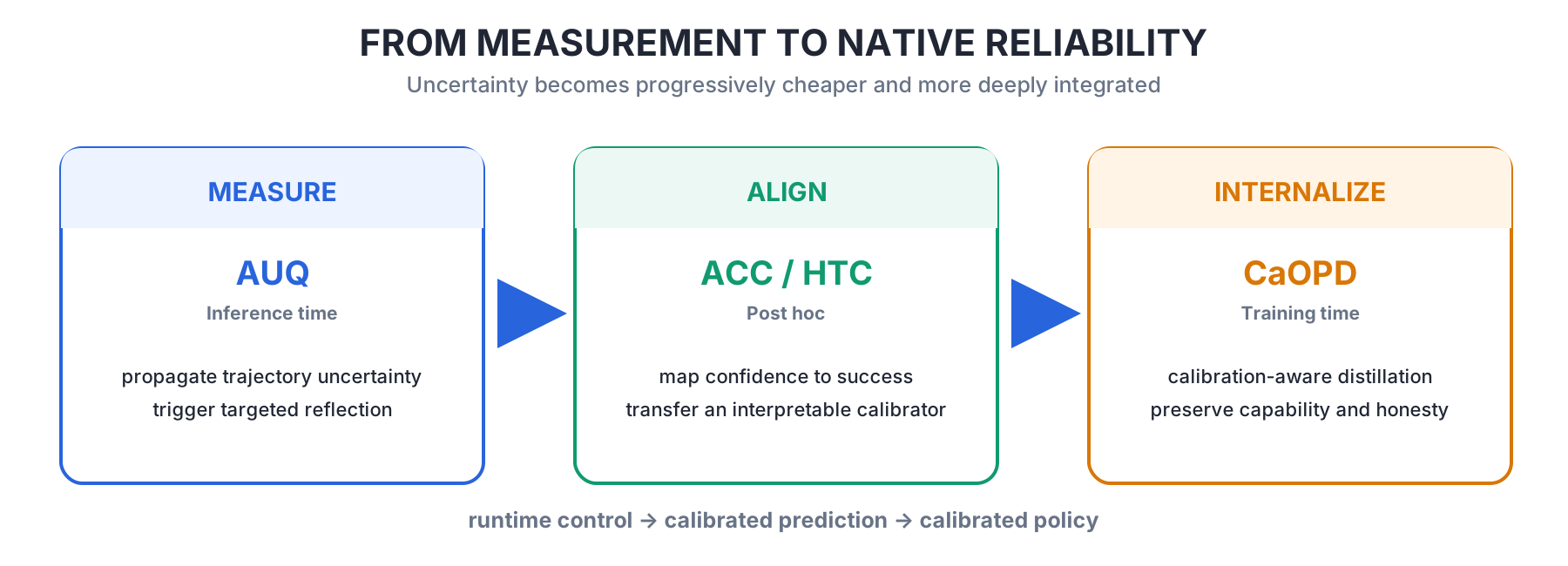
Acknowledgements / sources: Figures 4 and 5 are cropped from the cited papers; Figure 6 is adapted from the author’s AUQ analysis slides; all other figures are original. The reproducible vector-figure source is in scripts/blog_figures/calibrating_long_horizon_agents.py.
October 5 Update on Reflection Beam
Updated October 5, 2026. Beam introduces an important distinction for this post: Reflection reports forecasting RL reward improvement, with correlation r = 0.79, versus 0.46 for a Best-of-N-ceiling baseline. That is not a reported confidence-calibration result. (Reflection, 2026)
Identify what the prediction is about
| Prediction target | Question answered | Evidence I would require |
|---|---|---|
| Reward improvement after RL | Will this training intervention improve its scored behavior? | Held-out intervention forecasts and prediction error |
| Trajectory success probability | How likely is this agent to finish correctly? | Proper scores and reliability curves against independent success labels |
| Value of additional effort | Is another reasoning/tool step worth its cost? | Controlled budget interventions and net utility |
Three different prediction problems. Success in one does not establish success in the other two.
Correlation can be high even when predictions have the wrong scale or systematic bias. A judge-defined reward can also rise without independently measured task correctness improving. For agentic calibration, we still need a defined event, probabilities for that event, and labels collected outside the optimized reward channel.
Connect confidence to the value of more computation
Reflection’s accuracy–length plot shows an early phase with shorter, better solutions and a later phase where additional tokens support further gains. This is a useful reminder that “shorter is better” is not a universal training target. (Reflection, 2026)
The research direction I would explore is conditional value of computation, not simply “high confidence means stop.” A task can have low success probability because further effort is useful, because a tool is unavailable, or because the problem is underspecified. Those cases require different actions.
Build a controlled dataset by branching from the same prefix under several effort budgets. Hold model, tools, and permissions fixed; measure the extra verified success gained, additional latency, and token/tool cost. Train a predictor of that marginal gain, then compare its controller with a fixed budget, random allocation, and a confidence-only gate on unseen task families. This tests whether uncertainty improves allocation rather than merely correlating with difficulty.
Just Enough Thinking supplies relevant prior work on solve-rate-dependent length penalties. It does not make task success confidence, local token certainty, and marginal value of effort interchangeable.
Recalibrate after changing the policy or harness
For an efficient reasoning policy or a consolidated student, rerun the accuracy–calibration–cost evaluation jointly. For an ACC/HTC-style calibrator, shorter traces may change the meaning of token counts and other process features. For a CaOPD-style intervention, explicitly test whether calibration survives the new data mixture and deployment context. For an AUQ-style controller, measure the net benefit of verification and reflection, including correct answers damaged by unnecessary intervention. These are proposed experiments, not reported Beam results.
Takeaway. Beam motivates a useful bridge from training predictability to runtime compute decisions. It does not yet show that its confidence estimates are calibrated, and it should not be treated as evidence for Jev/RLCD-style probability training.
How to cite
Zhang, Jiaxin. (Jun 2026). Calibrating Long-Horizon Agents: Confidence and Uncertainty at Inference Time. Jiaxin Zhang’s Blog. https://jxzhangjhu.github.io/blog/2026/calibrating-long-horizon-agents/
Or in BibTeX:
@article{zhang2026calibratingagents,
  title   = "Calibrating Long-Horizon Agents: Confidence and Uncertainty at Inference Time",
  author  = "Zhang, Jiaxin",
  journal = "Jiaxin Zhang's Blog",
  year    = "2026",
  month   = "Jun",
  url      = "https://jxzhangjhu.github.io/blog/2026/calibrating-long-horizon-agents/"
}
References
[1] Pranjal Aggarwal, et al. “AutoMix: Automatically Mixing Language Models.” arXiv:2310.12963, 2024.
[2] Victor Barres, et al. “τ²-Bench: Evaluating Conversational Agents in a Dual-Control Environment.” arXiv:2506.07982, 2025.
[3] José Cambronero, et al. “Abstain and Validate: A Dual-LLM Policy for Reducing Noise in Agentic Program Repair.” arXiv:2510.03217, 2025.
[4] Jinhao Duan, et al. “UProp: Investigating the Uncertainty Propagation of LLMs in Multi-Step Agentic Decision-Making.” arXiv:2506.17419, 2025.
[5] Yichao Fu, et al. “Deep Think with Confidence.” arXiv:2508.15260, 2025.
[6] Zhiyuan Hu, et al. “Uncertainty of Thoughts: Uncertainty-Aware Planning Enhances Information Seeking in Large Language Models.” NeurIPS 2024. arXiv:2402.03271.
[7] Carlos E. Jimenez, et al. “SWE-bench: Can Language Models Resolve Real-World GitHub Issues?” ICLR 2024. arXiv:2310.06770.
[8] Saurav Kadavath, et al. “Language Models (Mostly) Know What They Know.” arXiv:2207.05221, 2022.
[9] Jean Kaddour, et al. “Agentic Uncertainty Reveals Agentic Overconfidence.” arXiv:2602.06948, 2026.
[10] Zhewei Kang, et al. “Scalable Best-of-N Selection for Large Language Models via Self-Certainty.” arXiv:2502.18581, 2025.
[11] Alex Kendall, Yarin Gal. “What Uncertainties Do We Need in Bayesian Deep Learning for Computer Vision?” NeurIPS 2017. arXiv:1703.04977.
[12] Adrian Kieback, et al. “TASR: Training-Free Adaptive Stopping for Iterative Retrieval.” arXiv:2606.13814, 2026.
[13] Michael Kirchhof, Gjergji Kasneci, Enkelejda Kasneci. “Position: Uncertainty Quantification Needs Reassessment for Large Language Model Agents.” ICML 2025. arXiv:2505.22655.
[14] Polina Kirichenko, et al. “AbstentionBench: Reasoning LLMs Fail on Unanswerable Questions.” arXiv:2506.09038, 2025.
[15] Lorenz Kuhn, Yarin Gal, Sebastian Farquhar. “Semantic Uncertainty: Linguistic Invariances for Uncertainty Estimation in Natural Language Generation.” ICLR 2023. arXiv:2302.09664.
[16] Divake Kumar, et al. “Uncertainty Quantification for Computer-Use Agents: A Benchmark across Vision-Language Models and GUI Grounding Datasets.” arXiv:2606.25760, 2026.
[17] Ziming Li, et al. “Same Signal, Opposite Meaning: Direction-Informed Adaptive Learning for LLM Agents.” arXiv:2605.06908, 2026.
[18] Stephanie Lin, Jacob Hilton, Owain Evans. “Teaching Models to Express Their Uncertainty in Words.” TMLR 2022. arXiv:2205.14334.
[19] Andrey Malinin, Mark Gales. “Uncertainty Estimation in Autoregressive Structured Prediction.” ICLR 2021. arXiv:2002.07650.
[20] Grégoire Mialon, et al. “GAIA: A Benchmark for General AI Assistants.” ICLR 2024. arXiv:2311.12983.
[21] Changdae Oh, et al. “Uncertainty Quantification in LLM Agents: Foundations, Emerging Challenges, and Opportunities.” arXiv:2602.05073, 2026.
[22] Victor Ojewale, et al. “What Benchmarks Don’t Measure: The Case for Evaluating Abstention Competence in Autonomous Agents.” arXiv:2606.02965, 2026.
[23] Arka Pal, et al. “Knowing What You Know Is Not Enough: Large Language Model Confidences Don’t Align With Their Actions.” arXiv:2511.13240, 2025.
[24] Stephan Rabanser, et al. “Towards a Science of AI Agent Reliability.” arXiv:2602.16666, 2026.
[25] Suresh Raghu, Satwik Pandey, Shashwat Pandey. “Proper Scoring Rules for Agentic Uncertainty Quantification.” arXiv:2605.24756, 2026.
[26] Ashish Rana, et al. “Oblivion: Self-Adaptive Agentic Memory Control through Decay-Driven Activation.” arXiv:2604.00131, 2026.
[27] Allen Z. Ren, et al. “Robots That Ask For Help: Uncertainty Alignment for Large Language Model Planners.” CoRL 2023. arXiv:2307.01928.
[28] Arindam Sharma, Cristina David. “Assessing Correctness in LLM-Based Code Generation via Uncertainty Estimation.” arXiv:2502.11620, 2025.
[29] Kaiwen Shi, et al. “Confidence Laundering in Agent Systems: Why Uncertainty Needs a Latent Carrier.” arXiv:2606.20662, 2026.
[30] Noah Shinn, et al. “Reflexion: Language Agents with Verbal Reinforcement Learning.” NeurIPS 2023. arXiv:2303.11366.
[31] Adi Simhi, et al. “Old Habits Die Hard: How Conversational History Geometrically Traps LLMs.” arXiv:2603.03308, 2026.
[32] Akshit Sinha, et al. “The Illusion of Diminishing Returns: Measuring Long Horizon Execution in LLMs.” arXiv:2509.09677, 2025.
[33] Manan Suri, et al. “Structured Uncertainty guided Clarification for LLM Agents.” arXiv:2511.08798, 2025.
[34] Sina Tayebati, et al. “TRACER: Trajectory Risk Aggregation for Critical Episodes in Agentic Reasoning.” ICML 2026. arXiv:2602.11409.
[35] Katherine Tian, et al. “Just Ask for Calibration: Strategies for Eliciting Calibrated Confidence Scores from Language Models Fine-Tuned with Human Feedback.” EMNLP 2023. arXiv:2305.14975.
[36] Eren Unlu. “Know When to Trust the Skill: Delayed Appraisal and Epistemic Vigilance for Single-Agent LLMs.” arXiv:2604.16753, 2026.
[37] Sanidhya Vijayvargiya, et al. “Ambig-SWE: Interactive Agents to Overcome Underspecificity in Software Engineering.” arXiv:2502.13069, 2025.
[38] Guanzhi Wang, et al. “Voyager: An Open-Ended Embodied Agent with Large Language Models.” arXiv:2305.16291, 2023.
[39] Jiawei Wang, et al. “Are LLM Decisions Faithful to Verbal Confidence?” arXiv:2601.07767, 2026a.
[40] Qingni Wang, et al. “SafeGround: Know When to Trust GUI Grounding Models via Uncertainty Calibration.” arXiv:2602.02419, 2026b.
[41] Xuezhi Wang, et al. “Self-Consistency Improves Chain of Thought Reasoning in Language Models.” ICLR 2023. arXiv:2203.11171.
[42] Wujiang Xu, et al. “A-MEM: Agentic Memory for LLM Agents.” arXiv:2502.12110, 2025.
[43] Weihao Xuan, et al. “The Confidence Dichotomy: Analyzing and Mitigating Miscalibration in Tool-Use Agents.” ACL 2026. arXiv:2601.07264.
[44] Daniel Yang, Yao-Hung Hubert Tsai, Makoto Yamada. “On Verbalized Confidence Scores for LLMs.” arXiv:2412.14737, 2024.
[45] Shunyu Yao, et al. “ReAct: Synergizing Reasoning and Acting in Language Models.” ICLR 2023. arXiv:2210.03629.
[46] Shunyu Yao, et al. “Tree of Thoughts: Deliberate Problem Solving with Large Language Models.” NeurIPS 2023. arXiv:2305.10601.
[47] Luke Yoffe, et al. “DebUnc: Improving Large Language Model Agent Communication With Uncertainty Metrics.” arXiv:2407.06426, 2024.
[48] Skylar Zhai, et al. “Abstain-R1: Calibrated Abstention and Post-Refusal Clarification via Verifiable RL.” arXiv:2604.17073, 2026.
[49] Jiaxin Zhang, Prafulla Kumar Choubey, Kung-Hsiang Huang, Caiming Xiong, Chien-Sheng Wu. “Agentic Uncertainty Quantification.” EMNLP 2026. arXiv:2601.15703.
[50] Jiaxin Zhang, Caiming Xiong, Chien-Sheng Wu. “Agentic Confidence Calibration.” ICML 2026. arXiv:2601.15778.
[51] Jiaxin Zhang, et al. “From Passive Metric to Active Signal: The Evolving Role of Uncertainty Quantification in Large Language Models.” arXiv:2601.15690, 2026c.
[52] Jiaxin Zhang, et al. “The Illusion of Certainty: Decoupling Capability and Calibration in On-Policy Distillation.” arXiv:2604.16830, 2026d.
[53] Andrew Zhao, et al. “ExpeL: LLM Agents Are Experiential Learners.” AAAI 2024. arXiv:2308.10144.
[54] Qiwei Zhao, et al. “SAUP: Situation Awareness Uncertainty Propagation on LLM Agent.” ACL 2025. arXiv:2412.01033.
[55] Reflection. “Introducing Beam: Reflection’s 501B Open-Weight Model.” October 5, 2026.
[56] Violet Xiang, et al. “Just Enough Thinking: Efficient Reasoning with Adaptive Length Penalties Reinforcement Learning.” arXiv:2506.05256, 2025.